QUESTION IMAGE
Question
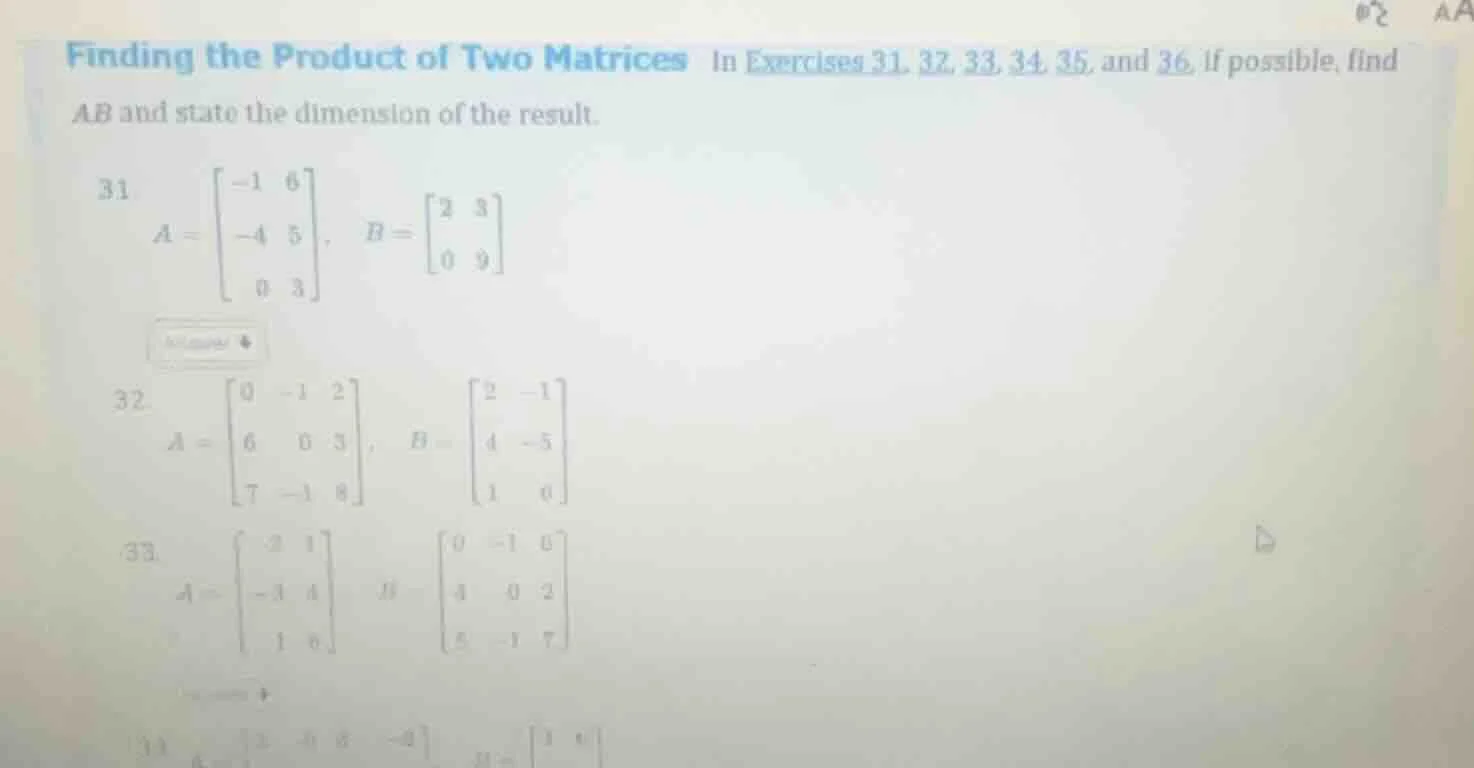
finding the product of two matrices in exercises 31, 32, 33, 34, 35, and 36, if possible, find ab and state the dimension of the result.
31
$a = \
$, $b = \
$
32
$a = \
$, $b = \
$
33
$a = \
$, $b = \
$
(note: part of problem 34 is visible but incomplete in the provided text)
Let's solve problem 31 first.
Problem 31:
We have matrix \( A =
\) (dimension \( 3 \times 2 \)) and matrix \( B =
\) (dimension \( 2 \times 2 \)). To multiply two matrices \( A \) (dimension \( m \times n \)) and \( B \) (dimension \( n \times p \)), the number of columns of \( A \) must equal the number of rows of \( B \) (here \( n = 2 \) for both), and the resulting matrix will have dimension \( m \times p \) (so \( 3 \times 2 \) here).
Step 1: Calculate the first row of \( AB \)
The first row of \( A \) is \( [-1, 6] \), and we multiply it with the columns of \( B \):
- First element (row 1, column 1): \( (-1)(2) + (6)(0) = -2 + 0 = -2 \)
- Second element (row 1, column 2): \( (-1)(3) + (6)(9) = -3 + 54 = 51 \)
Step 2: Calculate the second row of \( AB \)
The second row of \( A \) is \( [-4, 5] \):
- First element (row 2, column 1): \( (-4)(2) + (5)(0) = -8 + 0 = -8 \)
- Second element (row 2, column 2): \( (-4)(3) + (5)(9) = -12 + 45 = 33 \)
Step 3: Calculate the third row of \( AB \)
The third row of \( A \) is \( [0, 3] \):
- First element (row 3, column 1): \( (0)(2) + (3)(0) = 0 + 0 = 0 \)
- Second element (row 3, column 2): \( (0)(3) + (3)(9) = 0 + 27 = 27 \)
So the product \( AB =
\), and the dimension is \( 3 \times 2 \).
Problem 32:
Matrix \( A =
\) (dimension \( 3 \times 3 \)) and matrix \( B =
\) (dimension \( 3 \times 2 \)). The number of columns of \( A \) (3) equals the number of rows of \( B \) (3), so the product \( AB \) will have dimension \( 3 \times 2 \).
Step 1: First row of \( AB \) (row of \( A \): \( [0, -1, 2] \))
- Column 1: \( (0)(2) + (-1)(4) + (2)(1) = 0 - 4 + 2 = -2 \)
- Column 2: \( (0)(-1) + (-1)(-5) + (2)(0) = 0 + 5 + 0 = 5 \)
Step 2: Second row of \( AB \) (row of \( A \): \( [6, 0, 3] \))
- Column 1: \( (6)(2) + (0)(4) + (3)(1) = 12 + 0 + 3 = 15 \)
- Column 2: \( (6)(-1) + (0)(-5) + (3)(0) = -6 + 0 + 0 = -6 \)
Step 3: Third row of \( AB \) (row of \( A \): \( [7, -1, 8] \))
- Column 1: \( (7)(2) + (-1)(4) + (8)(1) = 14 - 4 + 8 = 18 \)
- Column 2: \( (7)(-1) + (-1)(-5) + (8)(0) = -7 + 5 + 0 = -2 \)
So \( AB =
\), dimension \( 3 \times 2 \).
Problem 33:
Matrix \( A =
\) (dimension \( 3 \times 2 \)) and matrix \( B =
\) – wait, no, looking at the image, \( B \) is \(
\)? Wait, no, the user's image for 33: \( A =
\) (3x2) and \( B =
\)? Wait, no, \( B \) should be 2x3? Wait, no, the first row of \( B \) is \( [0, -1, 0] \), second \( [4, 0, 2] \), third \( [5, -1, 7] \)? Wait, no, maybe a typo. Wait, original \( A \) is 3x2, so \( B \) must be 2x3 to multiply. Wait, maybe the user's \( B \) is \(
\) (2x3) and a third row? No, maybe the image has a typo. Assuming \( B \) is \(
\) (2x3), then:
\( A \) is 3x2, \( B \) is 2x3, so \( AB \) is 3x3.
Step 1: First row of \( A \): \( [3, 1] \)
- Column 1: \( 3(0) + 1(4) = 0 + 4 = 4 \)
- Column 2: \( 3(-1) + 1(0) = -3 + 0 = -3 \)
- Column 3: \( 3(0) + 1(2) = 0 + 2 = 2 \)
Step 2: Second row of \( A \): \( [-3, 4] \)
-…

Snap & solve any problem in the app
Get step-by-step solutions on Sovi AI
Photo-based solutions with guided steps
Explore more problems and detailed explanations
Let's solve problem 31 first.
Problem 31:
We have matrix \( A =
\) (dimension \( 3 \times 2 \)) and matrix \( B =
\) (dimension \( 2 \times 2 \)). To multiply two matrices \( A \) (dimension \( m \times n \)) and \( B \) (dimension \( n \times p \)), the number of columns of \( A \) must equal the number of rows of \( B \) (here \( n = 2 \) for both), and the resulting matrix will have dimension \( m \times p \) (so \( 3 \times 2 \) here).
Step 1: Calculate the first row of \( AB \)
The first row of \( A \) is \( [-1, 6] \), and we multiply it with the columns of \( B \):
- First element (row 1, column 1): \( (-1)(2) + (6)(0) = -2 + 0 = -2 \)
- Second element (row 1, column 2): \( (-1)(3) + (6)(9) = -3 + 54 = 51 \)
Step 2: Calculate the second row of \( AB \)
The second row of \( A \) is \( [-4, 5] \):
- First element (row 2, column 1): \( (-4)(2) + (5)(0) = -8 + 0 = -8 \)
- Second element (row 2, column 2): \( (-4)(3) + (5)(9) = -12 + 45 = 33 \)
Step 3: Calculate the third row of \( AB \)
The third row of \( A \) is \( [0, 3] \):
- First element (row 3, column 1): \( (0)(2) + (3)(0) = 0 + 0 = 0 \)
- Second element (row 3, column 2): \( (0)(3) + (3)(9) = 0 + 27 = 27 \)
So the product \( AB =
\), and the dimension is \( 3 \times 2 \).
Problem 32:
Matrix \( A =
\) (dimension \( 3 \times 3 \)) and matrix \( B =
\) (dimension \( 3 \times 2 \)). The number of columns of \( A \) (3) equals the number of rows of \( B \) (3), so the product \( AB \) will have dimension \( 3 \times 2 \).
Step 1: First row of \( AB \) (row of \( A \): \( [0, -1, 2] \))
- Column 1: \( (0)(2) + (-1)(4) + (2)(1) = 0 - 4 + 2 = -2 \)
- Column 2: \( (0)(-1) + (-1)(-5) + (2)(0) = 0 + 5 + 0 = 5 \)
Step 2: Second row of \( AB \) (row of \( A \): \( [6, 0, 3] \))
- Column 1: \( (6)(2) + (0)(4) + (3)(1) = 12 + 0 + 3 = 15 \)
- Column 2: \( (6)(-1) + (0)(-5) + (3)(0) = -6 + 0 + 0 = -6 \)
Step 3: Third row of \( AB \) (row of \( A \): \( [7, -1, 8] \))
- Column 1: \( (7)(2) + (-1)(4) + (8)(1) = 14 - 4 + 8 = 18 \)
- Column 2: \( (7)(-1) + (-1)(-5) + (8)(0) = -7 + 5 + 0 = -2 \)
So \( AB =
\), dimension \( 3 \times 2 \).
Problem 33:
Matrix \( A =
\) (dimension \( 3 \times 2 \)) and matrix \( B =
\) – wait, no, looking at the image, \( B \) is \(
\)? Wait, no, the user's image for 33: \( A =
\) (3x2) and \( B =
\)? Wait, no, \( B \) should be 2x3? Wait, no, the first row of \( B \) is \( [0, -1, 0] \), second \( [4, 0, 2] \), third \( [5, -1, 7] \)? Wait, no, maybe a typo. Wait, original \( A \) is 3x2, so \( B \) must be 2x3 to multiply. Wait, maybe the user's \( B \) is \(
\) (2x3) and a third row? No, maybe the image has a typo. Assuming \( B \) is \(
\) (2x3), then:
\( A \) is 3x2, \( B \) is 2x3, so \( AB \) is 3x3.
Step 1: First row of \( A \): \( [3, 1] \)
- Column 1: \( 3(0) + 1(4) = 0 + 4 = 4 \)
- Column 2: \( 3(-1) + 1(0) = -3 + 0 = -3 \)
- Column 3: \( 3(0) + 1(2) = 0 + 2 = 2 \)
Step 2: Second row of \( A \): \( [-3, 4] \)
- Column 1: \( -3(0) + 4(4) = 0 + 16 = 16 \)
- Column 2: \( -3(-1) + 4(0) = 3 + 0 = 3 \)
- Column 3: \( -3(0) + 4(2) = 0 + 8 = 8 \)
Step 3: Third row of \( A \): \( [1, 6] \)
- Column 1: \( 1(0) + 6(4) = 0 + 24 = 24 \)
- Column 2: \( 1(-1) + 6(0) = -1 + 0 = -1 \)
- Column 3: \( 1(0) + 6(2) = 0 + 12 = 12 \)
So \( AB =
\), dimension \( 3 \times 3 \). (Assuming \( B \) is 2x3 as corrected.)
Problem 34 (partially visible):
Matrix \( A \) has a row \( [3, -6, 8, -2] \) (so dimension \( m \times 4 \)) and \( B =
\)? Wait, no, \( B \) should be 4x2 to multiply with \( A \) (if \( A \) is \( m \times 4 \)). Assuming \( B \) is \(
\) (4x2), but the image is cut off. If you can provide the full matrices, we can solve it.
For now, the solutions for 31, 32, 33 (with correction) are as above. If you need help with the remaining parts, please provide the full matrices.