QUESTION IMAGE
Question
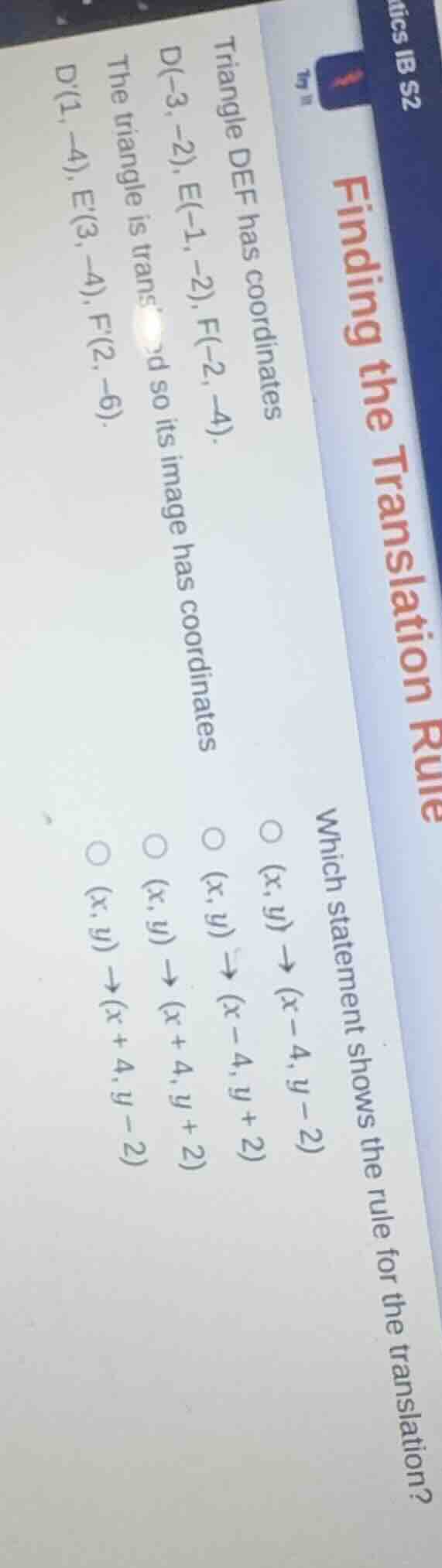
finding the translation rule
triangle def has coordinates
d(-3, -2), e(-1, -2), f(-2, -4).
the triangle is translated so its image has coordinates
d(1, -4), e(3, -4), f(2, -6).
which statement shows the rule for the translation?
○ (x, y) → (x − 4, y − 2)
○ (x, y) → (x − 4, y + 2)
○ (x, y) → (x + 4, y + 2)
○ (x, y) → (x + 4, y − 2)
Step1: Analyze translation for x - coordinate (using point D)
Original \( D(-3, -2) \), Image \( D'(1, -4) \). Let the translation in x - direction be \( a \), so \( -3 + a=1 \). Solving for \( a \): \( a = 1+ 3=4 \). So \( x \)-coordinate changes by \( +4 \) (i.e., \( x
ightarrow x + 4 \)).
Step2: Analyze translation for y - coordinate (using point D)
Original \( y=-2 \), Image \( y = - 4 \). Let the translation in y - direction be \( b \), so \( -2 + b=-4 \). Solving for \( b \): \( b=-4 + 2=-2 \). Wait, no, wait. Wait, let's check another point. Take point E: Original \( E(-1,-2) \), Image \( E'(3,-4) \). \( x \): \( -1 + 4 = 3 \) (matches). \( y \): \( -2 + (-2)=-4 \)? Wait, no, wait the option has \( (x,y)
ightarrow(x + 4,y - 2) \)? Wait, no, wait let's check point F. Original \( F(-2,-4) \), Image \( F'(2,-6) \). \( x \): \( -2+4 = 2 \) (matches). \( y \): \( -4+(-2)=-6 \) (matches). Wait, but let's re - calculate. For x - translation: \( x_{new}=x_{old}+h \), \( h=x_{new}-x_{old} \). For D: \( 1-(-3)=4 \), E: \( 3-(-1)=4 \), F: \( 2-(-2)=4 \). So \( h = 4 \). For y - translation: \( y_{new}=y_{old}+k \), \( k=y_{new}-y_{old} \). For D: \( -4-(-2)=-2 \), E: \( -4-(-2)=-2 \), F: \( -6-(-4)=-2 \). So \( k=-2 \). So the translation rule is \( (x,y)
ightarrow(x + 4,y - 2) \)? Wait, no, wait the options: Let's check the options again. Wait the options are:
- \( (x,y)
ightarrow(x - 4,y - 2) \)
- \( (x,y)
ightarrow(x - 4,y + 2) \)
- \( (x,y)
ightarrow(x + 4,y + 2) \)
- \( (x,y)
ightarrow(x + 4,y - 2) \)
From our calculation, \( x \) increases by 4 (\( x+4 \)) and \( y \) decreases by 2 (\( y - 2 \)), so the rule is \( (x,y)
ightarrow(x + 4,y - 2) \), which is the fourth option. Wait, but let's confirm with each point:
- For D: \( (-3,-2)
ightarrow(-3 + 4,-2-2)=(1,-4) \) (matches \( D' \))
- For E: \( (-1,-2)
ightarrow(-1 + 4,-2-2)=(3,-4) \) (matches \( E' \))
- For F: \( (-2,-4)
ightarrow(-2 + 4,-4-2)=(2,-6) \) (matches \( F' \))
So the translation rule is \( (x,y)
ightarrow(x + 4,y - 2) \), which is the fourth option (the last option: \( (x,y)
ightarrow(x + 4,y - 2) \))? Wait, no, the options are:
Looking at the options in the image (as per the user's image):
Option 4: \( (x,y)
ightarrow(x + 4,y - 2) \) (the last option)
Wait, let's re - do the steps:
For x - coordinate translation:
\( \Delta x=x_{image}-x_{original} \)
For \( D(-3,-2)\) to \( D'(1,-4) \): \( \Delta x=1-(-3)=4 \)
For \( E(-1,-2)\) to \( E'(3,-4) \): \( \Delta x=3-(-1)=4 \)
For \( F(-2,-4)\) to \( F'(2,-6) \): \( \Delta x=2-(-2)=4 \)
So \( x \) is translated by \( + 4 \) (i.e., \( x
ightarrow x + 4 \))
For y - coordinate translation:
\( \Delta y=y_{image}-y_{original} \)
For \( D(-3,-2)\) to \( D'(1,-4) \): \( \Delta y=-4-(-2)=-2 \)
For \( E(-1,-2)\) to \( E'(3,-4) \): \( \Delta y=-4-(-2)=-2 \)
For \( F(-2,-4)\) to \( F'(2,-6) \): \( \Delta y=-6-(-4)=-2 \)
So \( y \) is translated by \( - 2 \) (i.e., \( y
ightarrow y - 2 \))
So the translation rule is \( (x,y)
ightarrow(x + 4,y - 2) \)

Snap & solve any problem in the app
Get step-by-step solutions on Sovi AI
Photo-based solutions with guided steps
Explore more problems and detailed explanations
\( (x,y)
ightarrow(x + 4,y - 2) \) (the fourth option, i.e., the option with \( (x,y)
ightarrow(x + 4,y - 2) \))