QUESTION IMAGE
Question
first branch: legislative
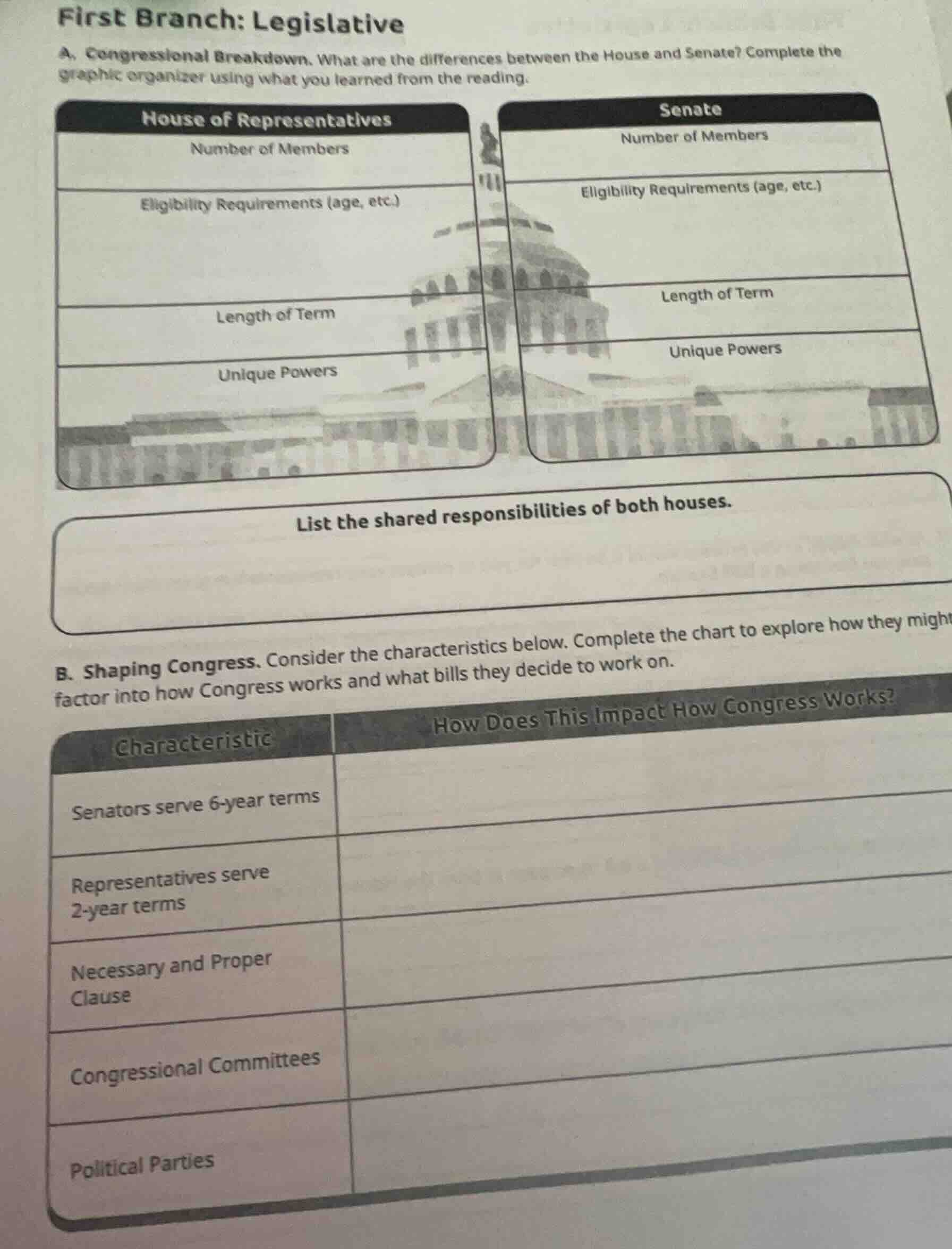
a. congressional breakdown. what are the differences between the house and senate? complete the graphic organizer using what you learned from the reading.
house of representatives
number of members
eligibility requirements (age, etc.)
length of term
unique powers
senate
number of members
eligibility requirements (age, etc.)
length of term
unique powers
list the shared responsibilities of both houses.
b. shaping congress. consider the characteristics below. complete the chart to explore how they might factor into how congress works and what bills they decide to work on.
characteristic\thow does this impact how congress works?
senators serve 6 - year terms\t
representatives serve 2 - year terms\t
necessary and proper clause\t
congressional committees\t
political parties\t
Part A: Congressional Breakdown (House vs. Senate)
House of Representatives
- Number of Members: 435 (apportioned by state population).
- Eligibility Requirements: At least 25 years old, U.S. citizen for at least 7 years, resident of the state they represent.
- Length of Term: 2 years (all seats up for election every 2 years).
- Unique Powers: Initiate revenue (tax) bills; impeach federal officials; elect President if no candidate wins electoral college majority.
Senate
- Number of Members: 100 (2 per state).
- Eligibility Requirements: At least 30 years old, U.S. citizen for at least 9 years, resident of the state they represent.
- Length of Term: 6 years (staggered elections, 1/3 of seats up every 2 years).
- Unique Powers: Confirm presidential appointments (e.g., judges, cabinet); ratify treaties; hold impeachment trials.
Shared Responsibilities
Both houses:
- Pass legislation (bills must be approved by both to become law).
- Declare war (with President’s request or approval).
- Conduct oversight of the executive branch.
Part B: Shaping Congress (Characteristic Impacts)
| Characteristic | How Does This Impact How Congress Works? |
|---|---|
| Representatives serve 2 - year terms | Encourages responsiveness to constituents (must campaign frequently, so more attuned to short - term local concerns). |
| Necessary and Proper Clause | Expands Congress’s power to pass laws “necessary and proper” to execute its enumerated powers (flexibility in legislation). |
| Congressional Committees | Specialize in policy areas (e.g., finance, defense), streamlining lawmaking by dividing work and allowing expert review. |
| Political Parties | Organize Congress, set agendas, and coordinate voting (partisanship shapes bill passage and committee assignments). |
These answers are based on U.S. constitutional and governmental principles governing the legislative branch.

Snap & solve any problem in the app
Get step-by-step solutions on Sovi AI
Photo-based solutions with guided steps
Explore more problems and detailed explanations
Part A: Congressional Breakdown (House vs. Senate)
House of Representatives
- Number of Members: 435 (apportioned by state population).
- Eligibility Requirements: At least 25 years old, U.S. citizen for at least 7 years, resident of the state they represent.
- Length of Term: 2 years (all seats up for election every 2 years).
- Unique Powers: Initiate revenue (tax) bills; impeach federal officials; elect President if no candidate wins electoral college majority.
Senate
- Number of Members: 100 (2 per state).
- Eligibility Requirements: At least 30 years old, U.S. citizen for at least 9 years, resident of the state they represent.
- Length of Term: 6 years (staggered elections, 1/3 of seats up every 2 years).
- Unique Powers: Confirm presidential appointments (e.g., judges, cabinet); ratify treaties; hold impeachment trials.
Shared Responsibilities
Both houses:
- Pass legislation (bills must be approved by both to become law).
- Declare war (with President’s request or approval).
- Conduct oversight of the executive branch.
Part B: Shaping Congress (Characteristic Impacts)
| Characteristic | How Does This Impact How Congress Works? |
|---|---|
| Representatives serve 2 - year terms | Encourages responsiveness to constituents (must campaign frequently, so more attuned to short - term local concerns). |
| Necessary and Proper Clause | Expands Congress’s power to pass laws “necessary and proper” to execute its enumerated powers (flexibility in legislation). |
| Congressional Committees | Specialize in policy areas (e.g., finance, defense), streamlining lawmaking by dividing work and allowing expert review. |
| Political Parties | Organize Congress, set agendas, and coordinate voting (partisanship shapes bill passage and committee assignments). |
These answers are based on U.S. constitutional and governmental principles governing the legislative branch.