QUESTION IMAGE
Question
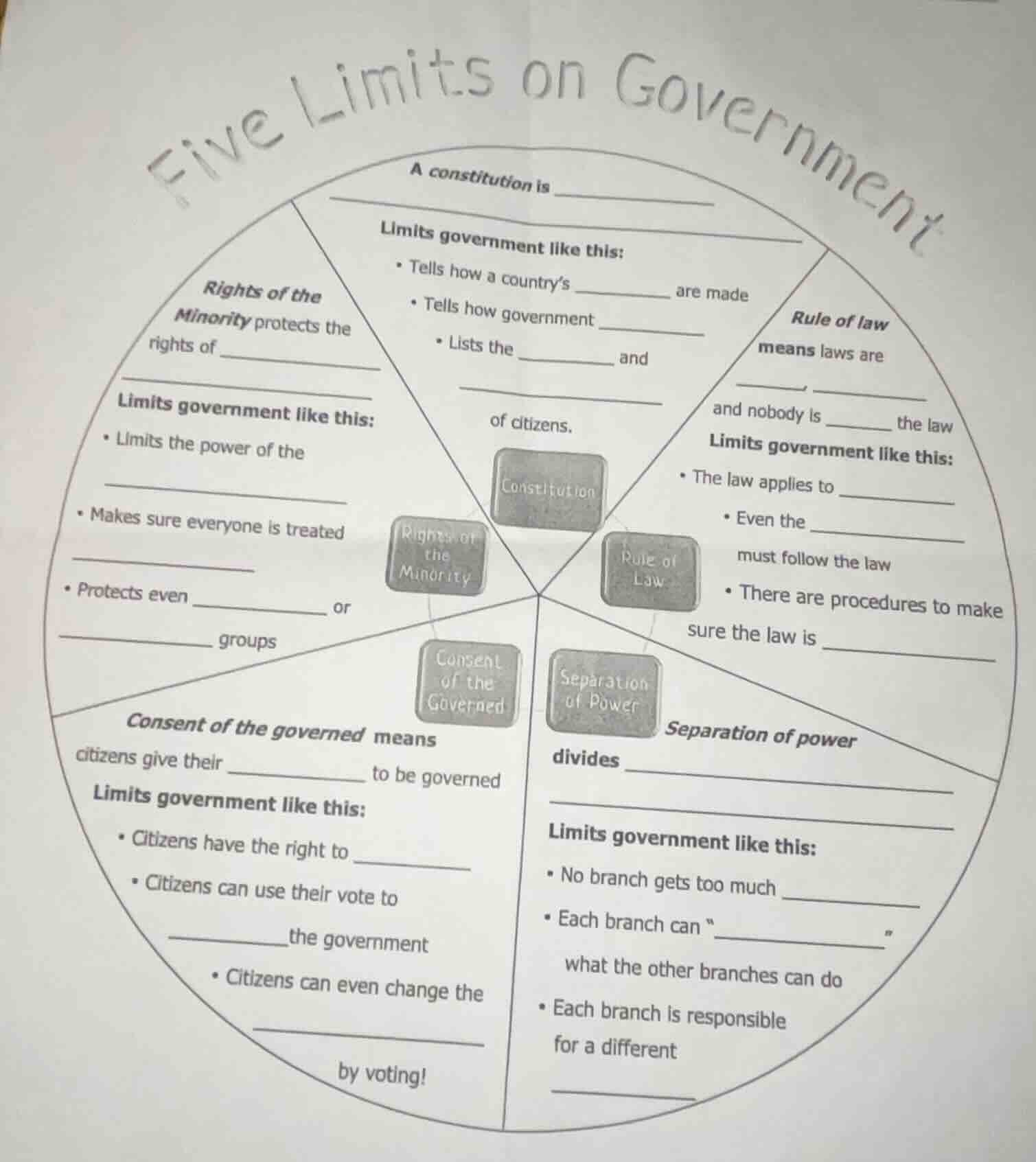
five limits on government
constitution:
a constitution is ______
limits government like this:
- tells how a country’s ______ are made
- tells how government ______
- lists the ____ and ____ of citizens.
rule of law:
rule of law means laws are ____, __ and nobody is ____ the law
limits government like this:
- the law applies to ______
- even the ______ must follow the law
- there are procedures to make sure the law is ______
separation of power:
separation of power divides ______
limits government like this:
- no branch gets too much ______
- each branch can “______” what the other branches can do
- each branch is responsible for a different ______
consent of the governed:
consent of the governed means citizens give their ______ to be governed
limits government like this:
- citizens have the right to ______
- citizens can use their vote to ______ the government
- citizens can even change the ______ by voting!
rights of the minority:
rights of the minority protects the rights of ______
limits government like this:
- limits the power of the ______
- makes sure everyone is treated ______
- protects even ____ or ____ groups
To solve this fill - in - the - blank problem about the five limits on government, we analyze each section based on the knowledge of political science (a subfield of Social Science, specifically Politics):
1. Constitution Section
- A constitution is a fundamental law (it is the basic law that sets the framework for a country's governance).
- Tells how a country’s laws are made (the constitution outlines the legislative process).
- Tells how government is organized (it defines the structure of the government, like the different branches).
- Lists the rights and responsibilities of citizens (it enumerates what citizens can do and what is expected of them).
2. Rule of Law Section
- Rule of law means laws are fair, just (laws should be equitable and morally right) and nobody is above the law (everyone, including government officials, is subject to the law).
- Limits government like this:
- The law applies to everyone (there is no discrimination in the application of law).
- Even the government officials must follow the law (no one is exempt from legal obligations).
- There are procedures to make sure the law is enforced (to ensure that laws are put into action).
3. Rights of the Minority Section
- Rights of the Minority protects the rights of smaller groups (groups that are not in the majority in terms of population or power).
- Limits government like this:
- Limits the power of the majority (so that the majority does not oppress the minority).
- Makes sure everyone is treated equally (regardless of being in the minority or majority).
- Protects even unpopular or marginalized groups (groups that may not be well - liked or are on the fringes of society).
4. Consent of the Governed Section
- Consent of the governed means citizens give their approval (they agree to be governed by the government) to be governed.
- Limits government like this:
- Citizens have the right to vote (to participate in the selection of their leaders).
- Citizens can use their vote to influence the government (to make the government act in their interests).
- Citizens can even change the government by voting! (if they are not satisfied with the current government, they can vote for a new one).
5. Separation of Power Section
- Separation of power divides government power (the power of the state is split among different branches).
- Limits government like this:
- No branch gets too much power (to prevent tyranny or abuse of power).
- Each branch can “check” what the other branches can do (this is the system of checks and balances, e.g., the legislative branch can check the executive branch's actions).
- Each branch is responsible for a different function (like the legislative branch makes laws, the executive enforces them, and the judicial interprets them).
Final Answers (Filling in the Blanks)
- Constitution: A constitution is \(\boldsymbol{\text{the fundamental law}}\); Tells how a country’s \(\boldsymbol{\text{laws}}\) are made; Tells how government \(\boldsymbol{\text{is organized}}\); Lists the \(\boldsymbol{\text{rights}}\) and \(\boldsymbol{\text{responsibilities}}\) of citizens.
- Rule of Law: Rule of law means laws are \(\boldsymbol{\text{fair}}\), \(\boldsymbol{\text{just}}\) and nobody is \(\boldsymbol{\text{above}}\) the law; The law applies to \(\boldsymbol{\text{everyone}}\); Even the \(\boldsymbol{\text{government officials}}\) must follow the law; There are procedures to mak…

Snap & solve any problem in the app
Get step-by-step solutions on Sovi AI
Photo-based solutions with guided steps
Explore more problems and detailed explanations
To solve this fill - in - the - blank problem about the five limits on government, we analyze each section based on the knowledge of political science (a subfield of Social Science, specifically Politics):
1. Constitution Section
- A constitution is a fundamental law (it is the basic law that sets the framework for a country's governance).
- Tells how a country’s laws are made (the constitution outlines the legislative process).
- Tells how government is organized (it defines the structure of the government, like the different branches).
- Lists the rights and responsibilities of citizens (it enumerates what citizens can do and what is expected of them).
2. Rule of Law Section
- Rule of law means laws are fair, just (laws should be equitable and morally right) and nobody is above the law (everyone, including government officials, is subject to the law).
- Limits government like this:
- The law applies to everyone (there is no discrimination in the application of law).
- Even the government officials must follow the law (no one is exempt from legal obligations).
- There are procedures to make sure the law is enforced (to ensure that laws are put into action).
3. Rights of the Minority Section
- Rights of the Minority protects the rights of smaller groups (groups that are not in the majority in terms of population or power).
- Limits government like this:
- Limits the power of the majority (so that the majority does not oppress the minority).
- Makes sure everyone is treated equally (regardless of being in the minority or majority).
- Protects even unpopular or marginalized groups (groups that may not be well - liked or are on the fringes of society).
4. Consent of the Governed Section
- Consent of the governed means citizens give their approval (they agree to be governed by the government) to be governed.
- Limits government like this:
- Citizens have the right to vote (to participate in the selection of their leaders).
- Citizens can use their vote to influence the government (to make the government act in their interests).
- Citizens can even change the government by voting! (if they are not satisfied with the current government, they can vote for a new one).
5. Separation of Power Section
- Separation of power divides government power (the power of the state is split among different branches).
- Limits government like this:
- No branch gets too much power (to prevent tyranny or abuse of power).
- Each branch can “check” what the other branches can do (this is the system of checks and balances, e.g., the legislative branch can check the executive branch's actions).
- Each branch is responsible for a different function (like the legislative branch makes laws, the executive enforces them, and the judicial interprets them).
Final Answers (Filling in the Blanks)
- Constitution: A constitution is \(\boldsymbol{\text{the fundamental law}}\); Tells how a country’s \(\boldsymbol{\text{laws}}\) are made; Tells how government \(\boldsymbol{\text{is organized}}\); Lists the \(\boldsymbol{\text{rights}}\) and \(\boldsymbol{\text{responsibilities}}\) of citizens.
- Rule of Law: Rule of law means laws are \(\boldsymbol{\text{fair}}\), \(\boldsymbol{\text{just}}\) and nobody is \(\boldsymbol{\text{above}}\) the law; The law applies to \(\boldsymbol{\text{everyone}}\); Even the \(\boldsymbol{\text{government officials}}\) must follow the law; There are procedures to make sure the law is \(\boldsymbol{\text{enforced}}\).
- Rights of the Minority: Rights of the Minority protects the rights of \(\boldsymbol{\text{smaller groups}}\); Limits the power of the \(\boldsymbol{\text{majority}}\); Makes sure everyone is treated \(\boldsymbol{\text{equally}}\); Protects even \(\boldsymbol{\text{unpopular}}\) or \(\boldsymbol{\text{marginalized}}\) groups.
- Consent of the Governed: Consent of the governed means citizens give their \(\boldsymbol{\text{approval}}\) to be governed; Citizens have the right to \(\boldsymbol{\text{vote}}\); Citizens can use their vote to \(\boldsymbol{\text{influence}}\) the government; Citizens can even change the \(\boldsymbol{\text{government}}\) by voting!
- Separation of Power: Separation of power divides \(\boldsymbol{\text{government power}}\); No branch gets too much \(\boldsymbol{\text{power}}\); Each branch can “\(\boldsymbol{\text{check}}\)” what the other branches can do; Each branch is responsible for a different \(\boldsymbol{\text{function}}\).