QUESTION IMAGE
Question
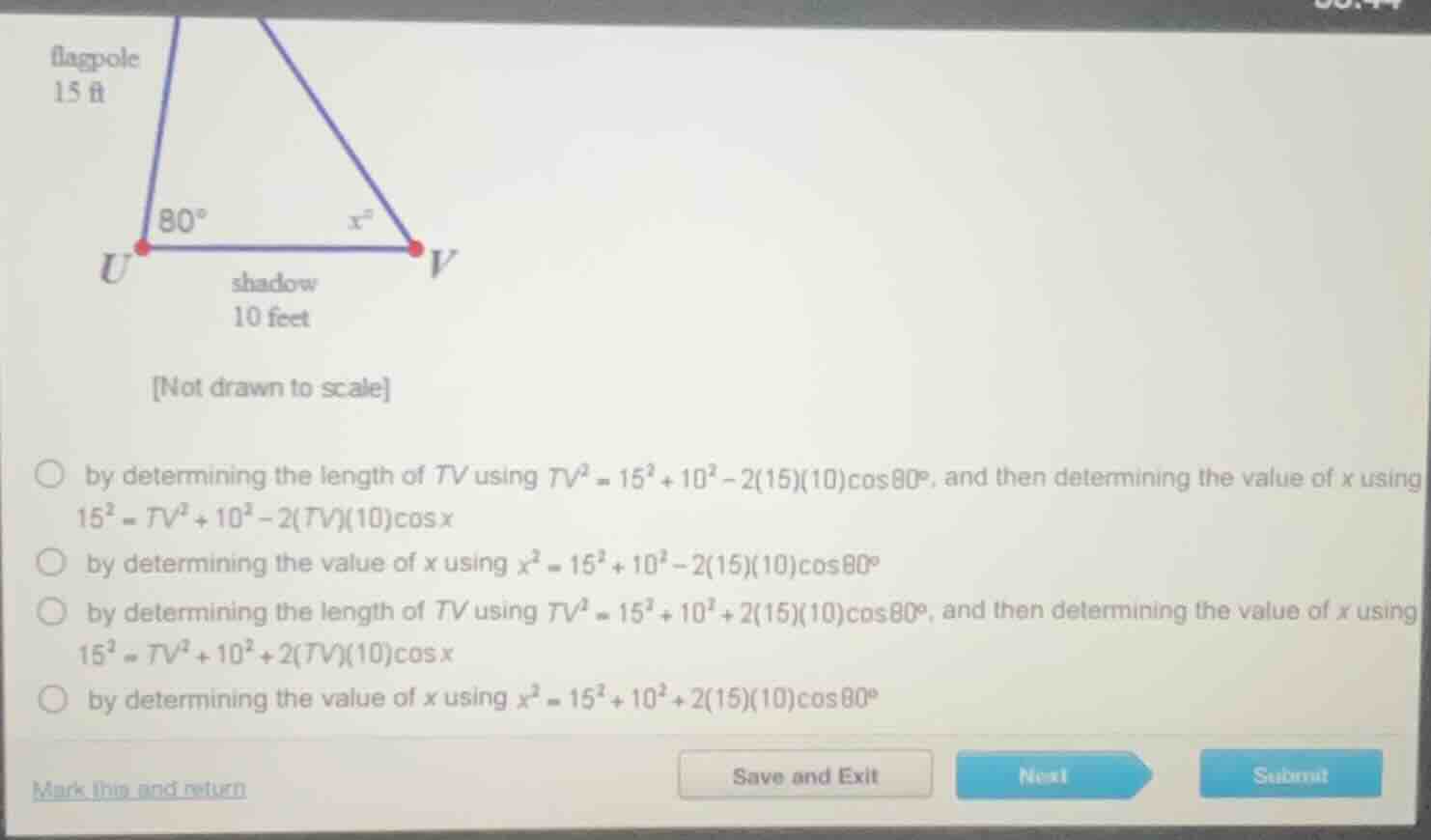
flagpole
15 ft
80°
x°
u v
shadow
10 feet
not drawn to scale
by determining the length of tv using tv² = 15² + 10² - 2(15)(10)cos80°, and then determining the value of x using 15² = tv² + 10² - 2(tv)(10)cosx
by determining the value of x using x² = 15² + 10² - 2(15)(10)cos80°
by determining the length of tv using tv² = 15² + 10² + 2(15)(10)cos80°, and then determining the value of x using 15² = tv² + 10² + 2(tv)(10)cosx
by determining the value of x using x² = 15² + 10² + 2(15)(10)cos80°
mark this and return
save and exit next submit
Step1: Recall the Law of Cosines
The Law of Cosines states that for a triangle with sides \(a\), \(b\), \(c\) and the angle opposite side \(c\) being \(C\), \(c^{2}=a^{2}+b^{2}-2ab\cos C\).
Step2: Analyze the first triangle (to find \(TV\))
In the triangle with sides \(15\) ft (flagpole), \(10\) ft (shadow), and \(TV\), and the included angle \(80^{\circ}\) at \(U\), we can apply the Law of Cosines. Let \(a = 15\), \(b=10\), \(C = 80^{\circ}\), and the side opposite \(C\) is \(TV\). So, \(TV^{2}=15^{2}+ 10^{2}-2(15)(10)\cos80^{\circ}\).
Step3: Analyze the second triangle (to find \(x\))
Now, for the triangle with sides \(15\) ft, \(TV\) (found above), and \(10\) ft, and the angle opposite the side of length \(15\) (which is \(x\) at \(V\)), we apply the Law of Cosines again. Let \(a = TV\), \(b = 10\), \(c=15\), and the angle opposite \(c\) is \(x\). So, \(15^{2}=TV^{2}+10^{2}-2(TV)(10)\cos x\).
Step4: Evaluate the options
- Option 1: Matches the two - step process using the Law of Cosines correctly.
- Option 2: Incorrectly applies the Law of Cosines directly to find \(x\) without first finding \(TV\) and also misapplies the formula (the angle in the formula for \(x\) is not \(80^{\circ}\)).
- Option 3: Incorrectly uses a plus sign in the Law of Cosines formula (\(TV^{2}=15^{2}+10^{2}+2(15)(10)\cos80^{\circ}\)) which is wrong as the Law of Cosines has a minus sign for the cosine term.
- Option 4: Incorrectly uses a plus sign in the Law of Cosines formula and also misapplies the formula to find \(x\).

Snap & solve any problem in the app
Get step-by-step solutions on Sovi AI
Photo-based solutions with guided steps
Explore more problems and detailed explanations
by determining the length of \(TV\) using \(TV^{2}=15^{2}+10^{2}-2(15)(10)\cos80^{\circ}\), and then determining the value of \(x\) using \(15^{2}=TV^{2}+10^{2}-2(TV)(10)\cos x\)