QUESTION IMAGE
Question
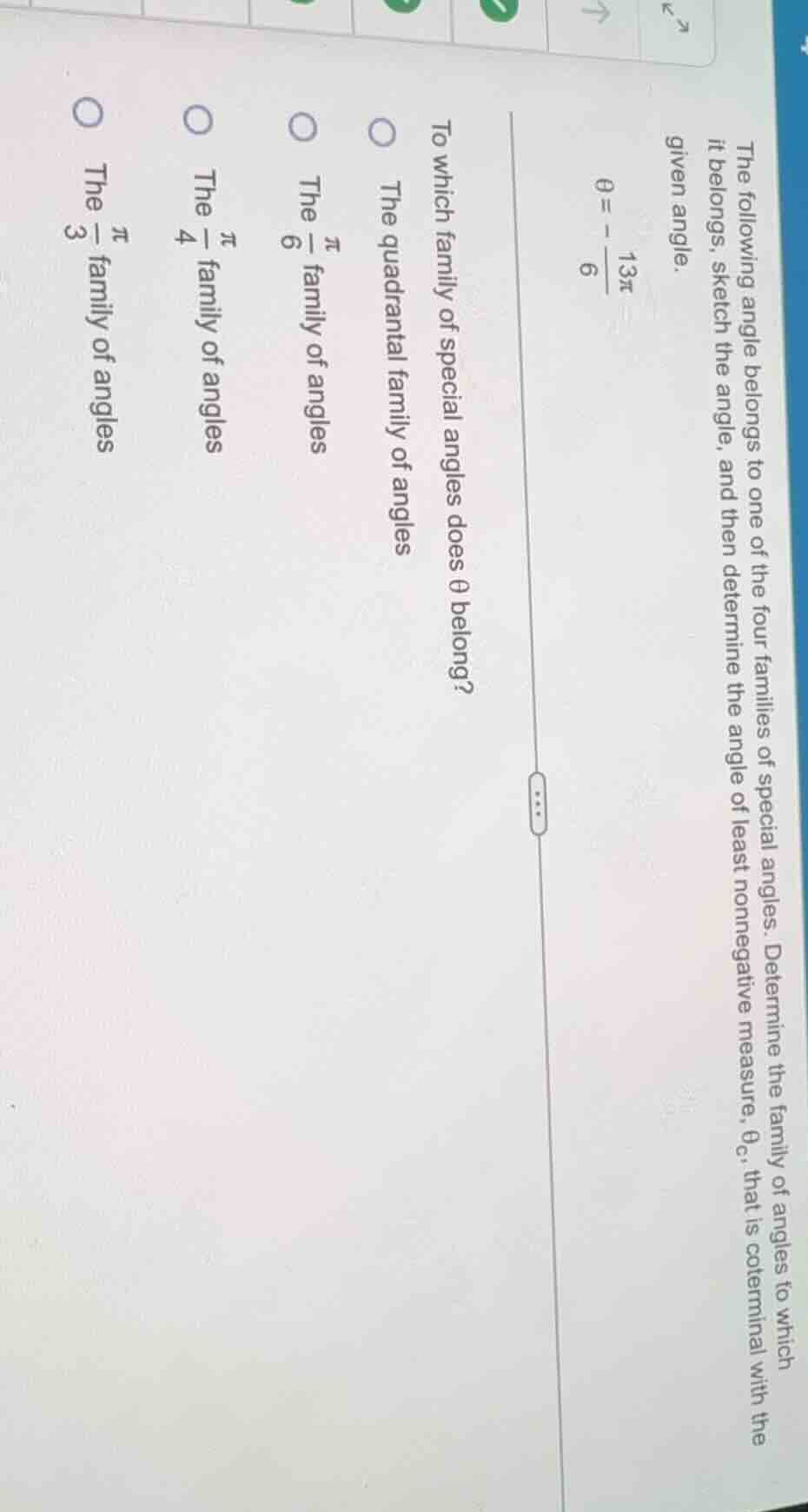
the following angle belongs to one of the four families of special angles. determine the family of angles to which it belongs, sketch the angle, and then determine the angle of least nonnegative measure, ( \theta_c ), that is coterminal with the given angle. (\theta = -\frac{13pi}{6}) to which family of special angles does ( \theta ) belong? the quadrantal family of angles the ( \frac{pi}{6} ) family of angles the ( \frac{pi}{4} ) family of angles the ( \frac{pi}{3} ) family of angles
Step1: Find coterminal angle
To find the least nonnegative coterminal angle, we add multiples of \(2\pi\) to the given angle \(\theta = -\frac{13\pi}{6}\) until we get a nonnegative angle.
First, let's add \(2\pi\) (which is \(\frac{12\pi}{6}\)): \(-\frac{13\pi}{6}+\frac{12\pi}{6}=-\frac{\pi}{6}\). Still negative.
Add another \(2\pi\) (total \(4\pi=\frac{24\pi}{6}\)): \(-\frac{13\pi}{6}+\frac{24\pi}{6}=\frac{11\pi}{6}\)? Wait, no, wait. Wait, let's do it step by step. Wait, actually, the formula for coterminal angles is \(\theta + 2k\pi\), \(k\in\mathbb{Z}\). We need to find the smallest \(k\) such that \(\theta + 2k\pi\geq0\).
For \(\theta = -\frac{13\pi}{6}\), solve \(-\frac{13\pi}{6}+2k\pi\geq0\).
\(2k\pi\geq\frac{13\pi}{6}\)
\(k\geq\frac{13}{12}\approx1.08\). So \(k = 2\) (since \(k\) must be integer). Wait, no, \(k = 2\) gives \(2k\pi = 4\pi=\frac{24\pi}{6}\). Then \(-\frac{13\pi}{6}+\frac{24\pi}{6}=\frac{11\pi}{6}\)? Wait, no, that's not right. Wait, maybe I made a mistake. Wait, let's try \(k = 1\): \(-\frac{13\pi}{6}+2\pi=-\frac{13\pi}{6}+\frac{12\pi}{6}=-\frac{\pi}{6}\) (negative). \(k = 2\): \(-\frac{13\pi}{6}+4\pi=-\frac{13\pi}{6}+\frac{24\pi}{6}=\frac{11\pi}{6}\)? Wait, no, that's not correct. Wait, actually, the reference angle or the family: Wait, the given angle is \(-\frac{13\pi}{6}\). Let's find the coterminal angle by adding \(2\pi\) twice? Wait, no, let's think about the family of angles. The family of angles with reference angle \(\frac{\pi}{6}\) are angles of the form \(\frac{\pi}{6}+k\pi\) or \(-\frac{\pi}{6}+k\pi\)? Wait, no, the special angle families: The \(\frac{\pi}{6}\) family includes angles like \(\frac{\pi}{6},\frac{5\pi}{6},\frac{7\pi}{6},\frac{11\pi}{6},-\frac{\pi}{6},-\frac{5\pi}{6}\), etc. Wait, the coterminal angle of \(-\frac{13\pi}{6}\): Let's add \(2\pi\) three times? Wait, no, let's calculate the coterminal angle correctly.
Wait, \(-\frac{13\pi}{6}+2\pi=-\frac{13\pi}{6}+\frac{12\pi}{6}=-\frac{\pi}{6}\) (still negative).
\(-\frac{13\pi}{6}+4\pi=-\frac{13\pi}{6}+\frac{24\pi}{6}=\frac{11\pi}{6}\). Wait, \(\frac{11\pi}{6}\) is in the fourth quadrant, and its reference angle is \(2\pi-\frac{11\pi}{6}=\frac{\pi}{6}\). So the family of angles with reference angle \(\frac{\pi}{6}\) is the \(\frac{\pi}{6}\) family. Let's check the options. The options are: quadrantal (angles like \(0,\frac{\pi}{2},\pi,\frac{3\pi}{2}\)), \(\frac{\pi}{6}\) family, \(\frac{\pi}{4}\) family, \(\frac{\pi}{3}\) family. The reference angle of the coterminal angle \(\frac{11\pi}{6}\) is \(\frac{\pi}{6}\), so it belongs to the \(\frac{\pi}{6}\) family of angles.
Step2: Identify the family
The reference angle of the coterminal angle (or the angle itself, when considering coterminal) has a reference angle of \(\frac{\pi}{6}\), so it belongs to the \(\frac{\pi}{6}\) family of angles.

Snap & solve any problem in the app
Get step-by-step solutions on Sovi AI
Photo-based solutions with guided steps
Explore more problems and detailed explanations
The \(\frac{\pi}{6}\) family of angles