QUESTION IMAGE
Question
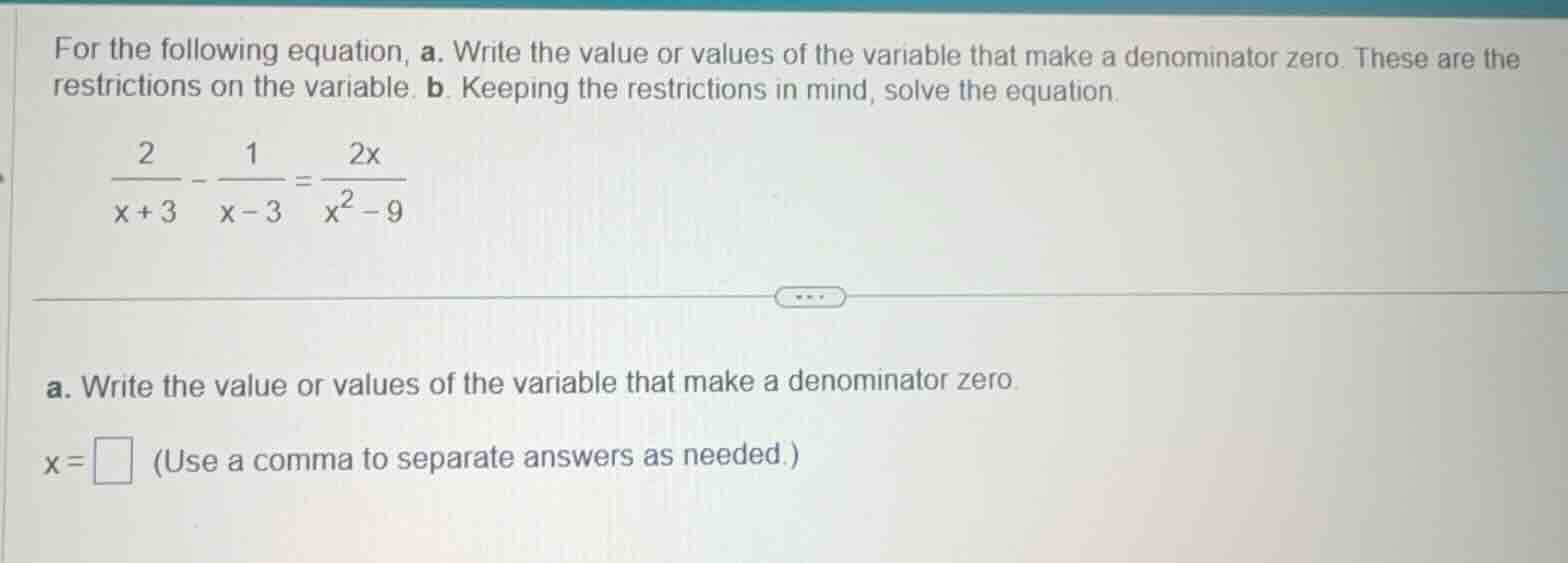
for the following equation, a. write the value or values of the variable that make a denominator zero. these are the restrictions on the variable. b. keeping the restrictions in mind, solve the equation.\\(\frac{2}{x + 3} - \frac{1}{x - 3} = \frac{2x}{x^2 - 9}\\)\\(\quad\\)a. write the value or values of the variable that make a denominator zero.\\(x = \square\\) (use a comma to separate answers as needed.)
Step1: Identify denominators
Denominators: $x+3$, $x-3$, $x^2-9$
Step2: Factor $x^2-9$
$x^2-9=(x+3)(x-3)$
Step3: Solve for zero denominators
Set $x+3=0$ → $x=-3$
Set $x-3=0$ → $x=3$
Step4: Solve the rational equation
Multiply all terms by $(x+3)(x-3)$:
$2(x-3) - 1(x+3) = 2x$
Step5: Expand and simplify
$2x-6 -x-3 = 2x$
$x-9=2x$
Step6: Isolate $x$
$x-2x=9$ → $-x=9$ → $x=-9$
Verify $x=-9$ does not make denominators zero.

Snap & solve any problem in the app
Get step-by-step solutions on Sovi AI
Photo-based solutions with guided steps
Explore more problems and detailed explanations
a. $x=-3, 3$
b. $x=-9$