QUESTION IMAGE
Question
following questions.
- what is the title of the image?
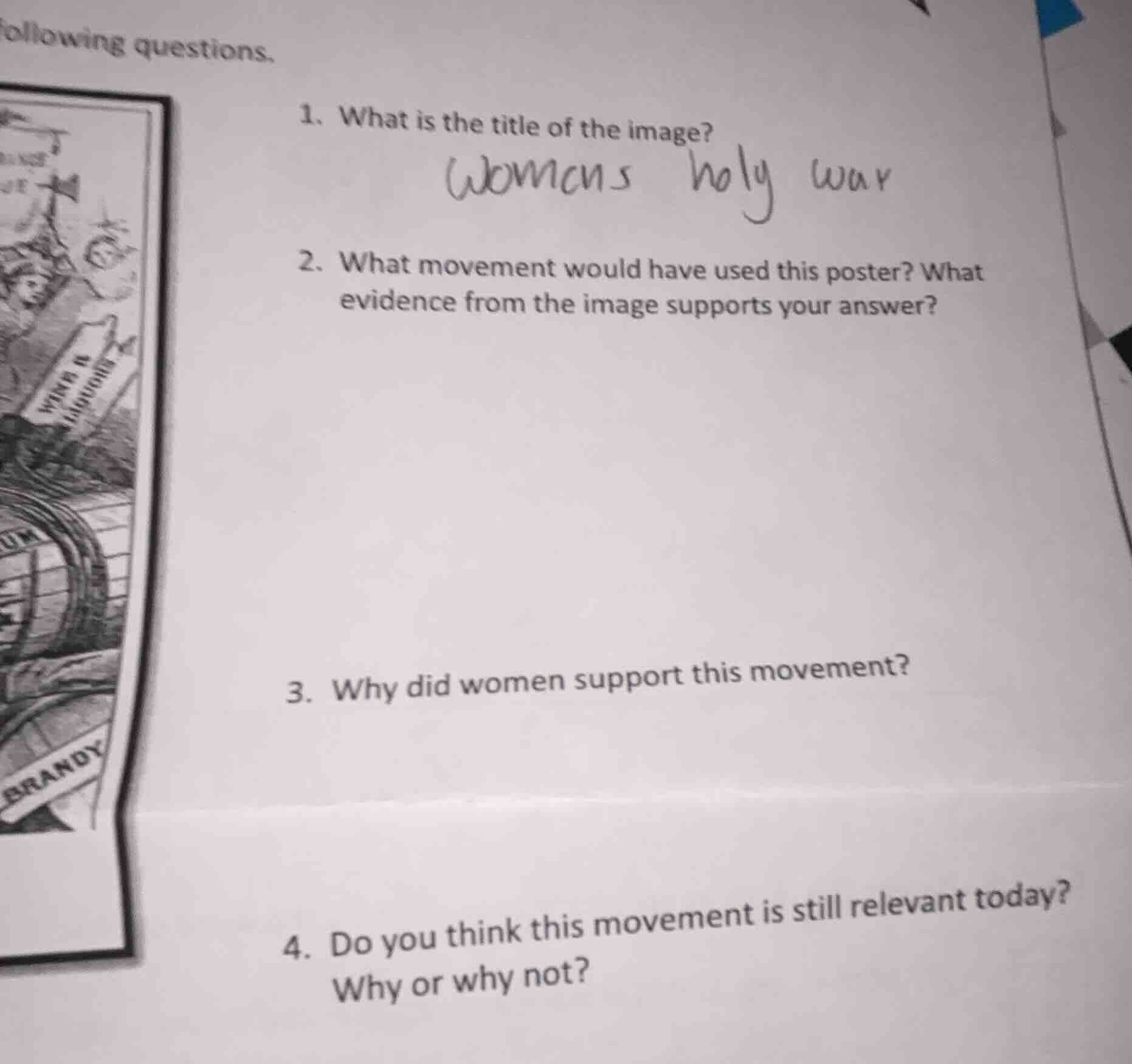
- what movement would have used this poster? what evidence from the image supports your answer?
- why did women support this movement?
- do you think this movement is still relevant today? why or why not?
Brief Explanations
- The title is provided in handwritten text.
- The poster's focus on opposing alcohol (seen in labels like "WINE & LIQUORS" and "BRANDY") and the title "Women's Holy War" link it to the Temperance Movement, which advocated for reducing/banishing alcohol, with women as key organizers.
- Women supported this movement because alcohol abuse was linked to domestic violence, poverty, and neglect of family, which disproportionately harmed women and children in the 19th-early 20th century. They saw temperance as a way to protect their homes and families.
- The movement has modern relevance: alcohol addiction still causes family harm, public health issues, and social inequality. Modern advocacy for substance abuse prevention, underage drinking laws, and support for affected families echoes the core goals of the original temperance movement.

Snap & solve any problem in the app
Get step-by-step solutions on Sovi AI
Photo-based solutions with guided steps
Explore more problems and detailed explanations
- Women's Holy War
- This poster would have been used by the Temperance Movement. Evidence includes the imagery of women rallying against alcohol containers labeled "WINE & LIQUORS" and "BRANDY," plus the title "Women's Holy War" which references women's leading role in anti-alcohol activism.
- Women supported the movement because alcohol abuse often led to domestic violence, family poverty, and the neglect of children, and they viewed temperance as a way to protect their homes and communities.
- Yes, this movement is still relevant today. Alcohol addiction continues to contribute to domestic harm, public health crises, and socioeconomic disparities, and modern efforts focused on substance abuse prevention, supporting affected families, and regulating alcohol access align with the original movement's core goals of reducing alcohol-related harm.