QUESTION IMAGE
Question
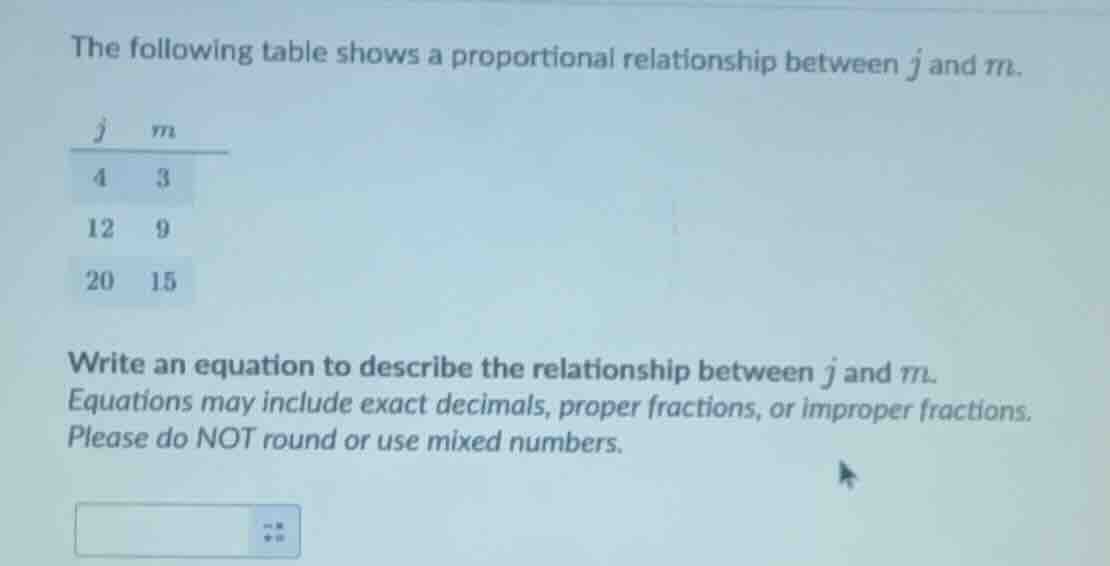
the following table shows a proportional relationship between j and m.
| j | m |
|---|---|
| 12 | 9 |
| 20 | 15 |
write an equation to describe the relationship between j and m.
equations may include exact decimals, proper fractions, or improper fractions.
please do not round or use mixed numbers.
Step1: Recall proportional relationship formula
For a proportional relationship, the formula is \( m = k \cdot j \), where \( k \) is the constant of proportionality. We need to find \( k \) using the given values.
Step2: Calculate the constant of proportionality \( k \)
Using the first pair of values \( j = 4 \) and \( m = 3 \), we substitute into the formula \( k=\frac{m}{j} \). So \( k = \frac{3}{4} \)? Wait, no, wait. Wait, let's check with another pair. For \( j = 12 \), \( m = 9 \), \( \frac{m}{j}=\frac{9}{12}=\frac{3}{4} \). For \( j = 20 \), \( m = 15 \), \( \frac{15}{20}=\frac{3}{4} \). Wait, no, wait, maybe I got \( j \) and \( m \) reversed. Wait, the problem says relationship between \( j \) and \( m \). Let's see, if we want to express \( m \) in terms of \( j \), or \( j \) in terms of \( m \)? Wait, let's check the ratios. Let's see, when \( j = 4 \), \( m = 3 \); \( j = 12 \), \( m = 9 \); \( j = 20 \), \( m = 15 \). So the ratio of \( m \) to \( j \) is \( \frac{3}{4} \)? Wait, no, \( 3/4 = 0.75 \), \( 9/12 = 0.75 \), \( 15/20 = 0.75 \). So \( m=\frac{3}{4}j \)? Wait, no, wait, let's check \( j \) in terms of \( m \). \( j = \frac{4}{3}m \)? Wait, no, when \( m = 3 \), \( j = 4 \), so \( j=\frac{4}{3}m \)? Wait, no, \( 4 = \frac{4}{3} \times 3 \), yes. \( 12 = \frac{4}{3} \times 9 \), yes. \( 20 = \frac{4}{3} \times 15 \), \( \frac{4}{3} \times 15 = 20 \), yes. Wait, so which one is it? Wait, the problem says "relationship between \( j \) and \( m \)". Let's see the table: \( j \) values are 4, 12, 20; \( m \) values are 3, 9, 15. So the ratio of \( j \) to \( m \) is \( 4/3 \), \( 12/9 = 4/3 \), \( 20/15 = 4/3 \). So \( j=\frac{4}{3}m \)? Wait, but let's check the other way. If we do \( m = \frac{3}{4}j \), then when \( j = 4 \), \( m = 3 \), which matches. When \( j = 12 \), \( m = 9 \), which matches. When \( j = 20 \), \( m = 15 \), which matches. So both are correct, but we need to see the relationship. Wait, the problem says "write an equation to describe the relationship between \( j \) and \( m \)". Let's see the proportionality: since it's a proportional relationship, \( m = k j \), where \( k \) is the constant. So \( k = m/j = 3/4 \), so \( m = \frac{3}{4}j \)? Wait, no, wait, 3 divided by 4 is 0.75, and 9 divided by 12 is 0.75, 15 divided by 20 is 0.75. So yes, \( m = \frac{3}{4}j \)? Wait, but let's check \( j \) in terms of \( m \). \( j = \frac{4}{3}m \), because 4 is \( \frac{4}{3} \times 3 \), 12 is \( \frac{4}{3} \times 9 \), 20 is \( \frac{4}{3} \times 15 \). So which one is correct? Wait, the problem says "relationship between \( j \) and \( m \)". Let's see the table: when \( j \) increases, \( m \) increases. The constant of proportionality can be found by \( k = \frac{m}{j} \) or \( k = \frac{j}{m} \). Let's check the first pair: \( j = 4 \), \( m = 3 \). So \( \frac{m}{j} = \frac{3}{4} \), \( \frac{j}{m} = \frac{4}{3} \). Let's see which equation holds. Let's take \( m = \frac{3}{4}j \). For \( j = 4 \), \( m = \frac{3}{4} \times 4 = 3 \), correct. For \( j = 12 \), \( m = \frac{3}{4} \times 12 = 9 \), correct. For \( j = 20 \), \( m = \frac{3}{4} \times 20 = 15 \), correct. So the equation is \( m = \frac{3}{4}j \)? Wait, no, wait, maybe I had it reversed. Wait, the problem says "write an equation to describe the relationship between \( j \) and \( m \)". So either \( m = \frac{3}{4}j \) or \( j = \frac{4}{3}m \). But let's check the ratios again. Let's see, the ratio of \( m \) to \( j \) is constant at \( \frac{3}{4} \), so \( m = \frac{3}{4}j \). Wait, but let's confirm with the valu…

Snap & solve any problem in the app
Get step-by-step solutions on Sovi AI
Photo-based solutions with guided steps
Explore more problems and detailed explanations
\( m = \frac{3}{4}j \) (or \( j = \frac{4}{3}m \), but based on the ratio \( \frac{m}{j} = \frac{3}{4} \), the equation \( m = \frac{3}{4}j \) is correct as it shows \( m \) proportional to \( j \) with constant \( \frac{3}{4} \))