QUESTION IMAGE
Question
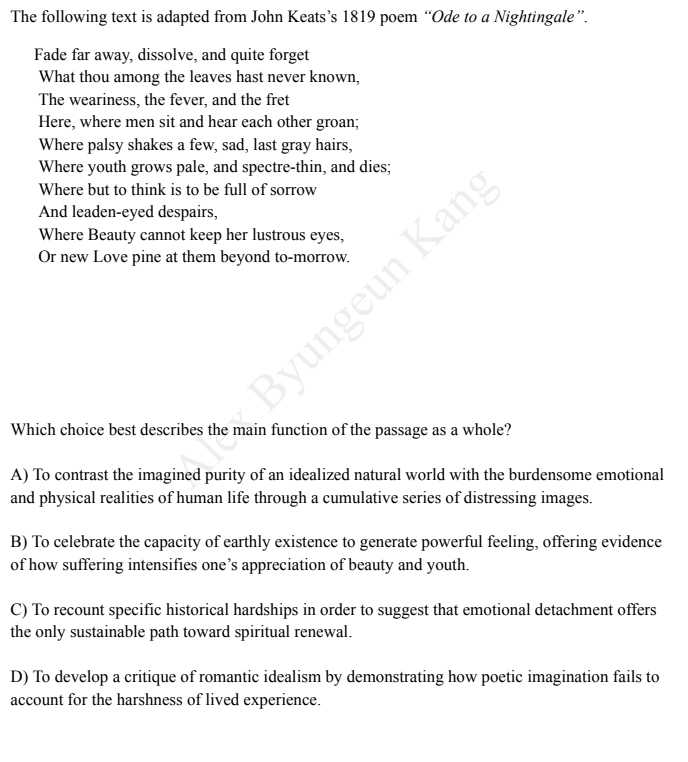
the following text is adapted from john keats’s 1819 poem “ode to a nightingale”.
fade far away, dissolve, and quite forget
what thou among the leaves hast never known,
the weariness, the fever, and the fret
here, where men sit and hear each other groan;
where palsy shakes a few, sad, last gray hairs,
where youth grows pale, and spectre - thin, and dies;
where but to think is to be full of sorrow
and leaden - eyed despairs,
where beauty cannot keep her lustrous eyes,
or new love pine at them beyond to - morrow.
which choice best describes the main function of the passage as a whole?
a) to contrast the imagined purity of an idealized natural world with the burdensome emotional and physical realities of human life through a cumulative series of distressing images.
b) to celebrate the capacity of earthly existence to generate powerful feeling, offering evidence of how suffering intensifies one’s appreciation of beauty and youth.
c) to recount specific historical hardships in order to suggest that emotional detachment offers the only sustainable path toward spiritual renewal.
d) to develop a critique of romantic idealism by demonstrating how poetic imagination fails to account for the harshness of lived experience.
The passage is addressed to a nightingale, a symbol of an idealized, carefree natural world. It lists a cumulative series of distressing human struggles: weariness, illness, aging, sorrow, the fading of beauty, and unfulfilled love. This directly contrasts the nightingale's unknown, peaceful existence with the harsh physical and emotional realities of human life, matching option A. Option B is incorrect as the passage focuses on suffering rather than celebrating earthly existence. Option C is wrong because there are no specific historical hardships mentioned. Option D is incorrect as the passage does not critique romantic idealism; it longs for the escape the nightingale's world represents.

Snap & solve any problem in the app
Get step-by-step solutions on Sovi AI
Photo-based solutions with guided steps
Explore more problems and detailed explanations
A) To contrast the imagined purity of an idealized natural world with the burdensome emotional and physical realities of human life through a cumulative series of distressing images.