QUESTION IMAGE
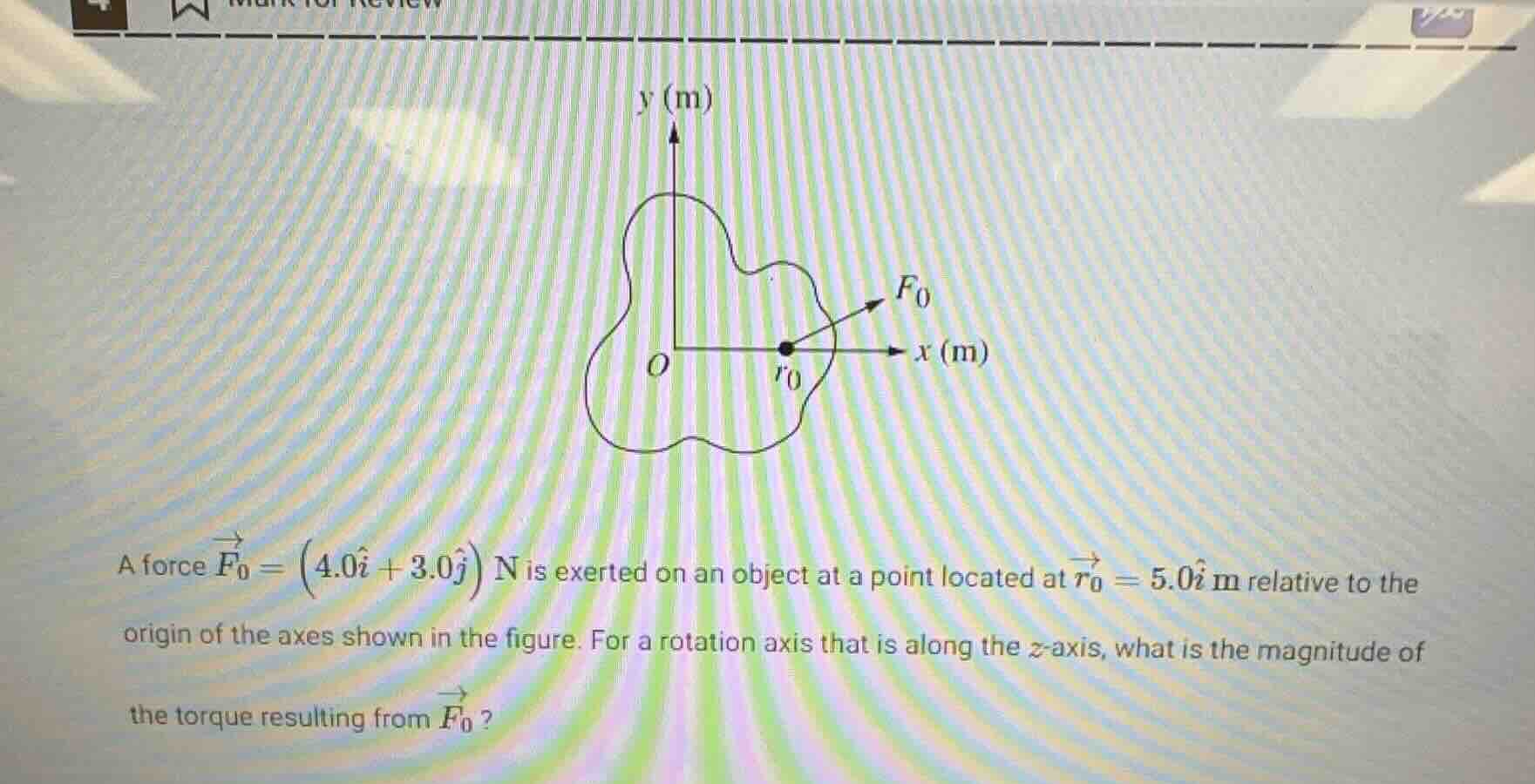
Question
a force \\(\vec{f}_0 = \left( 4.0\hat{i} + 3.0\hat{j} \
ight) \\, \text{n}\\) is exerted on an object at a point located at \\(\vec{r}_0 = 5.0\hat{i} \\, \text{m}\\) relative to the origin of the axes shown in the figure. for a rotation axis that is along the \\(z\\)-axis, what is the magnitude of the torque resulting from \\(\vec{f}_0\\)?
Step1: Recall Torque Formula
Torque \(\vec{\tau}\) is given by the cross product \(\vec{\tau}=\vec{r}\times\vec{F}\). For vectors \(\vec{r} = r_x\hat{i}+r_y\hat{j}+r_z\hat{k}\) and \(\vec{F}=F_x\hat{i}+F_y\hat{j}+F_z\hat{k}\), the cross product in component form is:
\[
\vec{\tau}=
=(r_yF_z - r_zF_y)\hat{i}+(r_zF_x - r_xF_z)\hat{j}+(r_xF_y - r_yF_x)\hat{k}
\]
Here, \(\vec{r_0} = 5.0\hat{i}\, \text{m}\) (so \(r_x = 5.0\), \(r_y = 0\), \(r_z = 0\)) and \(\vec{F_0}=(4.0\hat{i}+3.0\hat{j})\, \text{N}\) (so \(F_x = 4.0\), \(F_y = 3.0\), \(F_z = 0\)).
Step2: Calculate Torque Components
Substitute into the cross - product formula:
- For the \(\hat{i}\) component: \(r_yF_z - r_zF_y=0\times0 - 0\times3.0 = 0\)
- For the \(\hat{j}\) component: \(r_zF_x - r_xF_z=0\times4.0 - 5.0\times0 = 0\)
- For the \(\hat{k}\) component: \(r_xF_y - r_yF_x=5.0\times3.0 - 0\times4.0 = 15\)
So \(\vec{\tau}=15\hat{k}\, \text{N}\cdot\text{m}\). The magnitude of the torque is the magnitude of the \(\hat{k}\) component (since the other components are zero).

Snap & solve any problem in the app
Get step-by-step solutions on Sovi AI
Photo-based solutions with guided steps
Explore more problems and detailed explanations
The magnitude of the torque is \(\boldsymbol{15}\, \text{N}\cdot\text{m}\)