QUESTION IMAGE
Question
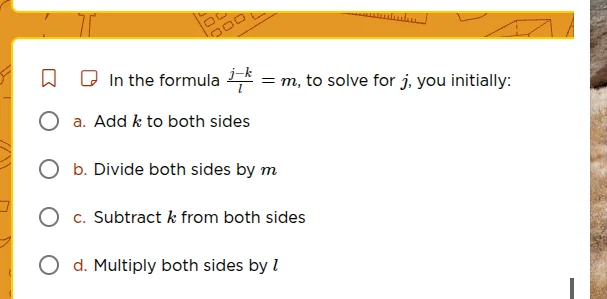
in the formula \\(\frac{j - k}{l} = m\\), to solve for \\(j\\), you initially:
a. add \\(k\\) to both sides
b. divide both sides by \\(m\\)
c. subtract \\(k\\) from both sides
d. multiply both sides by \\(l\\)
To solve for \( j \) in the formula \( \frac{j - k}{l}=m \), we need to isolate \( j \). The first step is to eliminate the denominator \( l \) from the left - hand side. According to the properties of equations, if we multiply both sides of an equation by the same non - zero number, the equation remains equivalent. So, we multiply both sides of the equation \( \frac{j - k}{l}=m \) by \( l \).
Step 1: Analyze the goal and operation
Our goal is to solve for \( j \) in \( \frac{j - k}{l}=m \). To get rid of the division by \( l \) on the left - hand side, we use the multiplication property of equality.
If we multiply both sides of the equation \( \frac{j - k}{l}=m \) by \( l \), we have:
\( \frac{j - k}{l}\times l=m\times l \)
Simplifying the left - hand side, the \( l \) in the numerator and denominator cancels out, and we get \( j - k = m\times l \) or \( j - k=ml \).
Now let's analyze the other options:
- Option a: Adding \( k \) to both sides at the beginning would give \( \frac{j - k}{l}+k=m + k \), which does not help in isolating \( j \) easily as the denominator \( l \) is still present.
- Option b: Dividing both sides by \( m \) (if \( m
eq0 \)) would give \( \frac{j - k}{l\times m}=1 \), which is not a helpful first step.
- Option c: Subtracting \( k \) from both sides would give \( \frac{j - k}{l}-k=m - k \), which also does not help in isolating \( j \) as the denominator \( l \) is still there.

Snap & solve any problem in the app
Get step-by-step solutions on Sovi AI
Photo-based solutions with guided steps
Explore more problems and detailed explanations
d. Multiply both sides by \( l \)