QUESTION IMAGE
Question
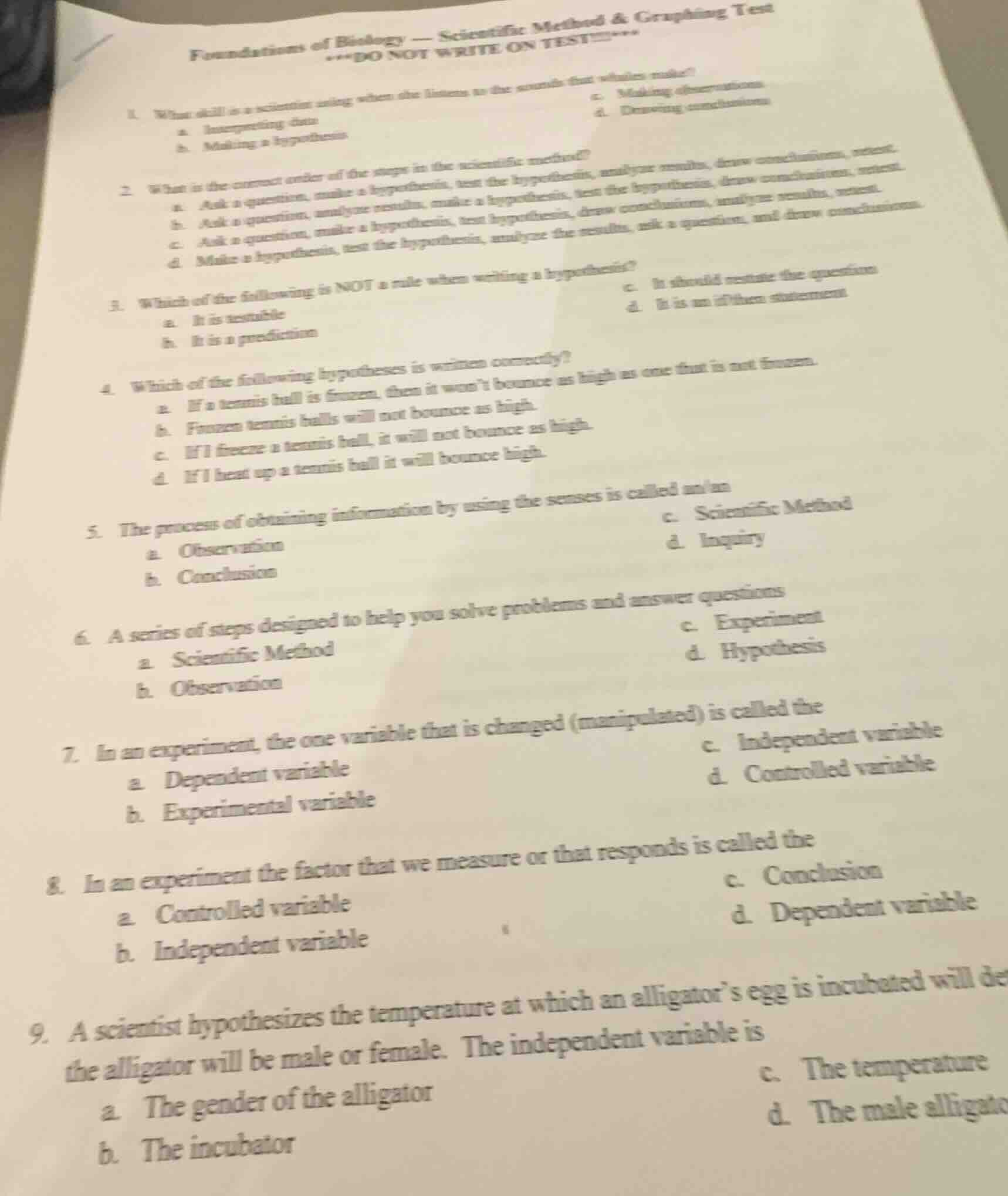
foundations of biology — scientific method & graphing testdo not write on test!!!1. what skill is a scientist using when she listens to the sounds that whales make?a. interpreting datab. making a hypothesisc. making observationsd. drawing conclusions2. what is the correct order of the steps in the scientific method?a. ask a question, make a hypothesis, test the hypothesis, analyze results, draw conclusions, retest.b. ask a question, analyze results, make a hypothesis, test the hypothesis, draw conclusions, retest.c. ask a question, make a hypothesis, test hypothesis, draw conclusions, analyze results, retest.d. make a hypothesis, test the hypothesis, analyze the results, ask a question, and draw conclusions.3. which of the following is not a rule when writing a hypothesis?a. it is testableb. it is a predictionc. it should restate the questiond. it is an if/then statement4. which of the following hypotheses is written correctly?a. if a tennis ball is frozen, then it wont bounce as high as one that is not frozen.b. frozen tennis balls will not bounce as high.c. if i freeze a tennis ball, it will not bounce as high.d. if i heat up a tennis ball it will bounce high.5. the process of obtaining information by using the senses is called an/ana. observationb. conclusionc. scientific methodd. inquiry6. a series of steps designed to help you solve problems and answer questionsa. scientific methodb. observationc. experimentd. hypothesis7. in an experiment, the one variable that is changed (manipulated) is called thea. dependent variableb. experimental variablec. independent variabled. controlled variable8. in an experiment the factor that we measure or that responds is called thea. controlled variableb. independent variablec. conclusiond. dependent variable9. a scientist hypothesizes the temperature at which an alligators egg is incubated will determine if the alligator will be male or female. the independent variable isa. the gender of the alligatorb. the incubatorc. the temperatured. the male alligator
- Listening to animal sounds uses sensory input to gather data, which is making observations.
- The scientific method follows the sequence: ask a question, form a hypothesis, test it, analyze results, draw conclusions, and retest if needed.
- A hypothesis does not restate the question; it is a testable, predictive if/then statement.
- A correct hypothesis uses a clear if/then structure to state a testable prediction comparing conditions.
- Using senses to gather information is defined as observation.
- The scientific method is a structured step-by-step process for problem-solving.
- The intentionally changed variable in an experiment is the independent variable (also called experimental variable, but independent is the standard term here).
- The variable measured in response to changes is the dependent variable.
- The independent variable is the factor intentionally changed, which is incubation temperature here.

Snap & solve any problem in the app
Get step-by-step solutions on Sovi AI
Photo-based solutions with guided steps
Explore more problems and detailed explanations
- c. Making observations
- a. Ask a question, make a hypothesis, test the hypothesis, analyze results, draw conclusions, retest.
- c. It should restate the question
- a. If a tennis ball is frozen, then it won't bounce as high as one that is not frozen.
- a. Observation
- a. Scientific Method
- c. Independent variable
- d. Dependent variable
- c. The temperature