QUESTION IMAGE
Question
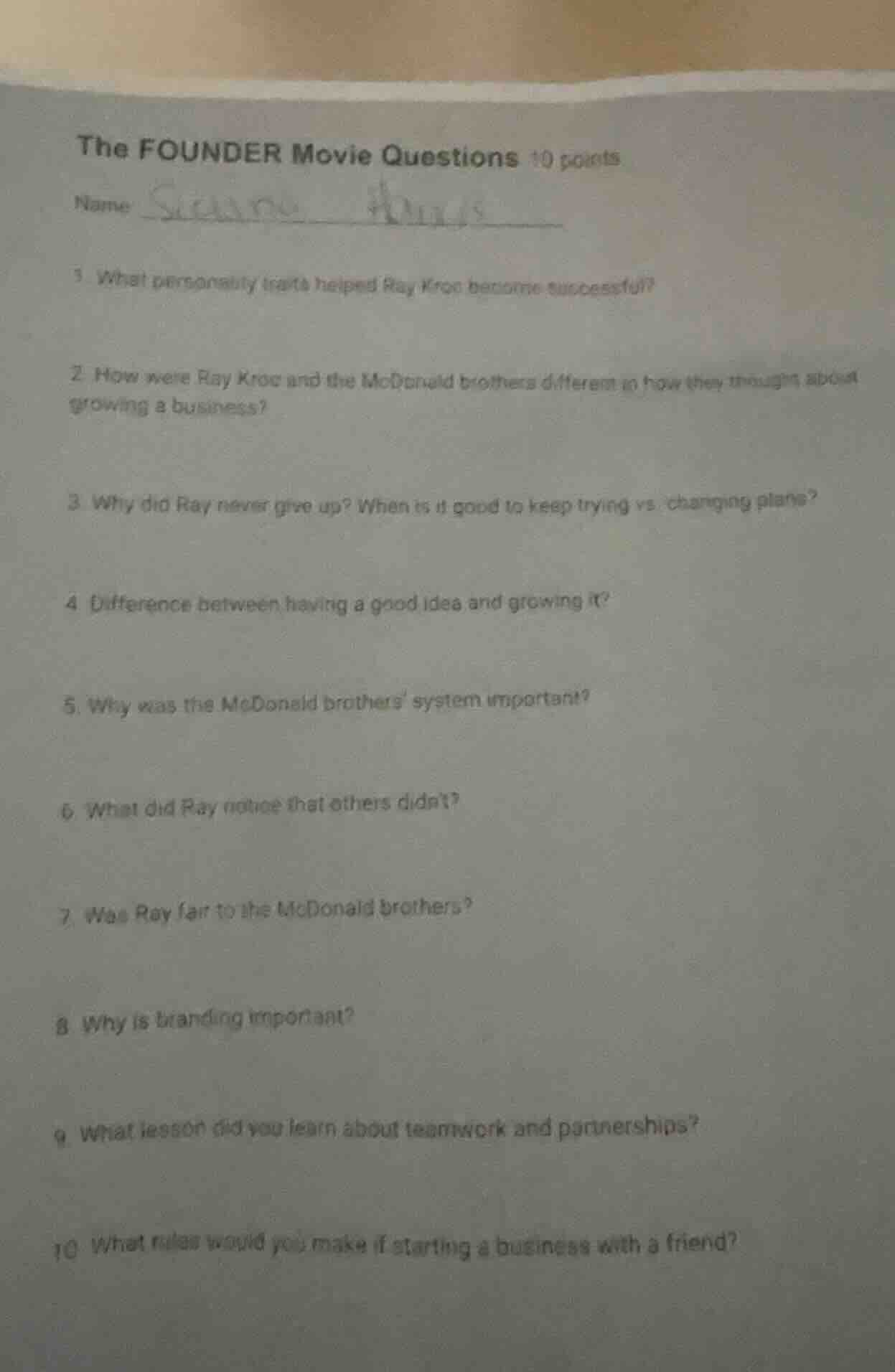
the founder movie questions 10 points
name
- what personality traits helped ray kroc become successful?
- how were ray kroc and the mcdonald brothers different in how they thought about growing a business?
- why did ray never give up? when is it good to keep trying vs. changing plans?
- difference between having a good idea and growing it?
- why was the mcdonald brothers system important?
- what did ray notice that others didnt?
- was ray fair to the mcdonald brothers?
- why is branding important?
- what lesson did you learn about teamwork and partnerships?
- what rules would you make if starting a business with a friend?
Brief Explanations
- Identifies key traits from Ray Kroc's drive and resilience in the film.
- Contrasts Ray's scalable expansion focus with the brothers' local, small-scale goals.
- Links Ray's persistence to his ambition; notes context for persistence vs. pivoting.
- Distinguishes idea conception from execution/scaling resources.
- Highlights the brothers' system as the foundation for fast-food efficiency.
- Points out Ray's recognition of the brand's national franchising potential.
- Evaluates Ray's contract tactics and profit motives against fairness.
- Explains branding's role in customer loyalty and market recognition.
- Draws lessons on aligned goals and clear agreements in partnerships.
- Proposes rules to protect both business and personal relationships.

Snap & solve any problem in the app
Get step-by-step solutions on Sovi AI
Photo-based solutions with guided steps
Explore more problems and detailed explanations
- Ray Kroc’s key successful traits were relentless persistence, extreme ambition, sharp business intuition, and a talent for scaling operations and persuading others.
- Ray Kroc focused on aggressive national/global franchising and scaling the brand for maximum profit, while the McDonald brothers prioritized maintaining local, small-scale control over their original restaurant and preserving its quality/community feel over rapid growth.
- Ray never gave up due to his intense ambition to build a massive, legacy-making business. It is good to keep trying when the core idea is viable and progress is visible; it is better to change plans when the idea is fundamentally flawed, or costs outweigh potential long-term benefits.
- Having a good idea is the initial creative concept (like the McDonald brothers' fast-service system), while growing it requires executing the idea at scale, securing resources (funding, franchisees), building a brand, and adapting to market demands to reach a large audience.
- The McDonald brothers' system was important because it created the first standardized, efficient fast-food model: it cut wait times, reduced costs, ensured consistent food quality, and laid the operational foundation for the modern fast-food industry.
- Ray noticed that the McDonald brothers' efficient system could be turned into a national (and eventually global) franchised brand, rather than just a single local restaurant. He saw the scalability and mass-market appeal that the brothers did not prioritize.
- This is subjective, but many view Ray as unfair: he used contract loopholes to take control of the McDonald's brand, reduced the brothers' royalties, and pushed them out of the business they founded, even though he benefited from their original system.
- Branding is important because it creates a recognizable identity that builds customer loyalty, differentiates a business from competitors, allows for premium pricing, and creates long-term brand equity that can support growth and expansion.
- A key lesson is that partnerships require clear, formalized agreements (not just verbal understandings) and aligned long-term goals. Misaligned priorities (like Ray's growth vs. the brothers' small-scale focus) can break partnerships, and it is critical to define roles, profit shares, and decision-making power upfront.
- Rules for starting a business with a friend would include:
- Draft a formal, written partnership agreement outlining roles, profit splits, and exit plans.
- Set clear, shared long-term business goals to avoid misalignment.
- Separate personal and business communication to protect the friendship.
- Assign decision-making authority for specific areas to avoid deadlock.
- Establish a process for resolving conflicts fairly, such as bringing in a neutral third party if needed.