QUESTION IMAGE
Question
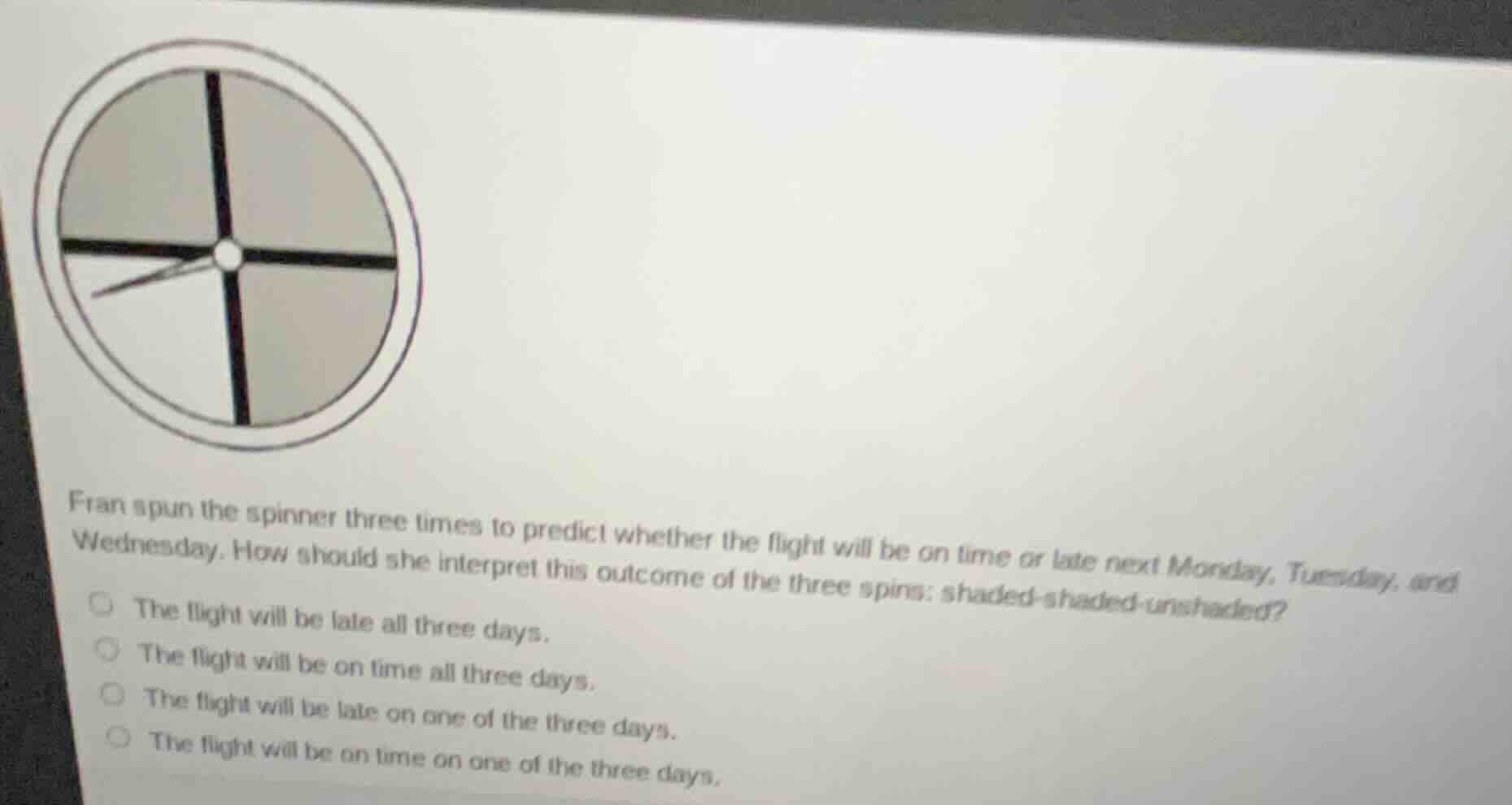
fran spun the spinner three times to predict whether the flight will be on time or late next monday, tuesday, and wednesday. how should she interpret this outcome of the three spins: shaded - shaded - unshaded?
the flight will be late all three days.
the flight will be on time all three days.
the flight will be late on one of the three days.
the flight will be on time on one of the three days.
First, we assume that the shaded region represents the flight being late and the unshaded region represents the flight being on time (or vice - versa, but we can infer from the options). The outcome of the spins is shaded - shaded - unshaded. So, we have two shaded (late) and one unshaded (on time) or two on - time and one late depending on the mapping. But looking at the options, we need to match the number of shaded and unshaded to the description of late and on - time. If we consider that shaded is late and unshaded is on time, then two shaded (late) and one unshaded (on time) would mean the flight is late on two days and on time on one day. But if we consider the other way (shaded is on time and unshaded is late), two shaded (on time) and one unshaded (late) would mean the flight is on time on two days and late on one day. Wait, no, let's re - examine the options. The options are about how many days the flight is late or on time. Let's count the number of shaded and unshaded in the spins: two shaded, one unshaded. Now let's look at the options:
- Option 1: "The flight will be late all three days." → This would require three shaded, so no.
- Option 2: "The flight will be on time all three days." → This would require three unshaded, so no.
- Option 3: "The flight will be late on one of the three days." → This would require one shaded, so no.
- Option 4: "The flight will be on time on one of the three days." → This would require one unshaded (since unshaded is on time), and we have one unshaded. So this matches. Wait, maybe I had the mapping reversed. Let's assume that shaded is on time and unshaded is late. Then two shaded (on time) and one unshaded (late) would mean on time two days, late one day. But the option "The flight will be on time on one of the three days" would be wrong. Wait, no, let's start over.
The spinner has a certain number of shaded and unshaded regions. From the diagram, it looks like 3 shaded and 1 unshaded? Wait, no, the diagram shows a spinner divided into four parts? Wait, the original diagram (even though it's a bit unclear) - the text says the outcome is shaded - shaded - unshaded. So three spins: two shaded, one unshaded. Now let's look at the options:
If we assume that shaded = late and unshaded = on time:
- Two shaded (late) and one unshaded (on time) → so late two days, on time one day. But none of the options say that. Wait, maybe I got the mapping wrong. Maybe shaded = on time and unshaded = late. Then two shaded (on time) and one unshaded (late) → on time two days, late one day. But the options:
Option 4: "The flight will be on time on one of the three days." No, that's one on time. Wait, no, let's count the number of unshaded in the spins: 1 unshaded. So if unshaded is on time, then the flight is on time on 1 day. If unshaded is late, then the flight is late on 1 day. Wait, the options:
- "The flight will be late all three days." → 3 late (3 shaded) → no.
- "The flight will be on time all three days." → 3 on time (3 shaded) → no.
- "The flight will be late on one of the three days." → 1 late (1 shaded) → no, we have 2 shaded.
- "The flight will be on time on one of the three days." → 1 on time (1 unshaded) → yes, because we have 1 unshaded. So if unshaded is on time, then the flight is on time on 1 day. So this option is correct.

Snap & solve any problem in the app
Get step-by-step solutions on Sovi AI
Photo-based solutions with guided steps
Explore more problems and detailed explanations
The flight will be on time on one of the three days.