QUESTION IMAGE
Question
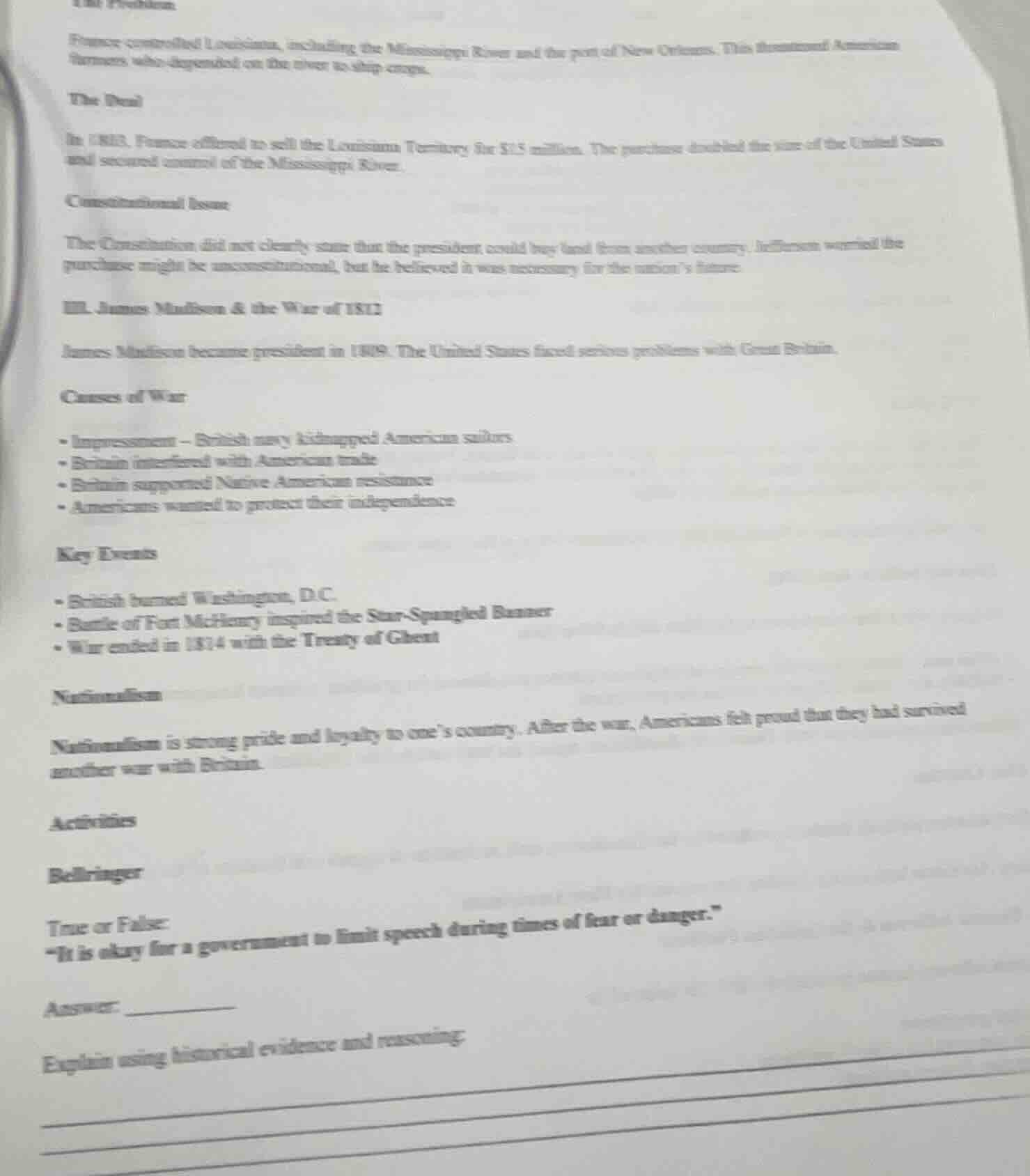
france controlled louisiana, including the mississippi river and the port of new orleans. this threatened american farmers who depended on the river to ship crops.
the deal
in 1803, france offered to sell the louisiana territory for $15 million. the purchase doubled the size of the united states and secured control of the mississippi river.
constitutional issue
the constitution did not clearly state that the president could buy land from another country. jefferson worried the purchase might be unconstitutional, but he believed it was necessary for the nations future.
iii. james madison & the war of 1812
james madison became president in 1809. the united states faced serious problems with great britain.
causes of war
- impressment -- british navy kidnapped american sailors
- britain interfered with american trade
- britain supported native american resistance
- americans wanted to protect their independence
key events
- british burned washington, d.c.
- battle of fort mchenry inspired the star-spangled banner
- war ended in 1814 with the treaty of ghent
nationalism
nationalism is strong pride and loyalty to ones country. after the war, americans felt proud that they had survived another war with britain.
activities
bellringer
true or false:
\it is okay for a government to limit speech during times of fear or danger.\
answer: ___________
explain using historical evidence and reasoning:
This is a subjective question with context tied to U.S. history and civil liberties. A common historical counterexample is the Alien and Sedition Acts (1798), which allowed the government to limit speech critical of the administration. This was widely criticized as overstepping, and later, courts (such as in Schenck v. United States and subsequent cases like New York Times Co. v. United States) have established that speech restrictions during crises must meet strict scrutiny—broad limits are not acceptable. While some narrow restrictions in extreme cases may be upheld, the broad statement that it is "okay" for government to limit speech during fear/danger is not universally valid, as it risks violating core First Amendment protections, which are foundational to U.S. democracy even in tense times.
Historical evidence like the 1798 Alien and Sedition Acts shows that broad government limits on speech during periods of fear (anti-French sentiment at the time) suppressed dissent and were widely seen as unconstitutional overreach. Additionally, modern First Amendment jurisprudence, such as the "clear and present danger" test refined in cases like Brandenburg v. Ohio, holds that only speech inciting imminent lawless action can be restricted, not general speech during times of fear or danger. Upholding broad limits would undermine the core democratic protection of free expression, which is intended to function even in stressful national moments.

Snap & solve any problem in the app
Get step-by-step solutions on Sovi AI
Photo-based solutions with guided steps
Explore more problems and detailed explanations
False