QUESTION IMAGE
Question
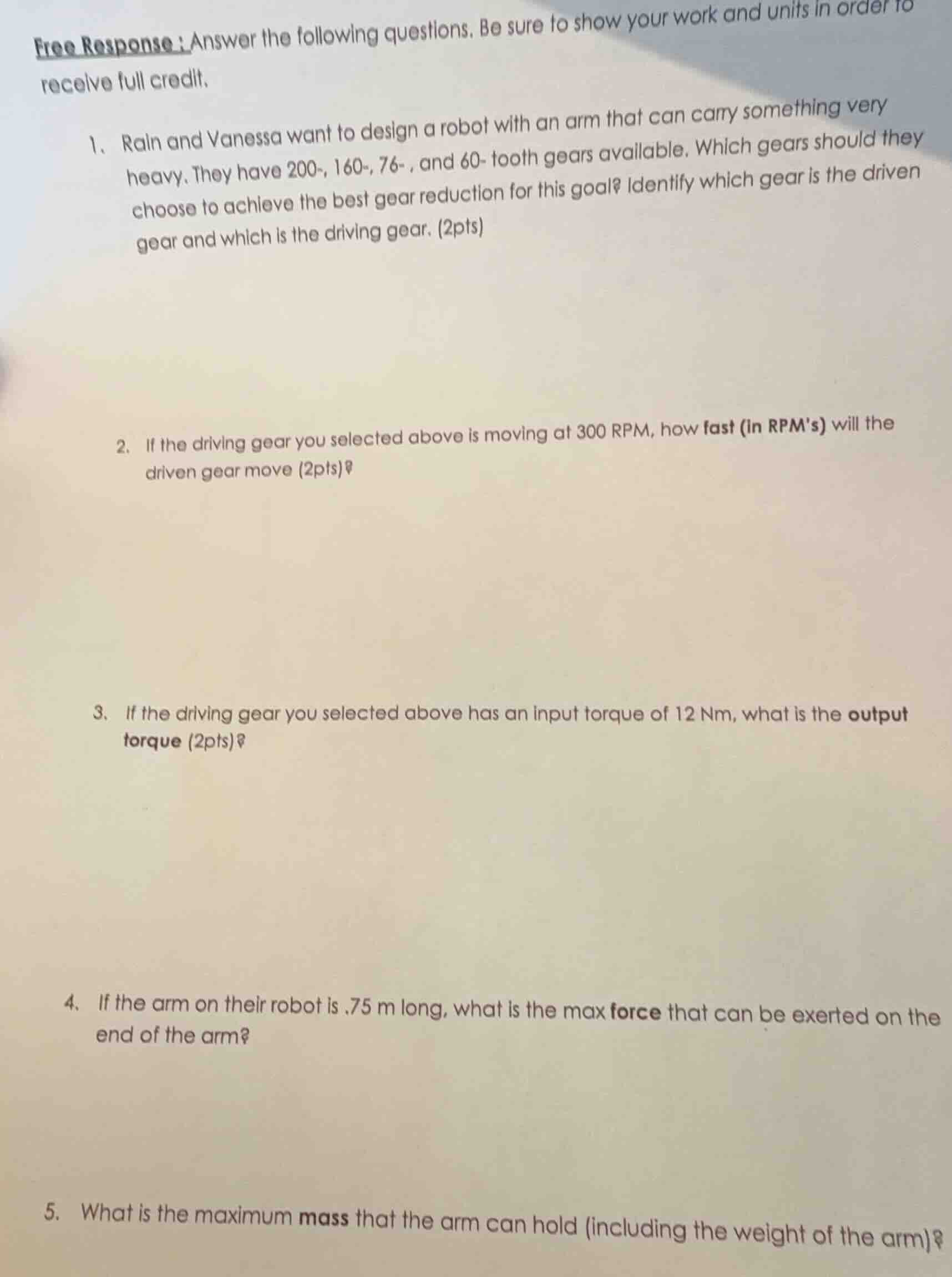
free response : answer the following questions. be sure to show your work and units in order to receive full credit.
- rain and vanessa want to design a robot with an arm that can carry something very heavy. they have 200-, 160-, 76-, and 60- tooth gears available. which gears should they choose to achieve the best gear reduction for this goal? identify which gear is the driven gear and which is the driving gear. (2pts)
- if the driving gear you selected above is moving at 300 rpm, how fast (in rpms) will the driven gear move (2pts)?
- if the driving gear you selected above has an input torque of 12 nm, what is the output torque (2pts)?
- if the arm on their robot is.75 m long, what is the max force that can be exerted on the end of the arm?
- what is the maximum mass that the arm can hold (including the weight of the arm)?
Step1: Max gear reduction selection
Gear reduction = $\frac{\text{Number of teeth on driven gear}}{\text{Number of teeth on driving gear}}$. To maximize reduction, use the smallest gear as driving (60-tooth) and largest as driven (200-tooth).
Step2: Calculate driven gear RPM
Gear ratio $GR = \frac{200}{60} = \frac{10}{3}$. Driven RPM = $\frac{\text{Driving RPM}}{GR} = \frac{300}{\frac{10}{3}} = 300 \times \frac{3}{10}$
Step3: Calculate output torque
Output torque = Input torque $\times GR = 12 \times \frac{10}{3}$
Step4: Calculate max arm force
Torque $\tau = F \times L \implies F = \frac{\tau}{L} = \frac{40}{0.75}$
Step5: Calculate max holdable mass
Force $F = m \times g$ (use $g=9.8\ \text{m/s}^2$), so $m = \frac{F}{g} = \frac{\frac{160}{3}}{9.8}$

Snap & solve any problem in the app
Get step-by-step solutions on Sovi AI
Photo-based solutions with guided steps
Explore more problems and detailed explanations
- Driving gear: 60-tooth gear; Driven gear: 200-tooth gear (this gives the largest gear reduction for maximum torque to lift heavy loads)
- $90$ RPM
- $40$ Nm
- $\frac{160}{3} \approx 53.33$ N
- $\approx 5.44$ kg