QUESTION IMAGE
Question
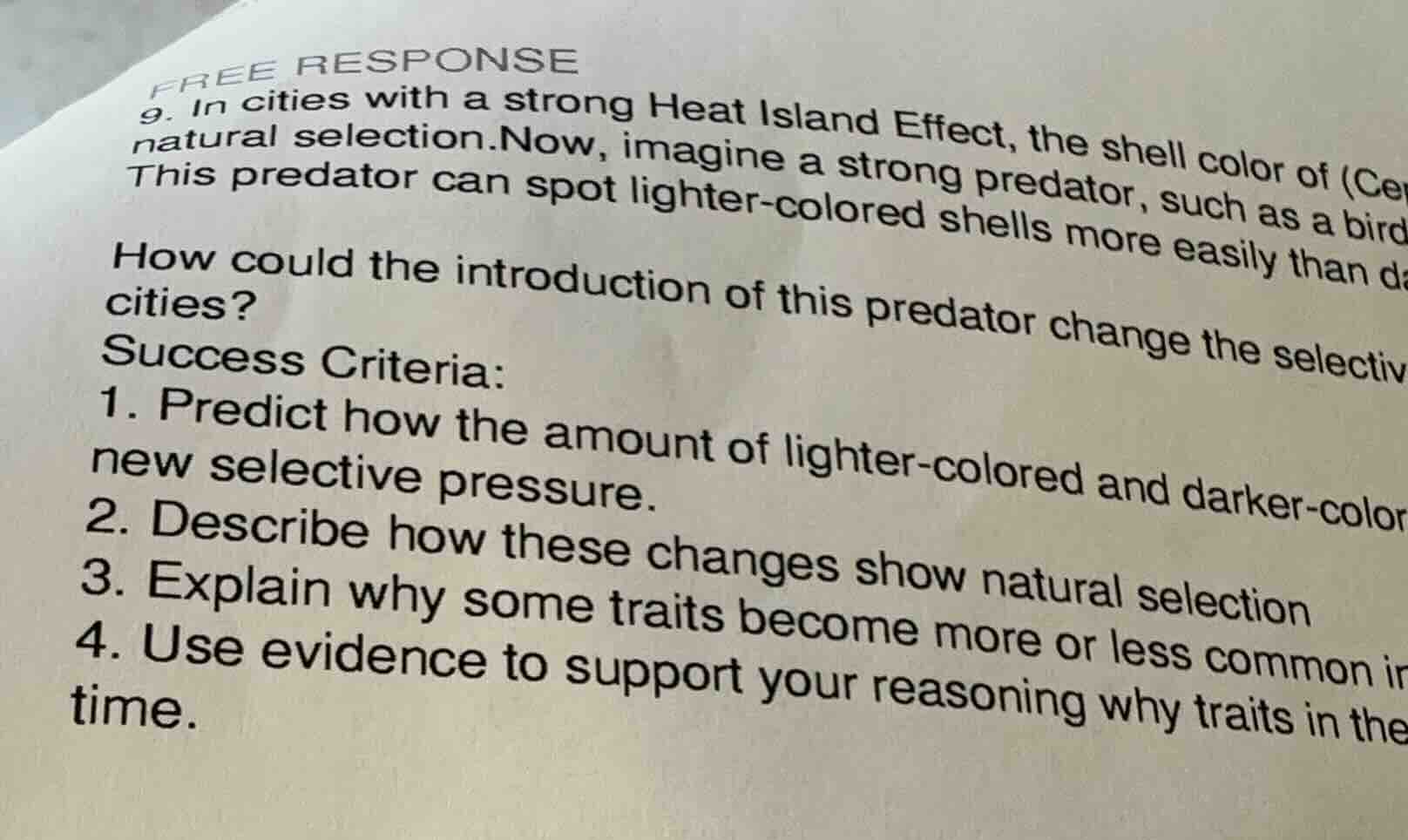
free response
- in cities with a strong heat island effect, the shell color of (cer natural selection.now, imagine a strong predator, such as a bird this predator can spot lighter - colored shells more easily than d
how could the introduction of this predator change the selectiv cities?
success criteria:
- predict how the amount of lighter - colored and darker - color new selective pressure.
- describe how these changes show natural selection
- explain why some traits become more or less common in
- use evidence to support your reasoning why traits in the time.
Brief Explanations
- Predict Trait Amounts: The predator spots lighter - colored shells more easily. So, lighter - colored individuals will be preyed upon more, leading to a decrease in their numbers. Darker - colored individuals, being harder for the predator to spot, will survive and reproduce more, increasing their numbers over time.
- Describe Natural Selection: Natural selection is the process where organisms with traits better suited to the environment (in this case, darker shell color which helps avoid the predator) are more likely to survive and pass on their genes. The introduction of the predator creates a new selective pressure. Lighter - colored shells are a disadvantage as they are more visible to the predator, while darker - colored shells are an advantage.
- Explain Trait Frequency: Traits (shell color) that increase an organism's fitness (ability to survive and reproduce) become more common. Since darker - colored shells help the organisms avoid the predator, they have higher fitness. Lighter - colored shells reduce fitness as they are more likely to be eaten, so these traits become less common.
- Evidence for Reasoning: The predator's ability to spot lighter - colored shells more easily is the key evidence. This differential predation (more on lighter - colored, less on darker - colored) will drive the change in trait frequencies. Over multiple generations, we would expect to see a shift in the population, with a greater proportion of darker - colored shells as the lighter - colored ones are selectively removed from the population.

Snap & solve any problem in the app
Get step-by-step solutions on Sovi AI
Photo-based solutions with guided steps
Explore more problems and detailed explanations
- Prediction of Trait Amounts: The number of lighter - colored shelled organisms will decrease, and the number of darker - colored shelled organisms will increase.
- Description of Natural Selection: The predator introduces a new selective pressure. Darker shell color is advantageous (helps avoid predation), so organisms with darker shells are more likely to survive and reproduce (natural selection). Lighter shell color is disadvantageous as it makes organisms more visible to the predator.
- Explanation of Trait Frequency: Traits that enhance survival (darker shell color) become more common because the organisms with these traits have higher fitness (more likely to survive and reproduce). Traits that reduce survival (lighter shell color) become less common as organisms with these traits are more likely to be preyed upon.
- Evidence for Reasoning: The predator can spot lighter - colored shells more easily, so lighter - colored organisms are at a higher risk of predation. This differential predation will lead to a change in the population's trait frequencies over time, with darker - colored traits becoming more prevalent.