QUESTION IMAGE
Question
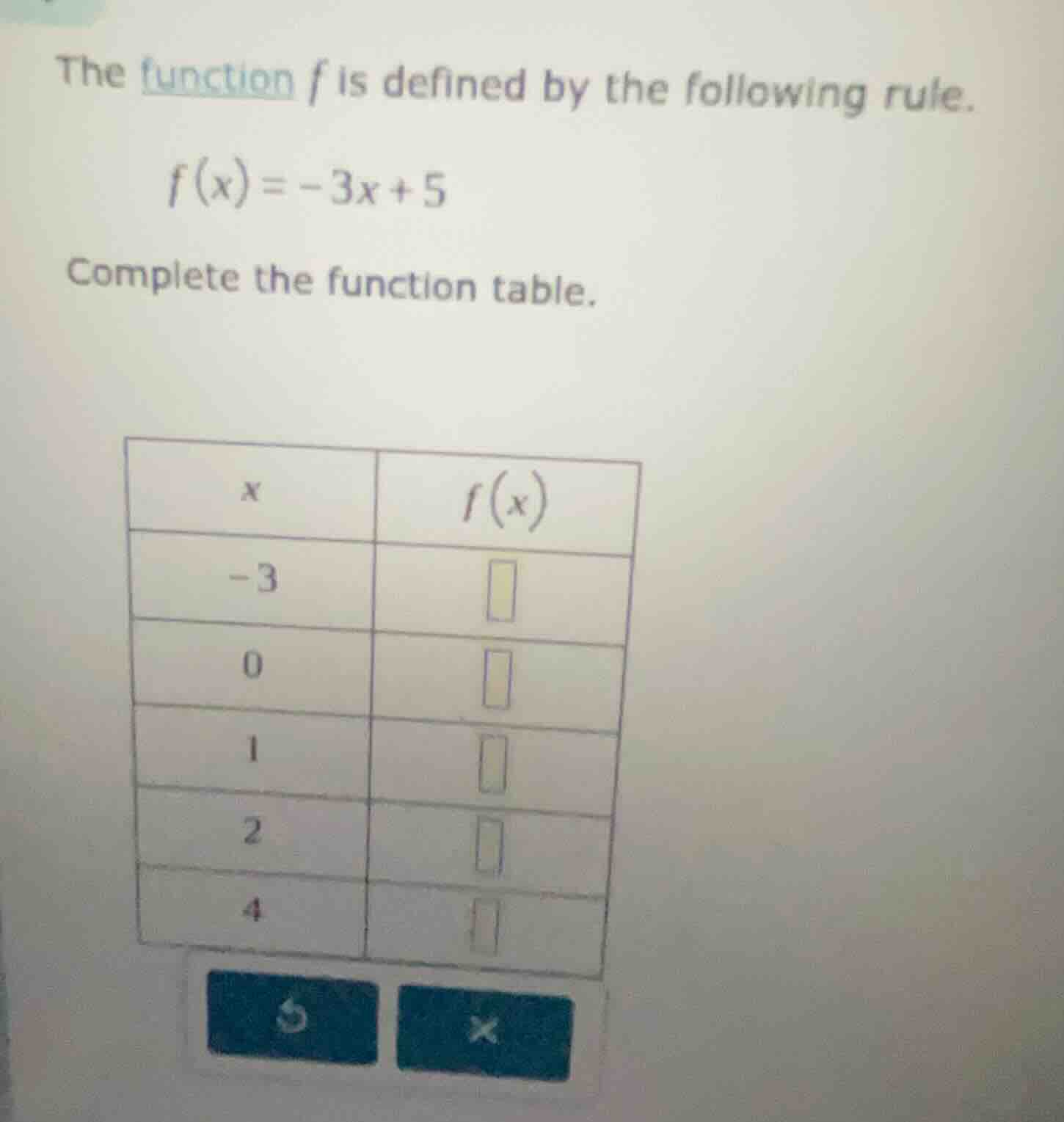
the function ( f ) is defined by the following rule. ( f(x) = -3x + 5 ) complete the function table.
| ( x ) | ( f(x) ) |
|---|---|
| ( 0 ) | ( square ) |
| ( 1 ) | ( square ) |
| ( 2 ) | ( square ) |
| ( 4 ) | ( square ) |
Step1: Substitute \( x = -3 \) into \( f(x) \)
\( f(-3) = -3\times(-3) + 5 = 9 + 5 = 14 \)
Step2: Substitute \( x = 0 \) into \( f(x) \)
\( f(0) = -3\times0 + 5 = 0 + 5 = 5 \)
Step3: Substitute \( x = 1 \) into \( f(x) \)
\( f(1) = -3\times1 + 5 = -3 + 5 = 2 \)
Step4: Substitute \( x = 2 \) into \( f(x) \)
\( f(2) = -3\times2 + 5 = -6 + 5 = -1 \)
Step5: Substitute \( x = 4 \) into \( f(x) \)
\( f(4) = -3\times4 + 5 = -12 + 5 = -7 \)

Snap & solve any problem in the app
Get step-by-step solutions on Sovi AI
Photo-based solutions with guided steps
Explore more problems and detailed explanations
When \( x = -3 \), \( f(x) = 14 \); when \( x = 0 \), \( f(x) = 5 \); when \( x = 1 \), \( f(x) = 2 \); when \( x = 2 \), \( f(x) = -1 \); when \( x = 4 \), \( f(x) = -7 \)
So the completed table (filling the blanks from top to bottom) is: \( 14 \), \( 5 \), \( 2 \), \( -1 \), \( -7 \)