QUESTION IMAGE
Question
function a and function b are linear functions.
function a
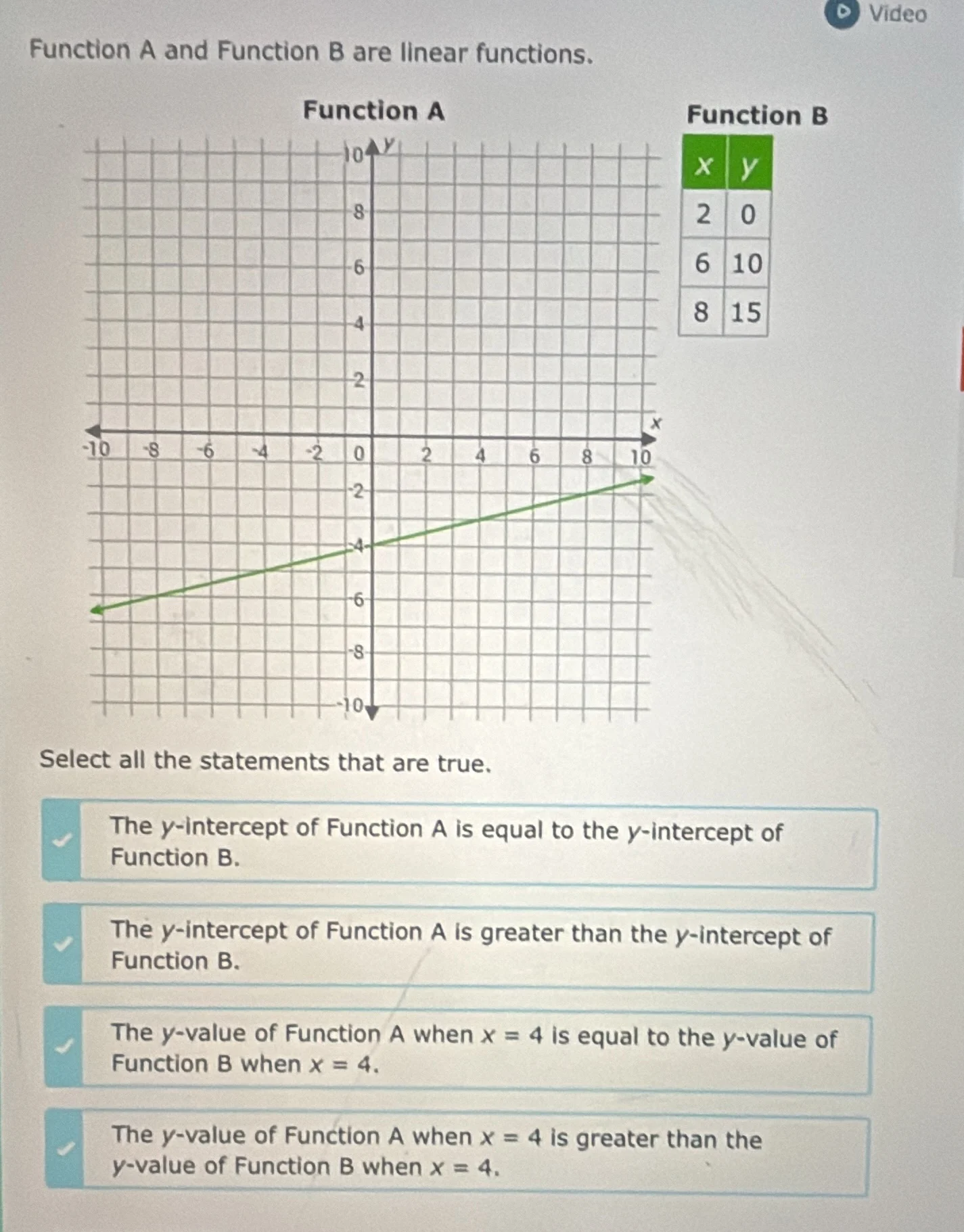
graph of function a with a line passing through (0, -4) and other points
function b
| x | y |
| 2 | 0 |
| 6 | 10 |
| 8 | 15 |
select all the statements that are true.
- the y-intercept of function a is equal to the y-intercept of function b.
- the y-intercept of function a is greater than the y-intercept of function b.
- the y-value of function a when x = 4 is equal to the y-value of function b when x = 4.
- the y-value of function a when x = 4 is greater than the y-value of function b when x = 4.
To solve this, we analyze each function:
Step 1: Find the equation of Function A
Function A is a line. From the graph, it passes through \((0, -4)\) (y - intercept) and we can find the slope. Let's take two points, say \((0, -4)\) and \((8, -2)\) (from the graph). The slope \(m_A=\frac{-2 - (-4)}{8 - 0}=\frac{2}{8}=\frac{1}{4}\). So the equation of Function A is \(y = \frac{1}{4}x-4\)
Step 2: Find the equation of Function B
Function B is a linear function. We have points \((2,0)\), \((6,10)\) and \((8,15)\). The slope \(m_B=\frac{10 - 0}{6 - 2}=\frac{10}{4}=\frac{5}{2}\). Using the point - slope form \(y - y_1=m(x - x_1)\) with \((x_1 = 2,y_1 = 0)\), we get \(y-0=\frac{5}{2}(x - 2)\), which simplifies to \(y=\frac{5}{2}x-5\)
Step 3: Analyze the y - intercepts
- The y - intercept of Function A is \(b_A=- 4\) (from \(y=\frac{1}{4}x - 4\))
- The y - intercept of Function B is \(b_B=-5\) (from \(y=\frac{5}{2}x-5\))
Since \(-4>-5\), the y - intercept of Function A is greater than the y - intercept of Function B.
Step 4: Analyze the y - values when \(x = 4\)
- For Function A: Substitute \(x = 4\) into \(y=\frac{1}{4}x-4\), we get \(y=\frac{1}{4}\times4-4=1 - 4=-3\)
- For Function B: Substitute \(x = 4\) into \(y=\frac{5}{2}x-5\), we get \(y=\frac{5}{2}\times4-5 = 10 - 5 = 5\)
Since \(-3<5\), the y - value of Function A when \(x = 4\) is less than the y - value of Function B when \(x = 4\)
Now let's analyze each statement:
- "The y - intercept of Function A is equal to the y - intercept of Function B."
Since \(b_A=-4\) and \(b_B = - 5\), this statement is false.
- "The y - intercept of Function A is greater than the y - intercept of Function B."
Since \(-4>-5\), this statement is true.
- "The y - value of Function A when \(x = 4\) is equal to the y - value of Function B when \(x = 4\)."
Since for \(x = 4\), \(y_A=-3\) and \(y_B = 5\), this statement is false.
- "The y - value of Function A when \(x = 4\) is greater than the y - value of Function B when \(x = 4\)."
Since \(-3<5\), this statement is false.
- For the y - intercept: The y - intercept of Function A is \(-4\) and of Function B is \(-5\). Since \(-4>-5\), the statement "The y - intercept of Function A is greater than the y - intercept of Function B" is true.
- For the \(x = 4\) case: When \(x = 4\), \(y\) - value of Function A is \(-3\) and of Function B is \(5\). So the statements about the equality or Function A's \(y\) - value being greater at \(x = 4\) are false. And the statement about equality of y - intercepts is false.

Snap & solve any problem in the app
Get step-by-step solutions on Sovi AI
Photo-based solutions with guided steps
Explore more problems and detailed explanations
The true statement is: The y - intercept of Function A is greater than the y - intercept of Function B.