QUESTION IMAGE
Question
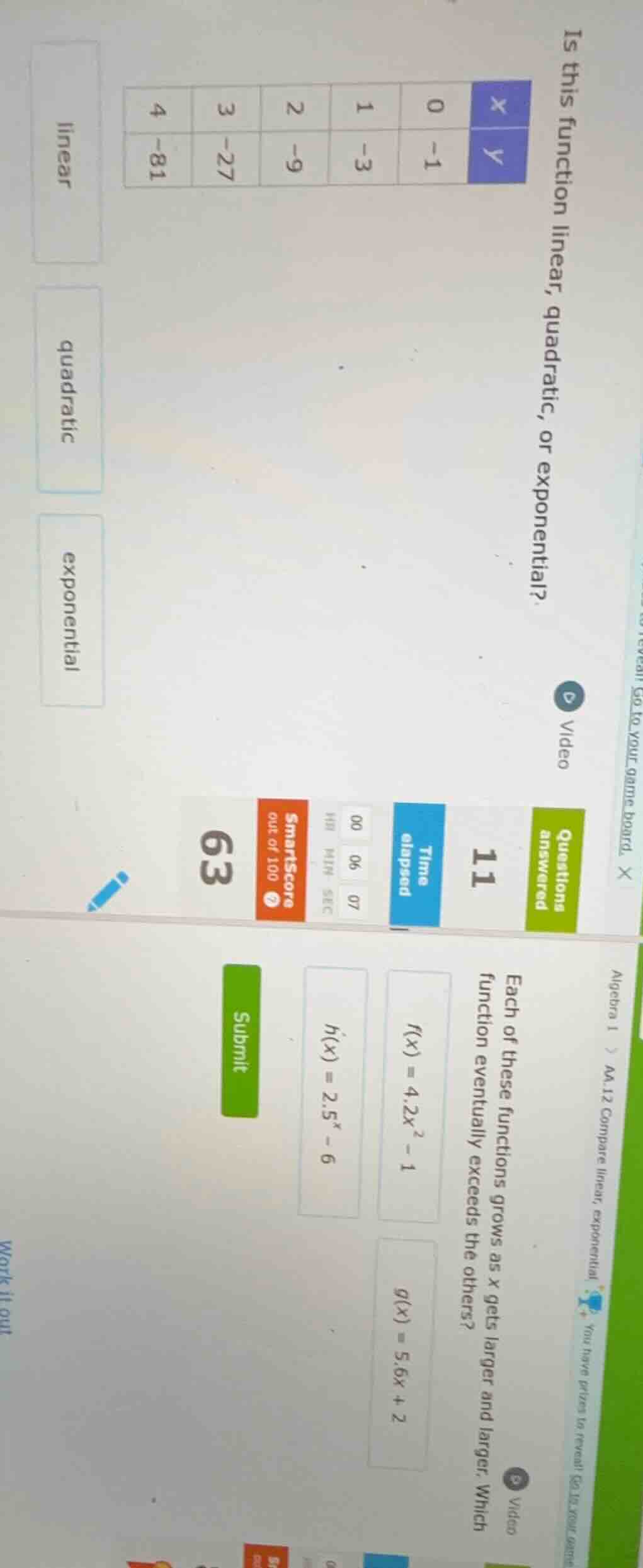
- is this function linear, quadratic, or exponential?
| x | y |
|---|---|
| 1 | -3 |
| 2 | -9 |
| 3 | -27 |
| 4 | -81 |
linear
quadratic
exponential
- each of these functions grows as x gets larger and larger. which function eventually exceeds the others?
$f(x)=4.2x^{2}-1$
$g(x)=5.6x + 2$
$h(x)=2.5^{x}-6$
submit
First Problem: Classify the function from the table
Step1: Check linear (constant Δy)
Calculate differences in y-values:
$\Delta y_1 = -3 - (-1) = -2$
$\Delta y_2 = -9 - (-3) = -6$
$\Delta y_3 = -27 - (-9) = -18$
$\Delta y_4 = -81 - (-27) = -54$
Differences are not constant, so not linear.
Step2: Check quadratic (constant 2nd Δy)
Calculate differences of the differences:
$\Delta^2 y_1 = -6 - (-2) = -4$
$\Delta^2 y_2 = -18 - (-6) = -12$
$\Delta^2 y_3 = -54 - (-18) = -36$
Second differences are not constant, so not quadratic.
Step3: Check exponential (constant ratio)
Calculate ratios of consecutive y-values:
$\frac{-3}{-1} = 3$
$\frac{-9}{-3} = 3$
$\frac{-27}{-9} = 3$
$\frac{-81}{-27} = 3$
Ratio is constant, so it is exponential.
Step1: Classify each function type
- $g(x)=5.6x+2$: linear (degree 1)
- $f(x)=4.2x^2-1$: quadratic (degree 2)
- $h(x)=2.5^x-6$: exponential (base >1)
Step2: Compare growth rates
For large positive $x$, exponential functions grow faster than polynomial functions (linear/quadratic), as their growth is multiplicative rather than additive/polynomial.

Snap & solve any problem in the app
Get step-by-step solutions on Sovi AI
Photo-based solutions with guided steps
Explore more problems and detailed explanations
exponential
---