QUESTION IMAGE
Question
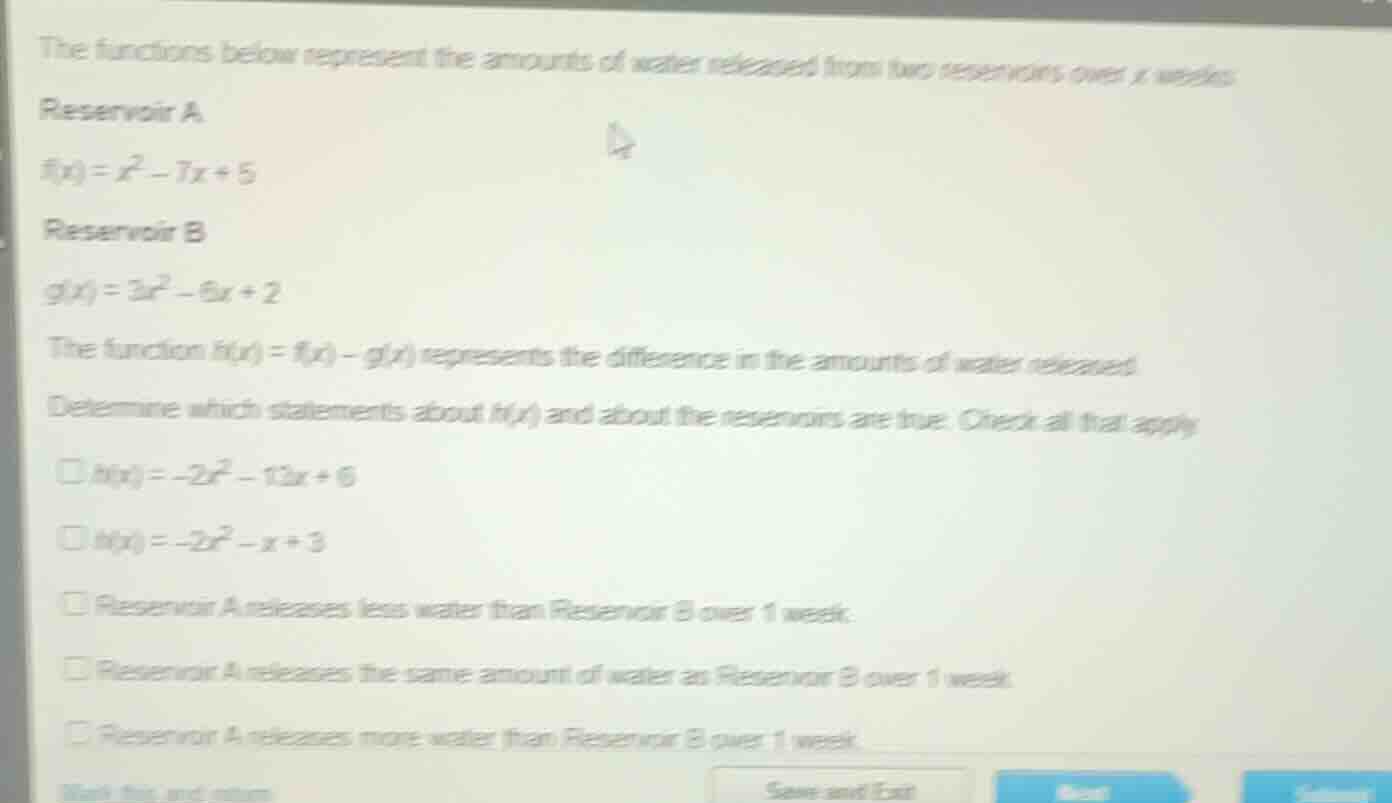
the functions below represent the amounts of water released from two reservoirs over x weeks
reservoir a
$f(x) = x^2 - 7x + 5$
reservoir b
$g(x) = 3x^2 - 6x + 2$
the function $h(x) = f(x) - g(x)$ represents the difference in the amounts of water released.
determine which statements about $h(x)$ and about the reservoirs are true. check all that apply
$\square$ $h(x) = -2x^2 - 13x + 6$
$\square$ $h(x) = -2x^2 - x + 3$
$\square$ reservoir a releases less water than reservoir b over 1 week.
$\square$ reservoir a releases the same amount of water as reservoir b over 1 week.
$\square$ reservoir a releases more water than reservoir b over 1 week.
Step1: Find h(x) = f(x) - g(x)
Substitute \( f(x) = x^2 - 7x + 5 \) and \( g(x) = 3x^2 - 6x + 2 \) into \( h(x) \):
\( h(x)=(x^2 - 7x + 5)-(3x^2 - 6x + 2) \)
Remove parentheses: \( h(x)=x^2 - 7x + 5 - 3x^2 + 6x - 2 \)
Combine like terms: \( h(x)=(x^2 - 3x^2)+(-7x + 6x)+(5 - 2) \)
\( h(x)=-2x^2 - x + 3 \)
Step2: Evaluate f(1) and g(1)
For \( f(1) \): \( f(1)=1^2 - 7(1)+5 = 1 - 7 + 5 = -1 \)
For \( g(1) \): \( g(1)=3(1)^2 - 6(1)+2 = 3 - 6 + 2 = -1 \) Wait, no, wait: \( 3 - 6 + 2=-1? \) Wait, 3 - 6 is -3, plus 2 is -1? Wait, no, let's recalculate:
Wait, \( f(1)=1 - 7 + 5 = -1 \)? Wait, 1 -7 is -6, plus 5 is -1. \( g(1)=3 - 6 + 2 = -1 \)? Wait, that would mean they are equal? But wait, maybe I made a mistake. Wait, no, let's check again. Wait, \( f(x)=x^2 -7x +5 \), so \( f(1)=1 -7 +5 = -1 \). \( g(x)=3x^2 -6x +2 \), so \( g(1)=3 -6 +2 = -1 \). Wait, but that would mean \( f(1)=g(1) \), so Reservoir A and B release the same amount over 1 week? But wait, let's check the h(x) at x=1: \( h(1)=-2(1)^2 -1 +3 = -2 -1 +3 = 0 \). So \( h(1)=f(1)-g(1)=0 \), so \( f(1)=g(1) \). Wait, but let's check the first two options. The first option is \( h(x)=-2x^2 -13x +6 \), which is wrong. The second option is \( h(x)=-2x^2 -x +3 \), which is correct from step1. Then, for the reservoir questions:
Wait, wait, maybe I miscalculated f(1) and g(1). Wait, \( f(1)=1 -7 +5 = -1 \)? That seems odd, but mathematically, yes. \( g(1)=3 -6 +2 = -1 \). So \( f(1)=g(1) \), so Reservoir A releases the same amount as B over 1 week. Wait, but let's check again:
Wait, \( f(1)=1^2 -7(1)+5 = 1 -7 +5 = -1 \). \( g(1)=3(1)^2 -6(1)+2 = 3 -6 +2 = -1 \). So yes, they are equal. So the correct statements are:
- \( h(x)=-2x^2 -x +3 \) (second option)
- Reservoir A releases the same amount of water as Reservoir B over 1 week (fourth option)
Wait, but let's confirm the h(x) calculation again. \( f(x)-g(x)=(x^2 -7x +5)-(3x^2 -6x +2)=x^2 -7x +5 -3x^2 +6x -2 = -2x^2 -x +3 \). Correct. So the first option is wrong, second is correct. Then, for x=1, f(1)=1 -7 +5=-1, g(1)=3 -6 +2=-1, so they are equal. So the statement "Reservoir A releases the same amount of water as Reservoir B over 1 week" is correct. The third statement says A releases less, which is wrong. The fourth says same, which is correct. The fifth says more, which is wrong.

Snap & solve any problem in the app
Get step-by-step solutions on Sovi AI
Photo-based solutions with guided steps
Explore more problems and detailed explanations
- \( h(x) = -2x^2 - x + 3 \) (the second option)
- "Reservoir A releases the same amount of water as Reservoir B over 1 week" (the fourth option)