QUESTION IMAGE
Question
functions and systems
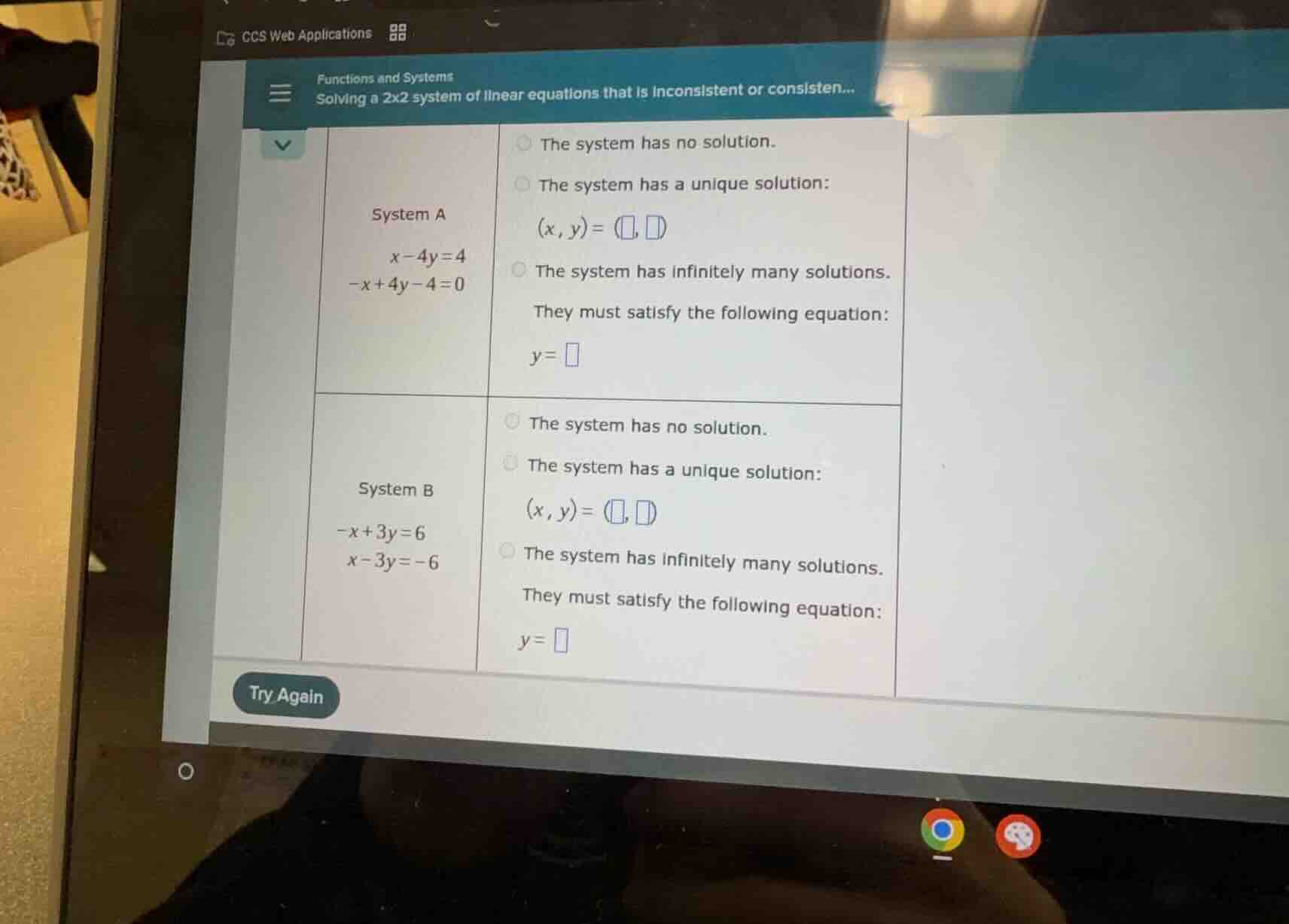
solving a 2x2 system of linear equations that is inconsistent or consisten...
system a
x - 4y = 4
-x + 4y - 4 = 0
the system has no solution.
the system has a unique solution:
(x, y) = (□, □)
the system has infinitely many solutions.
they must satisfy the following equation:
y = □
system b
-x + 3y = 6
x - 3y = -6
the system has no solution.
the system has a unique solution:
(x, y) = (□, □)
the system has infinitely many solutions.
they must satisfy the following equation:
y = □
try again
System A
Step1: Rewrite the second equation
Rewrite \(-x + 4y - 4 = 0\) as \(x - 4y = -4\).
Step2: Compare with the first equation
The first equation is \(x - 4y = 4\). Now we have two equations: \(x - 4y = 4\) and \(x - 4y = -4\). These are parallel lines (same slope, different intercepts), so there's no solution.
Step1: Add the two equations
Add \(-x + 3y = 6\) and \(x - 3y = -6\) together: \((-x + x)+(3y - 3y)=6 + (-6)\).
Step2: Simplify the result
Simplifying gives \(0 = 0\), which means the two equations are equivalent (the same line), so there are infinitely many solutions. Now, solve one of the equations for \(y\). Let's take \(-x + 3y = 6\), add \(x\) to both sides: \(3y = x + 6\), then divide by 3: \(y=\frac{x + 6}{3}=\frac{1}{3}x + 2\). But we can also express \(y\) from the other equation \(x - 3y = -6\): subtract \(x\) from both sides: \(-3y=-x - 6\), divide by \(-3\): \(y=\frac{1}{3}x + 2\). Alternatively, we can solve for \(y\) in terms that shows the relationship. From \(-x + 3y = 6\), we can write \(3y=x + 6\), so \(y=\frac{x + 6}{3}\), but if we want to express \(y\) such that it's clear, or we can note that the equations are dependent. Let's solve \(-x + 3y = 6\) for \(y\): \(3y=x + 6\) so \(y=\frac{x}{3}+2\). But since the system has infinitely many solutions, we can also use one of the equations to express \(y\). Let's take the first equation \(-x + 3y = 6\), solve for \(y\):
\(3y=x + 6\)
\(y=\frac{x + 6}{3}\) or we can also write from the second equation \(x - 3y=-6\) as \(x=3y - 6\), but the question asks for \(y=\) something. Wait, actually, since the two equations are the same line, we can solve one of them for \(y\). Let's take \(-x + 3y = 6\), add \(x\) to both sides: \(3y=x + 6\), divide by 3: \(y=\frac{1}{3}x + 2\). But maybe a simpler way: from \(-x + 3y = 6\), we can write \(3y=x + 6\), so \(y=\frac{x + 6}{3}\), but if we want to express \(y\) in terms that can be written as, for example, solving \(x - 3y=-6\) for \(y\): \(x + 6 = 3y\), so \(y=\frac{x + 6}{3}\) or \(y=\frac{1}{3}x + 2\). However, another way: since the two equations are dependent, we can use one equation to solve for \(y\). Let's take the first equation: \(-x + 3y = 6\), then \(3y=x + 6\), so \(y=\frac{x + 6}{3}\). But maybe the problem expects us to see that the two equations are the same, so we can solve one for \(y\). Let's do that:
From \(-x + 3y = 6\):
- Add \(x\) to both sides: \(3y=x + 6\)
- Divide by 3: \(y=\frac{x}{3}+2\)
But we can also write \(y\) in terms that shows the relationship. Alternatively, since the system has infinitely many solutions, we can express \(y\) from one of the equations. Let's take the second equation \(x - 3y=-6\), solve for \(y\):
\(x + 6 = 3y\)
\(y=\frac{x + 6}{3}\)
Which is the same as \(y=\frac{1}{3}x + 2\).

Snap & solve any problem in the app
Get step-by-step solutions on Sovi AI
Photo-based solutions with guided steps
Explore more problems and detailed explanations
The system has no solution.