QUESTION IMAGE
Question
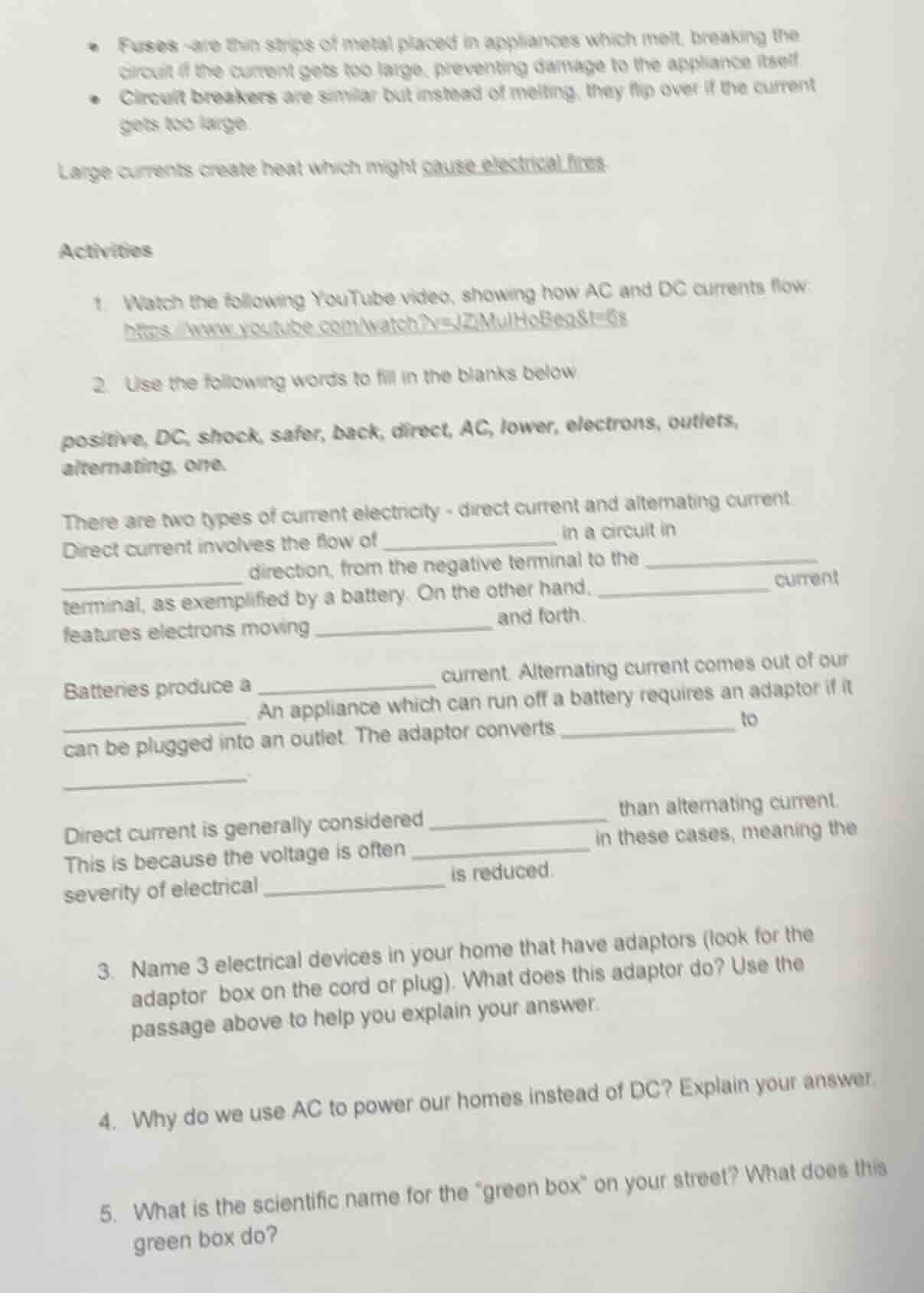
- fuses -are thin strips of metal placed in appliances which melt, breaking the circuit if the current gets too large, preventing damage to the appliance itself.• circuit breakers are similar but instead of melting, they flip over if the current gets too large.large currents create heat which might cause electrical fires.activities1. watch the following youtube video, showing how ac and dc currents flow:https://www.youtube.com/watch?v=j2mulhobeq&t=6s2. use the following words to fill in the blanks belowpositive, dc, shock, safer, back, direct, ac, lower, electrons, outlets, alternating, one.there are two types of current electricity - direct current and alternating current.direct current involves the flow of _____________ in a circuit in___________ direction, from the negative terminal to the ___________terminal, as exemplified by a battery. on the other hand, ___________ currentfeatures electrons moving ___________ and forth.batteries produce a ___________ current. alternating current comes out of our___________. an appliance which can run off a battery requires an adaptor if itcan be plugged into an outlet. the adaptor converts ___________ to___________.direct current is generally considered ___________ than alternating current.this is because the voltage is often ___________ in these cases, meaning theseverity of electrical _____________ is reduced.3. name 3 electrical devices in your home that have adaptors (look for the adaptor box on the cord or plug). what does this adaptor do? use the passage above to help you explain your answer.4. why do we use ac to power our homes instead of dc? explain your answer.5. what is the scientific name for the \green box\ on your street? what does this green box do?
For Activity 2:
- Direct current relies on electron flow in a fixed path from negative to positive terminals, matching battery behavior.
- Alternating current (AC) has electrons that switch direction, and home outlets supply AC, while batteries supply direct current (DC). Adaptors convert the AC from outlets to DC for battery-powered devices.
- DC is safer typically due to lower voltage, which reduces the severity of electrical shock.
For Activity 3:
Common home devices with adaptors include laptop chargers, phone chargers, and wireless router power supplies. These adaptors convert the alternating current (AC) from home outlets into direct current (DC), which is the type of current these battery-compatible devices require to operate.
For Activity 4:
AC is used for home power because it is much easier to step its voltage up or down using transformers. This allows efficient long-distance transmission of electricity at high voltages (reducing energy loss), followed by voltage reduction to safe, usable levels for home appliances. DC cannot be easily transformed in this way, making it less practical for large-scale power distribution.
For Activity 5:
The scientific name for the "green box" on the street is a distribution transformer (or sometimes a pad-mounted transformer). Its main function is to step down the high-voltage electricity transmitted from power lines to a lower, safe voltage level (typically the standard household voltage, e.g., 120/240V in the US) that can be used by homes and businesses.

Snap & solve any problem in the app
Get step-by-step solutions on Sovi AI
Photo-based solutions with guided steps
Explore more problems and detailed explanations
Activity 2 Blanks (in order):
- electrons
- one
- positive
- AC
- back
- DC
- outlets
- AC
- DC
- safer
- lower
- shock
Activity 3:
- Devices: Laptop charger, smartphone charger, wireless router power supply
- Adaptor function: Converts AC from home outlets to DC for the device to use.
Activity 4:
AC is used for home power because its voltage can be easily adjusted with transformers, enabling efficient long-distance transmission with minimal energy loss, then stepped down to safe levels for household use.
Activity 5:
- Scientific name: Distribution transformer (pad-mounted transformer)
- Function: Steps down high-voltage power from transmission lines to safe, usable low-voltage electricity for homes and businesses.