QUESTION IMAGE
Question
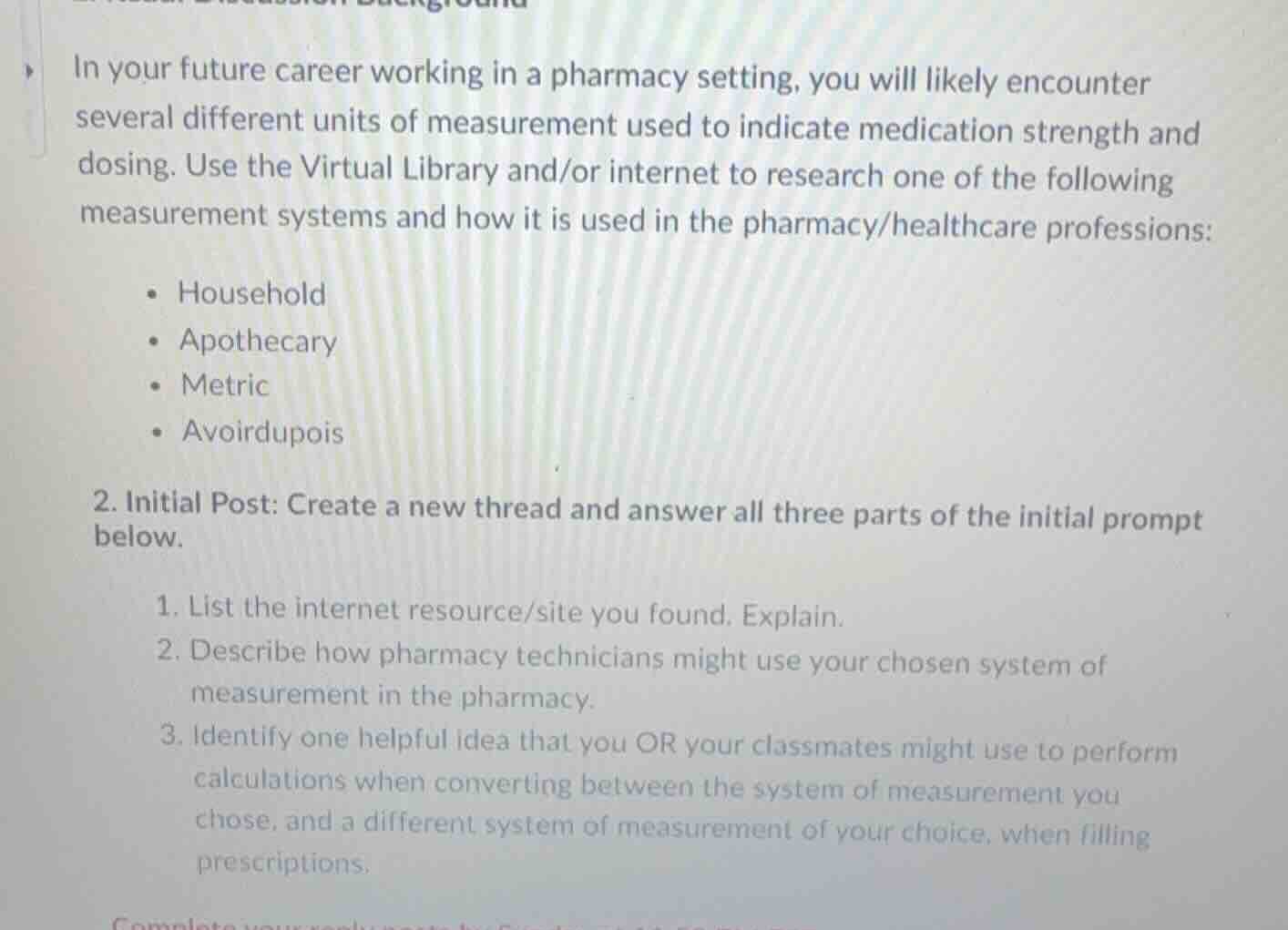
in your future career working in a pharmacy setting, you will likely encounter several different units of measurement used to indicate medication strength and dosing. use the virtual library and/or internet to research one of the following measurement systems and how it is used in the pharmacy/healthcare professions: - household - apothecary - metric - avoirdupois 2. initial post: create a new thread and answer all three parts of the initial prompt below. 1. list the internet resource/site you found. explain. 2. describe how pharmacy technicians might use your chosen system of measurement in the pharmacy. 3. identify one helpful idea that you or your classmates might use to perform calculations when converting between the system of measurement you chose, and a different system of measurement of your choice, when filling prescriptions.
To answer this, we'll choose the Metric system (a common choice for pharmacy due to its standardization) and address each part:
1. Internet Resource
A useful resource is the U.S. National Library of Medicine (NLM) (https://www.nlm.nih.gov/). It provides detailed information on pharmaceutical measurements, including the Metric system’s use in dosing, compounding, and labeling. The NLM is reliable for healthcare - related measurement standards, as it is a trusted source for medical and pharmacy - specific knowledge.
2. Use of the Metric System by Pharmacy Technicians
Pharmacy technicians use the Metric system in multiple ways:
- Dosing Medications: For liquid medications, volume is measured in milliliters ($mL$). For example, a prescription for 5 $mL$ of a liquid antibiotic is measured using metric - calibrated syringes or graduated cylinders. For solid medications (like tablets or capsules), mass is in milligrams ($mg$) or grams ($g$). A 500 $mg$ tablet of amoxicillin is dosed based on metric mass units.
- Compounding: When preparing custom medications (e.g., topical creams or oral suspensions), technicians use metric units to measure active ingredients (e.g., 1 $g$ of a steroid powder) and diluents (e.g., 100 $mL$ of a base for a cream).
- Labeling: Medication labels list strength (e.g., “200 $mg$/5 $mL$” for a liquid) and volume/mass of the dispensed product (e.g., “100 $mL$” of a suspension) using metric units, ensuring clarity for pharmacists, technicians, and patients.
3. Conversion Idea (Metric ↔ Household)
When converting between Metric (e.g., milliliters) and Household (e.g., teaspoons) systems (a common need for patient - friendly instructions), a helpful idea is to use memorized conversion factors and verify with a conversion chart. For example, 1 teaspoon ($tsp$) = 5 $mL$ (this is a standard conversion). When a prescription is in $mL$ (e.g., 15 $mL$ of a syrup) and the patient needs to take it using a household teaspoon, the technician can calculate: $15\ mL\div5\ mL/tsp = 3\ tsp$. To avoid errors, always cross - check with a conversion table (e.g., from a pharmacy reference guide) to ensure accuracy, as incorrect conversions can lead to under - or over - dosing.
This structure addresses all three parts of the initial prompt, using the Metric system as the chosen measurement system.

Snap & solve any problem in the app
Get step-by-step solutions on Sovi AI
Photo-based solutions with guided steps
Explore more problems and detailed explanations
To answer this, we'll choose the Metric system (a common choice for pharmacy due to its standardization) and address each part:
1. Internet Resource
A useful resource is the U.S. National Library of Medicine (NLM) (https://www.nlm.nih.gov/). It provides detailed information on pharmaceutical measurements, including the Metric system’s use in dosing, compounding, and labeling. The NLM is reliable for healthcare - related measurement standards, as it is a trusted source for medical and pharmacy - specific knowledge.
2. Use of the Metric System by Pharmacy Technicians
Pharmacy technicians use the Metric system in multiple ways:
- Dosing Medications: For liquid medications, volume is measured in milliliters ($mL$). For example, a prescription for 5 $mL$ of a liquid antibiotic is measured using metric - calibrated syringes or graduated cylinders. For solid medications (like tablets or capsules), mass is in milligrams ($mg$) or grams ($g$). A 500 $mg$ tablet of amoxicillin is dosed based on metric mass units.
- Compounding: When preparing custom medications (e.g., topical creams or oral suspensions), technicians use metric units to measure active ingredients (e.g., 1 $g$ of a steroid powder) and diluents (e.g., 100 $mL$ of a base for a cream).
- Labeling: Medication labels list strength (e.g., “200 $mg$/5 $mL$” for a liquid) and volume/mass of the dispensed product (e.g., “100 $mL$” of a suspension) using metric units, ensuring clarity for pharmacists, technicians, and patients.
3. Conversion Idea (Metric ↔ Household)
When converting between Metric (e.g., milliliters) and Household (e.g., teaspoons) systems (a common need for patient - friendly instructions), a helpful idea is to use memorized conversion factors and verify with a conversion chart. For example, 1 teaspoon ($tsp$) = 5 $mL$ (this is a standard conversion). When a prescription is in $mL$ (e.g., 15 $mL$ of a syrup) and the patient needs to take it using a household teaspoon, the technician can calculate: $15\ mL\div5\ mL/tsp = 3\ tsp$. To avoid errors, always cross - check with a conversion table (e.g., from a pharmacy reference guide) to ensure accuracy, as incorrect conversions can lead to under - or over - dosing.
This structure addresses all three parts of the initial prompt, using the Metric system as the chosen measurement system.