QUESTION IMAGE
Question
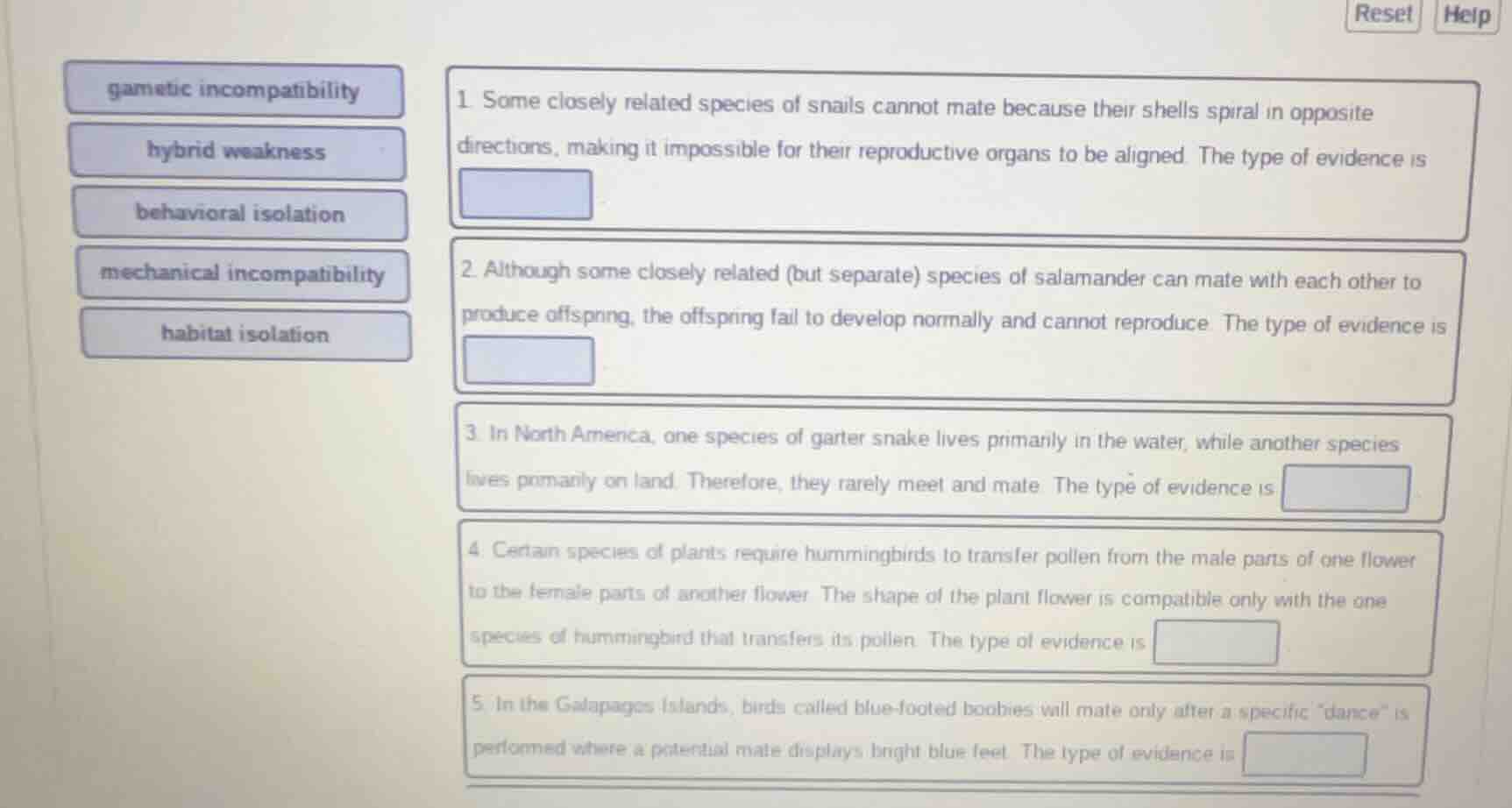
gametic incompatibility
hybrid weakness
behavioral isolation
mechanical incompatibility
habitat isolation
- some closely related species of snails cannot mate because their shells spiral in opposite directions, making it impossible for their reproductive organs to be aligned. the type of evidence is
- although some closely related (but separate) species of salamander can mate with each other to produce offspring, the offspring fail to develop normally and cannot reproduce. the type of evidence is
- in north america, one species of garter snake lives primarily in the water, while another species lives primarily on land. therefore, they rarely meet and mate. the type of evidence is
- certain species of plants require hummingbirds to transfer pollen from the male parts of one flower to the female parts of another flower. the shape of the plant flower is compatible only with the one species of hummingbird that transfers its pollen. the type of evidence is
- in the galapagos islands, birds called blue - footed boobies will mate only after a specific \dance\ is performed where a potential mate displays bright blue feet. the type of evidence is
Brief Explanations
- Snails with oppositely spiraled shells have physically mismatched reproductive organs, which is a mechanical barrier to mating.
- The offspring of salamander species fail to develop and reproduce, which is a post-zygotic weakness of hybrids.
- The two garter snake species live in different habitats (water vs. land), so they rarely encounter each other to mate.
- The plant's flower shape is physically matched only to its specific hummingbird pollinator, creating a mechanical barrier for cross-species pollination.
- Blue-footed boobies require a specific mating display (dance) to mate, which is a behavioral barrier to mating with other species.

Snap & solve any problem in the app
Get step-by-step solutions on Sovi AI
Photo-based solutions with guided steps
Explore more problems and detailed explanations
- mechanical incompatibility
- hybrid weakness
- habitat isolation
- mechanical incompatibility
- behavioral isolation