QUESTION IMAGE
Question
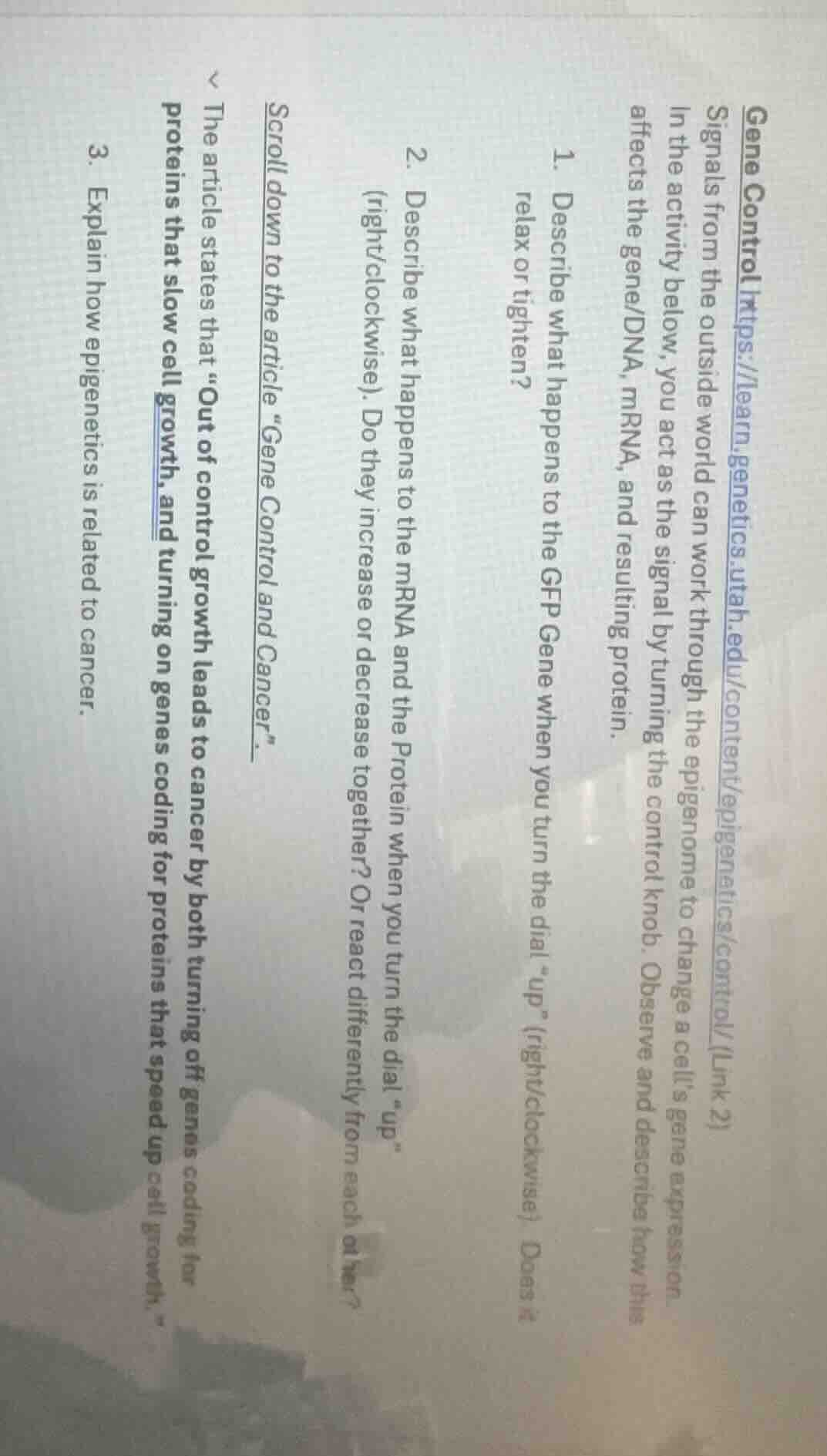
gene control https://learn.genetics.utah.edu/content/epigenetics/control/ (link 2)signals from the outside world can work through the epigenome to change a cells gene expression.in the activity below, you act as the signal by turning the control knob. observe and describe how this affects the gene/dna, mrna, and resulting protein.1. describe what happens to the gfp gene when you turn the dial \up\ (right/clockwise). does it relax or tighten?2. describe what happens to the mrna and the protein when you turn the dial \up\ (right/clockwise). do they increase or decrease together? or react differently from each other?scroll down to the article \gene control and cancer\.✓ the article states that \out of control growth leads to cancer by both turning off genes coding for proteins that slow cell growth, and turning on genes coding for proteins that speed up cell growth.\3. explain how epigenetics is related to cancer.
- When the dial is turned "up" (right/clockwise), the GFP gene relaxes. This loosens the chromatin structure, making the gene more accessible to transcription machinery, which promotes gene expression.
- Turning the dial "up" (right/clockwise) causes both mRNA and protein levels to increase, and they change in tandem: as mRNA production rises, the resulting protein production also rises proportionally, since mRNA is the template for protein synthesis.
- Epigenetics involves heritable changes in gene expression without altering the DNA sequence. In cancer, epigenetic modifications (like DNA methylation or histone modifications) can silence tumor suppressor genes (which make proteins that slow cell growth) and activate oncogenes (which make proteins that speed up cell growth). This unregulated cell growth leads to the formation and progression of cancer, as the normal controls on cell division are disrupted.

Snap & solve any problem in the app
Get step-by-step solutions on Sovi AI
Photo-based solutions with guided steps
Explore more problems and detailed explanations
- The GFP gene relaxes.
- Both mRNA and protein increase, and they rise together (correspondingly).
- Epigenetic changes silence tumor suppressor genes (that slow cell growth) and activate oncogenes (that speed cell growth), leading to unregulated cell growth that causes cancer.