QUESTION IMAGE
Question
genetic drift
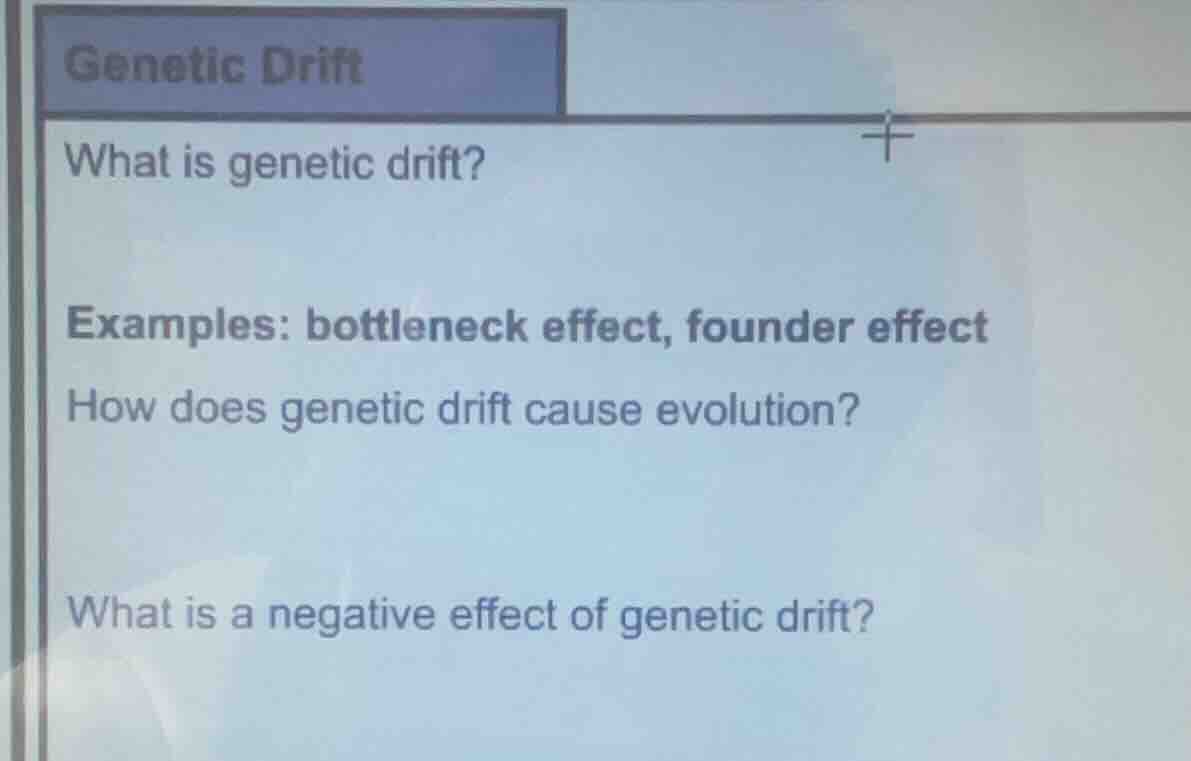
what is genetic drift?
examples: bottleneck effect, founder effect
how does genetic drift cause evolution?
what is a negative effect of genetic drift?
1. What is genetic drift?
Genetic drift is a mechanism of evolution (change in allele frequencies in a population over generations) due to random sampling of organisms. In small populations, chance events (like random deaths, non - reproduction) can cause significant changes in allele frequencies, independent of natural selection.
Evolution is defined as a change in allele frequencies in a population over time. Genetic drift causes random changes in allele frequencies. For example, in a small population, if a few individuals with a particular allele happen to die (due to a random event like a storm) or fail to reproduce, the frequency of that allele in the population will change. Over generations, these random changes can accumulate, leading to a change in the genetic composition of the population, thus causing evolution.
One negative effect is the loss of genetic variation. In a small population, genetic drift can cause alleles (including potentially beneficial ones) to be lost from the population. For example, in a small population of birds, if a rare allele that confers resistance to a new disease is present in only a few individuals, and those individuals are randomly killed (e.g., by a predator), the allele may be lost. This reduces the population's genetic diversity, making it more vulnerable to environmental changes (like new diseases, climate change) as there is less genetic variation to draw on for adaptation. Also, the bottleneck effect (a type of genetic drift) can lead to inbreeding depression. After a population bottleneck (a sharp reduction in population size), the remaining individuals are likely to be more closely related. Inbreeding among them can increase the frequency of harmful recessive alleles, leading to reduced fitness (e.g., higher rates of genetic disorders, lower reproductive success).

Snap & solve any problem in the app
Get step-by-step solutions on Sovi AI
Photo-based solutions with guided steps
Explore more problems and detailed explanations
Genetic drift is the random change in allele frequencies in a population over generations, occurring due to chance events (more impactful in small populations), and is a mechanism of evolution.