QUESTION IMAGE
Question
geometry exam - unit 7 name:
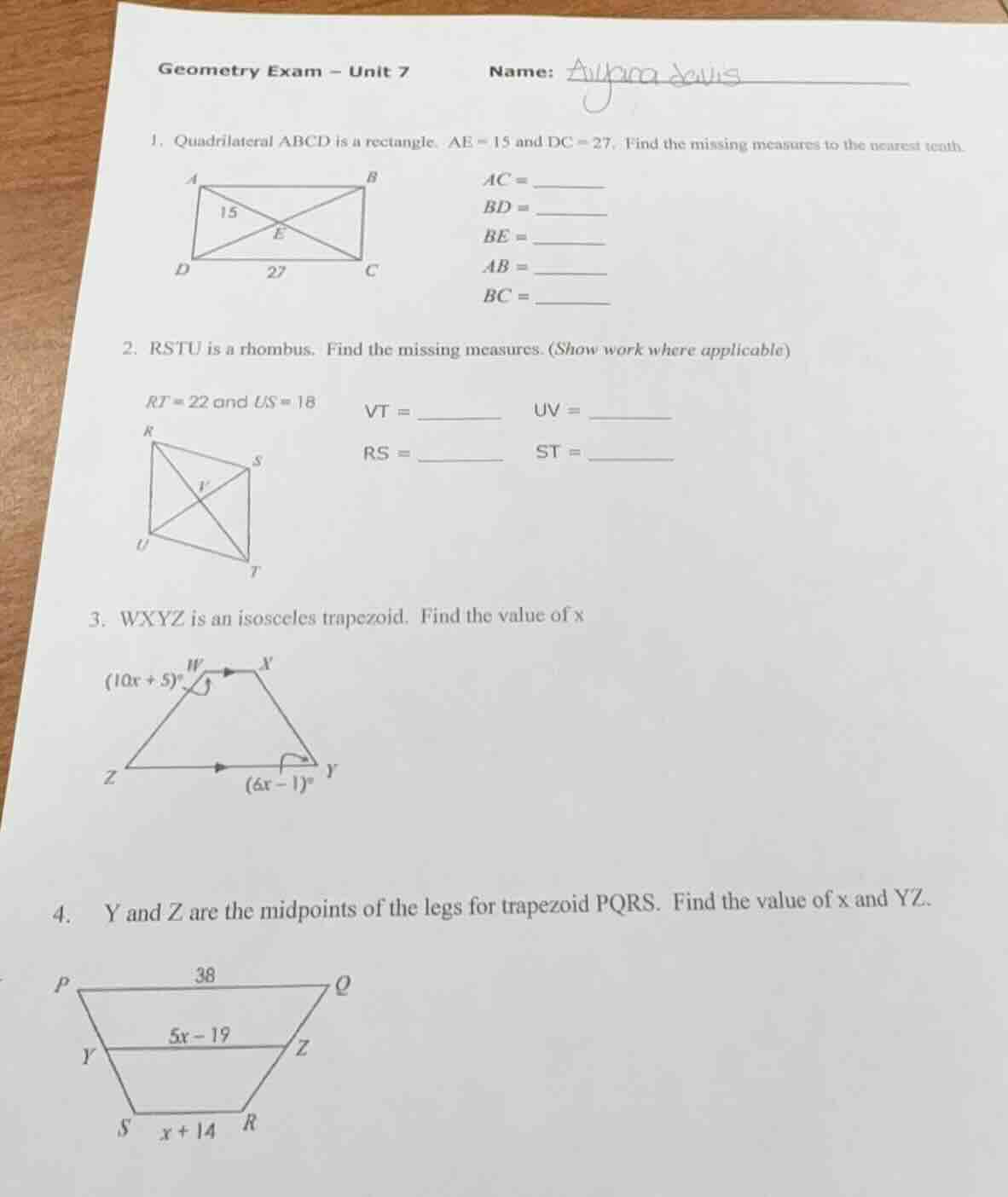
- quadrilateral abcd is a rectangle. ae = 15 and dc = 27. find the missing measures to the nearest tenth.
ac =
bd =
be =
ab =
bc =
- rstu is a rhombus. find the missing measures. (show work where applicable)
rt = 22 and us = 18
vt =
uv =
rs =
st =
- wxyz is an isosceles trapezoid. find the value of x
- y and z are the midpoints of the legs for trapezoid pqrs. find the value of x and yz.
Problem 1: Rectangle ABCD
Step 1: Diagonals of a rectangle are equal and bisect each other.
In a rectangle, diagonals \( AC \) and \( BD \) are equal and bisect each other. So, \( AE = EC \) and \( BE = ED \), and \( AC = BD \). Given \( AE = 15 \), then \( AC = 2 \times AE = 2 \times 15 = 30 \). So, \( BD = AC = 30 \), and \( BE=\frac{BD}{2}=\frac{30}{2}=15 \).
Step 2: Opposite sides of a rectangle are equal.
In rectangle \( ABCD \), \( AB = DC \) (opposite sides) and \( AD = BC \). Given \( DC = 27 \), so \( AB = 27 \).
Step 3: Use Pythagorean theorem to find \( BC \).
In right triangle \( ADC \), \( AD = BC \), \( DC = 27 \), \( AC = 30 \). By Pythagorean theorem, \( AD^{2}+DC^{2}=AC^{2} \). Let \( BC = AD = x \), then \( x^{2}+27^{2}=30^{2} \). So, \( x^{2}=30^{2}-27^{2}=(30 - 27)(30 + 27)=3\times57 = 171 \). Then \( x=\sqrt{171}\approx13.1 \).
Step 1: Diagonals of a rhombus bisect each other at right angles.
In a rhombus, diagonals bisect each other. Given \( RT = 22 \) and \( US = 18 \). So, \( VT=\frac{RT}{2}=\frac{22}{2}=11 \), and \( VU=\frac{US}{2}=\frac{18}{2}=9 \).
Step 2: Use Pythagorean theorem to find side length.
In right triangle \( UVT \), \( UV \) (side of rhombus) can be found using Pythagorean theorem. \( UV=\sqrt{VT^{2}+VU^{2}}=\sqrt{11^{2}+9^{2}}=\sqrt{121 + 81}=\sqrt{202}\approx14.2 \). Since all sides of a rhombus are equal, \( RS = ST = UV\approx14.2 \).
Step 1: Base angles of an isosceles trapezoid are supplementary to the adjacent angles? Wait, no, in an isosceles trapezoid, consecutive angles between the bases are supplementary. Wait, actually, in an isosceles trapezoid, the base angles are equal, and angles adjacent to each non - parallel side are supplementary. Wait, the given angles: \( \angle W=(10x + 5)^{\circ} \) and \( \angle Y=(6x-1)^{\circ} \). Wait, in an isosceles trapezoid \( WXYZ \) with \( WX\parallel ZY \), \( \angle W \) and \( \angle Z \) are equal, \( \angle Y \) and \( \angle X \) are equal, and \( \angle W+\angle Y = 180^{\circ} \) (consecutive angles between the bases are supplementary).
So, \( (10x + 5)+(6x - 1)=180 \)
Step 2: Solve for \( x \)
Combine like terms: \( 10x+6x+5 - 1=180 \)
\( 16x + 4=180 \)
Subtract 4 from both sides: \( 16x=180 - 4 = 176 \)
Divide both sides by 16: \( x=\frac{176}{16}=11 \)

Snap & solve any problem in the app
Get step-by-step solutions on Sovi AI
Photo-based solutions with guided steps
Explore more problems and detailed explanations
\( AC = 30 \), \( BD = 30 \), \( BE = 15 \), \( AB = 27 \), \( BC\approx13.1 \)