QUESTION IMAGE
Question
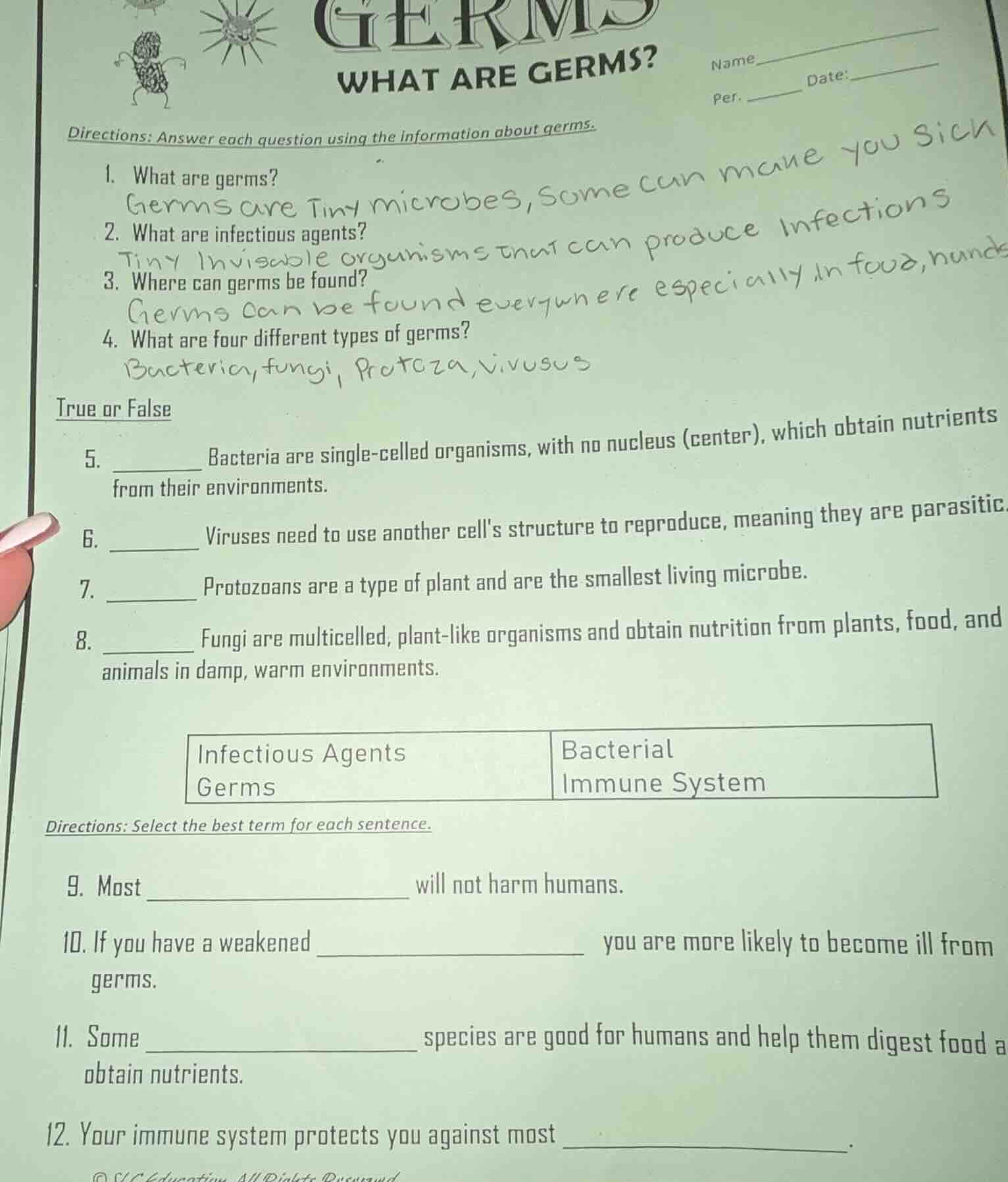
germs
what are germs?
name
per. date:
directions: answer each question using the information about germs.
- what are germs?
- what are infectious agents?
- where can germs be found?
- what are four different types of germs?
true or false
- ______ bacteria are single - celled organisms, with no nucleus (center), which obtain nutrients from their environments.
- ______ viruses need to use another cells structure to reproduce, meaning they are parasitic.
- ______ protozoans are a type of plant and are the smallest living microbe.
- ______ fungi are multicelled, plant - like organisms and obtain nutrition from plants, food, and animals in damp, warm environments.
infectious agents bacterial
germs immune system
directions: select the best term for each sentence.
- most ____________ will not harm humans.
- if you have a weakened ____________ you are more likely to become ill from germs.
- some ____________ species are good for humans and help them digest food a obtain nutrients.
- your immune system protects you against most ____________.
Response
Question 5
Brief Explanations
Bacteria are prokaryotes (single - celled, no nucleus) and they get nutrients from their environment. So the statement is true.
Brief Explanations
Viruses are obligate parasites. They need a host cell's machinery to reproduce. So the statement is true.
Brief Explanations
Protozoans are single - celled eukaryotes (not plants) and viruses are the smallest microbes (not protozoans). So the statement is false.

Snap & solve any problem in the app
Get step-by-step solutions on Sovi AI
Photo-based solutions with guided steps
Explore more problems and detailed explanations
True