QUESTION IMAGE
Question
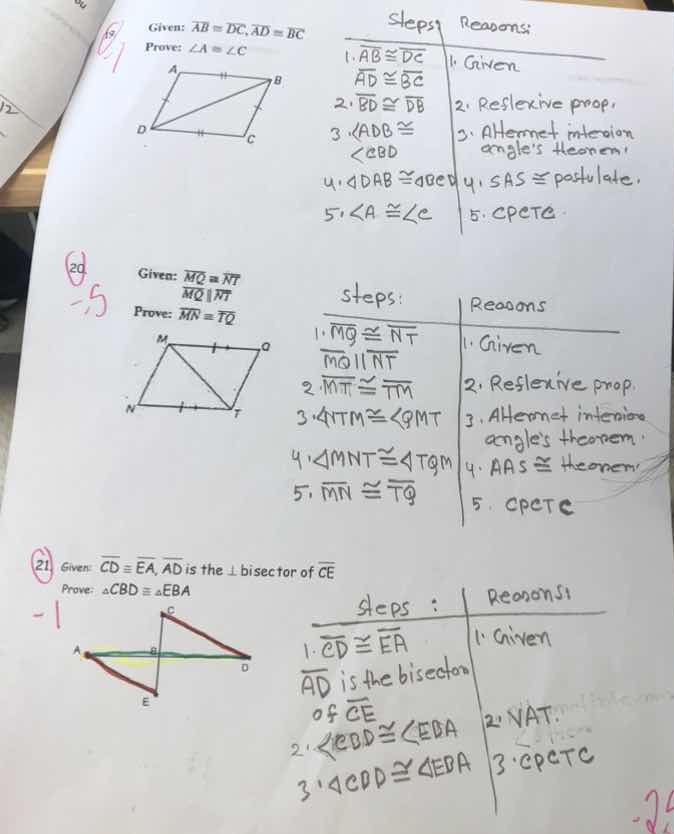
given: ( ab cong dc, ad cong bc ) prove: ( angle a cong angle c )
given: ( overline{mq} cong overline{nt} ), ( overline{mq} parallel overline{nt} ) prove: ( overline{mn} cong overline{tq} )
given: ( overline{cd} cong overline{ea} ), ( ad ) is the ( perp ) bisector of ( overline{ce} ) prove: ( \triangle cbd cong \triangle eba )
Problem 19 (Proving ∠A ≅ ∠C given AB ≅ DC, AD ≅ BC)
Step 1: Identify Given Information
We are given \( \overline{AB} \cong \overline{DC} \) and \( \overline{AD} \cong \overline{BC} \), and we have the common side \( \overline{BD} \cong \overline{BD} \) (reflexive property).
Step 2: Apply SAS Congruence Postulate
By the Side - Angle - Side (SAS) congruence postulate, since \( AB\cong DC \), \( BD\cong BD \), and \( AD\cong BC \), we can conclude that \( \triangle ADB\cong\triangle CBD \).
Step 3: Use CPCTC (Corresponding Parts of Congruent Triangles are Congruent)
Since \( \triangle ADB\cong\triangle CBD \), the corresponding angles \( \angle A \) and \( \angle C \) are congruent.
Step 1: Identify Given Information
We are given \( \overline{MQ}\cong\overline{NT} \) and \( \overline{MQ}\parallel\overline{NT} \), and we have the common side \( \overline{MT}\cong\overline{TM} \) (reflexive property).
Step 2: Identify Alternate Interior Angles
Since \( \overline{MQ}\parallel\overline{NT} \) and \( \overline{MT} \) is a transversal, the alternate interior angles \( \angle QTM\cong\angle GMT \) (Alternate Interior Angles Theorem).
Step 3: Apply AAS Congruence Theorem
By the Angle - Angle - Side (AAS) congruence theorem, since \( \angle QTM\cong\angle GMT \), \( \angle QMT\cong\angle NTM \) (alternate interior angles from \( \overline{MQ}\parallel\overline{NT} \)) and \( \overline{MQ}\cong\overline{NT} \), we can conclude that \( \triangle MNT\cong\triangle TQM \).
Step 4: Use CPCTC
Since \( \triangle MNT\cong\triangle TQM \), the corresponding sides \( \overline{MN} \) and \( \overline{TQ} \) are congruent.
Step 1: Identify Given Information
We are given \( \overline{CD}\cong\overline{EA} \) and \( AD \) is the perpendicular bisector of \( \overline{CE} \), so \( \overline{CB}\cong\overline{EB} \) (a perpendicular bisector of a segment bisects the segment) and \( \angle CBD\cong\angle EBA = 90^{\circ} \) (since \( AD \) is perpendicular to \( CE \)).
Step 2: Apply SAS Congruence Postulate
By the Side - Angle - Side (SAS) congruence postulate, since \( \overline{CD}\cong\overline{EA} \), \( \angle CBD\cong\angle EBA \), and \( \overline{CB}\cong\overline{EB} \), we can conclude that \( \triangle CBD\cong\triangle EBA \).

Snap & solve any problem in the app
Get step-by-step solutions on Sovi AI
Photo-based solutions with guided steps
Explore more problems and detailed explanations
By showing \( \triangle ADB\cong\triangle CBD \) (SAS) and using CPCTC, we prove \( \angle A\cong\angle C \).