QUESTION IMAGE
Question
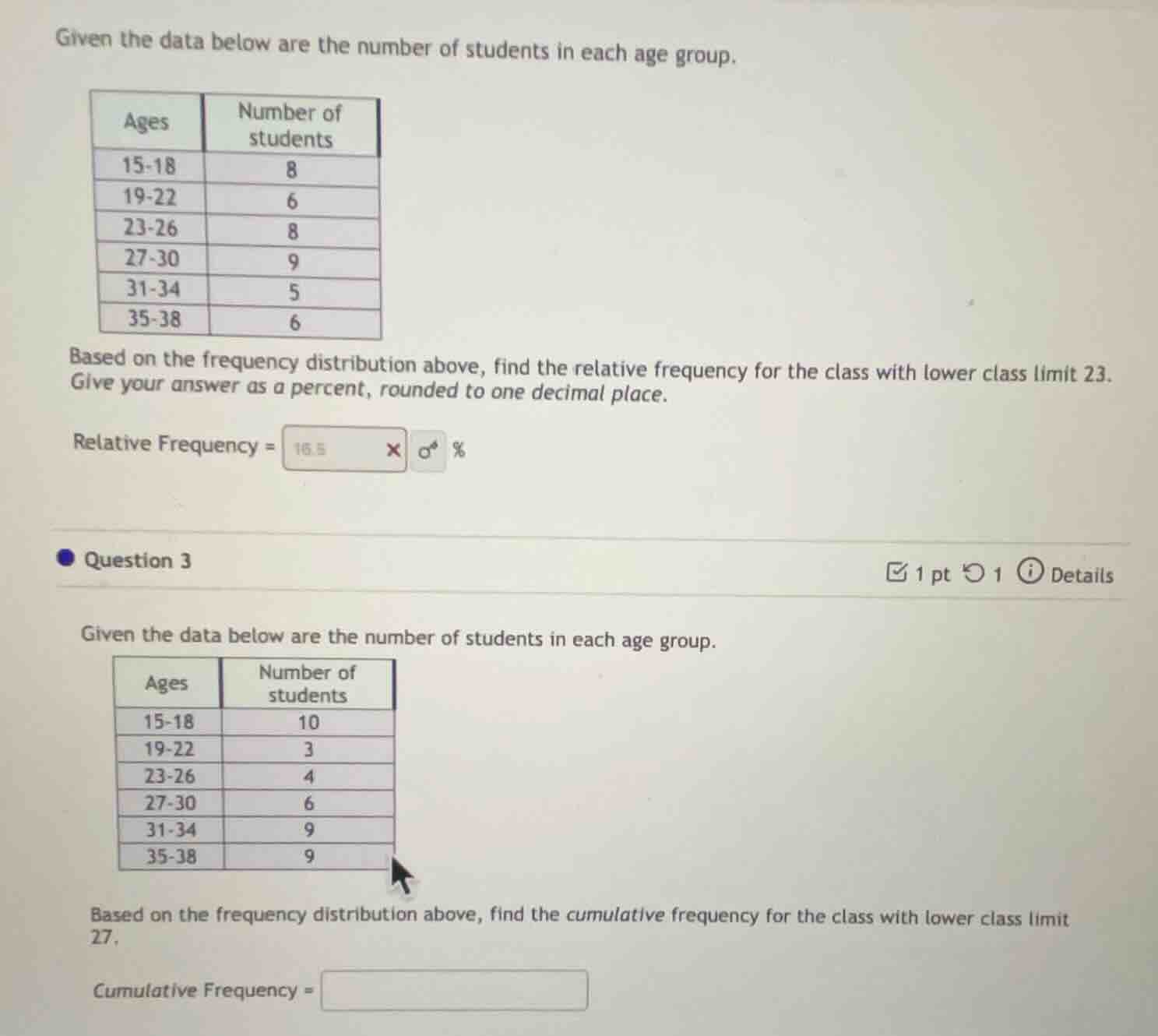
given the data below are the number of students in each age group.
ages | number of students
15 - 18 | 8
19 - 22 | 6
23 - 26 | 8
27 - 30 | 9
31 - 34 | 5
35 - 38 | 6
based on the frequency distribution above, find the relative frequency for the class with lower class limit 23. give your answer as a percent, rounded to one decimal place.
relative frequency =
question 3
given the data below are the number of students in each age group.
ages | number of students
15 - 18 | 10
19 - 22 | 3
23 - 26 | 4
27 - 30 | 6
31 - 34 | 9
35 - 38 | 9
based on the frequency distribution above, find the cumulative frequency for the class with lower class limit 27.
cumulative frequency =
First Sub - Question (Relative Frequency)
Step 1: Find total number of students
We sum up the number of students in all age groups. The number of students in each group is 8, 6, 8, 9, 5, 6. So the total number of students \(N=8 + 6+8 + 9+5 + 6\).
\(N=8+6 = 14\); \(14 + 8=22\); \(22+9 = 31\); \(31+5 = 36\); \(36+6 = 42\).
Step 2: Identify the frequency for the class with lower limit 23
The class with lower class limit 23 is 23 - 26, and the number of students (frequency \(f\)) in this class is 8.
Step 3: Calculate relative frequency
Relative frequency \(=\frac{f}{N}\times100\%\). Substituting \(f = 8\) and \(N = 42\), we get \(\frac{8}{42}\times100\%\).
\(\frac{8}{42}\approx0.1905\), and \(0.1905\times100\% = 19.1\%\) (rounded to one decimal place).
Second Sub - Question (Cumulative Frequency)
Step 1: Identify the classes before and including the class with lower limit 27
The class with lower limit 27 is 27 - 30. We need to sum the frequencies of all classes with lower limits less than or equal to 27. The classes are 15 - 18 (frequency = 10), 19 - 22 (frequency = 3), 23 - 26 (frequency = 4), and 27 - 30 (frequency = 6).
Step 2: Calculate cumulative frequency
Cumulative frequency \(=10 + 3+4 + 6\).
\(10+3 = 13\); \(13 + 4=17\); \(17+6 = 23\).

Snap & solve any problem in the app
Get step-by-step solutions on Sovi AI
Photo-based solutions with guided steps
Explore more problems and detailed explanations
s:
- Relative Frequency: \(19.1\%\)
- Cumulative Frequency: \(23\)