QUESTION IMAGE
Question
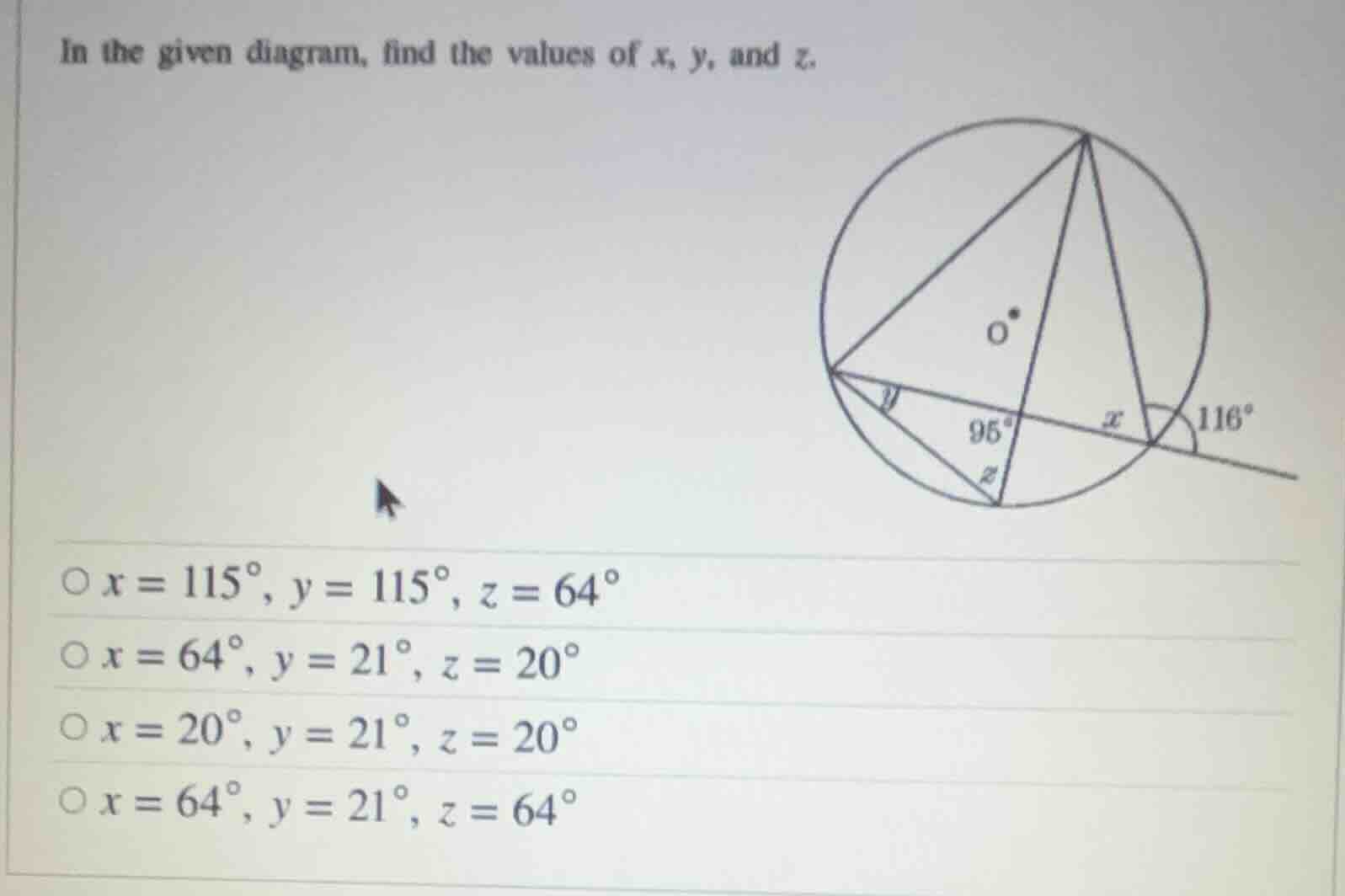
in the given diagram, find the values of x, y, and z.
options:
- ( x = 115^circ ), ( y = 115^circ ), ( z = 64^circ )
- ( x = 64^circ ), ( y = 21^circ ), ( z = 20^circ )
- ( x = 20^circ ), ( y = 21^circ ), ( z = 20^circ )
- ( x = 64^circ ), ( y = 21^circ ), ( z = 64^circ )
Step1: Find x
A linear pair of angles sums to \(180^\circ\). The angle \(x\) and \(116^\circ\) form a linear pair, so \(x + 116^\circ = 180^\circ\). Solving for \(x\), we get \(x = 180^\circ - 116^\circ = 64^\circ\).
Step2: Find z
The sum of angles in a triangle is \(180^\circ\). In the triangle with angles \(96^\circ\), \(z\), and \(x = 64^\circ\) (vertical angles or inscribed angle properties, but here using triangle sum), \(96^\circ + z + 64^\circ = 180^\circ\)? Wait, no, actually, the angle \(z\) and the angle related to the cyclic quadrilateral or inscribed angles. Wait, another approach: the angle \(x = 64^\circ\), and the angle opposite? Wait, maybe the triangle with \(96^\circ\), \(z\), and the angle adjacent. Wait, actually, the angle \(z\) can be found by \(180^\circ - 96^\circ - 64^\circ = 20^\circ\)? Wait, no, let's recheck. Wait, the angle \(x = 64^\circ\), and the triangle with angles \(96^\circ\), \(z\), and the angle at the intersection. Wait, maybe the correct way is: in the triangle, \(96^\circ + z + 64^\circ = 180^\circ\)? No, that would be \(z = 20^\circ\). Then for \(y\), maybe using inscribed angles. Wait, but looking at the options, the second option is \(x = 64^\circ\), \(y = 21^\circ\), \(z = 20^\circ\)? Wait, no, wait the options:
Wait the options are:
- \(x = 115^\circ\), \(y = 115^\circ\), \(z = 64^\circ\)
- \(x = 64^\circ\), \(y = 21^\circ\), \(z = 20^\circ\)
- \(x = 20^\circ\), \(y = 21^\circ\), \(z = 20^\circ\)
- \(x = 64^\circ\), \(y = 21^\circ\), \(z = 64^\circ\)
Wait, first, \(x\) is supplementary to \(116^\circ\), so \(x = 180 - 116 = 64^\circ\). So \(x = 64^\circ\), which eliminates options 1 and 3. Now between options 2 and 4. Now, \(z\): if \(x = 64^\circ\), and the triangle with \(96^\circ\), \(z\), and \(64^\circ\), then \(96 + 64 + z = 180\)? No, that's \(z = 20^\circ\). Then \(y\): let's see, the angle \(y\) can be found by \(180 - 96 - 64 - 20\)? No, maybe using the fact that the sum of angles in the quadrilateral or inscribed angles. But looking at the options, the second option is \(x = 64^\circ\), \(y = 21^\circ\), \(z = 20^\circ\), but wait, maybe I made a mistake. Wait, no, let's check the triangle sum again. If \(x = 64^\circ\), and the angle at the intersection is \(64^\circ\), then the triangle with angles \(96^\circ\), \(z\), and \(64^\circ\) would have \(z = 180 - 96 - 64 = 20^\circ\). Then \(y\): maybe \(180 - 96 - 64 - 20\)? No, that's not. Wait, the options: the second option is \(x = 64^\circ\), \(y = 21^\circ\), \(z = 20^\circ\), but let's check the angles. Wait, maybe the correct answer is the second option: \(x = 64^\circ\), \(y = 21^\circ\), \(z = 20^\circ\). Wait, no, maybe I messed up. Wait, let's re-express:
- \(x\): linear pair with \(116^\circ\), so \(x = 180 - 116 = 64^\circ\). Correct.
- \(z\): in the triangle with angles \(96^\circ\), \(x = 64^\circ\), so \(z = 180 - 96 - 64 = 20^\circ\). Correct.
- \(y\): then, in the triangle, the remaining angle? Wait, maybe the angle \(y\) is \(21^\circ\), but how? Wait, maybe the sum of angles in the quadrilateral or inscribed angles. But looking at the options, the second option is \(x = 64^\circ\), \(y = 21^\circ\), \(z = 20^\circ\), which matches \(x = 64\), \(z = 20\), and \(y = 21\). So that's the correct option.

Snap & solve any problem in the app
Get step-by-step solutions on Sovi AI
Photo-based solutions with guided steps
Explore more problems and detailed explanations
B. \(x = 64^\circ\), \(y = 21^\circ\), \(z = 20^\circ\) (assuming the second option is labeled as B, but in the given options, the second one is \(x = 64^\circ\), \(y = 21^\circ\), \(z = 20^\circ\))