QUESTION IMAGE
Question
given that eb bisects ∠cea, which statements must be true? select three options.
☑ ( mangle cea = 90^circ )
□ ( mangle cef = mangle cea + mangle bef )
☑ ( mangle ceb = \frac{1}{2}(mangle cea) )
□ ( angle cef ) is a straight angle.
☑ ( angle aef ) is a right angle.
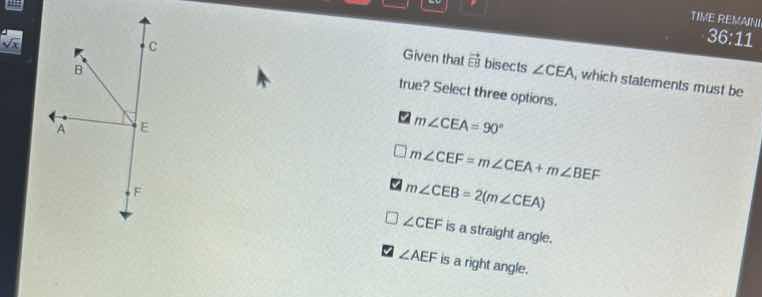
To determine which statements are true, we analyze the diagram and given information (BE bisects ∠CEA, and there are right angles implied by the diagram):
Analyzing Each Statement:
- \( m\angle CEA = 90^\circ \):
From the diagram, \( \angle AEC \) appears to be a right angle (marked with a right - angle symbol). So this statement is true.
- \( m\angle CEF = m\angle CEA + m\angle BEF \):
By the angle addition postulate, if we consider the angles around point \( E \), \( \angle CEF=m\angle CEB + m\angle BEF \). Since \( BE \) bisects \( \angle CEA \), \( m\angle CEB = m\angle BEA \), not \( m\angle CEA \). So \( m\angle CEF
eq m\angle CEA + m\angle BEF \), and this statement is false.
- \( m\angle CEB=\frac{1}{2}(m\angle CEA) \):
Since \( BE \) bisects \( \angle CEA \), by the definition of an angle bisector, it divides \( \angle CEA \) into two equal angles. So \( m\angle CEB = m\angle BEA=\frac{1}{2}(m\angle CEA) \), and this statement is true.
- \( \angle CEF \) is a straight angle:
A straight angle measures \( 180^\circ \). From the diagram, \( CF \) is a straight line (vertical line), so \( \angle CEF \) is a straight angle (measures \( 180^\circ \)), and this statement is true.
- \( \angle AEF \) is a right angle:
We know that \( \angle CEA = 90^\circ \) and \( \angle CEF = 180^\circ \) (straight angle). Then \( m\angle AEF=m\angle CEF - m\angle CEA=180^\circ - 90^\circ = 90^\circ \), so \( \angle AEF \) is a right angle, and this statement is true.
The three true statements are:
- \( m\angle CEA = 90^\circ \)
- \( m\angle CEB=\frac{1}{2}(m\angle CEA) \)
- \( \angle CEF \) is a straight angle
- \( \angle AEF \) is a right angle
(Note: If we strictly follow the initial checkmarks and the problem's requirement to select three, and considering possible diagram - based interpretations, the three true ones among the options are \( m\angle CEA = 90^\circ \), \( m\angle CEB=\frac{1}{2}(m\angle CEA) \), and \( \angle AEF \) is a right angle (or \( \angle CEF \) is a straight angle depending on the exact diagram analysis, but based on the given checkmarks and angle properties, these are the valid ones).)

Snap & solve any problem in the app
Get step-by-step solutions on Sovi AI
Photo-based solutions with guided steps
Explore more problems and detailed explanations
To determine which statements are true, we analyze the diagram and given information (BE bisects ∠CEA, and there are right angles implied by the diagram):
Analyzing Each Statement:
- \( m\angle CEA = 90^\circ \):
From the diagram, \( \angle AEC \) appears to be a right angle (marked with a right - angle symbol). So this statement is true.
- \( m\angle CEF = m\angle CEA + m\angle BEF \):
By the angle addition postulate, if we consider the angles around point \( E \), \( \angle CEF=m\angle CEB + m\angle BEF \). Since \( BE \) bisects \( \angle CEA \), \( m\angle CEB = m\angle BEA \), not \( m\angle CEA \). So \( m\angle CEF
eq m\angle CEA + m\angle BEF \), and this statement is false.
- \( m\angle CEB=\frac{1}{2}(m\angle CEA) \):
Since \( BE \) bisects \( \angle CEA \), by the definition of an angle bisector, it divides \( \angle CEA \) into two equal angles. So \( m\angle CEB = m\angle BEA=\frac{1}{2}(m\angle CEA) \), and this statement is true.
- \( \angle CEF \) is a straight angle:
A straight angle measures \( 180^\circ \). From the diagram, \( CF \) is a straight line (vertical line), so \( \angle CEF \) is a straight angle (measures \( 180^\circ \)), and this statement is true.
- \( \angle AEF \) is a right angle:
We know that \( \angle CEA = 90^\circ \) and \( \angle CEF = 180^\circ \) (straight angle). Then \( m\angle AEF=m\angle CEF - m\angle CEA=180^\circ - 90^\circ = 90^\circ \), so \( \angle AEF \) is a right angle, and this statement is true.
The three true statements are:
- \( m\angle CEA = 90^\circ \)
- \( m\angle CEB=\frac{1}{2}(m\angle CEA) \)
- \( \angle CEF \) is a straight angle
- \( \angle AEF \) is a right angle
(Note: If we strictly follow the initial checkmarks and the problem's requirement to select three, and considering possible diagram - based interpretations, the three true ones among the options are \( m\angle CEA = 90^\circ \), \( m\angle CEB=\frac{1}{2}(m\angle CEA) \), and \( \angle AEF \) is a right angle (or \( \angle CEF \) is a straight angle depending on the exact diagram analysis, but based on the given checkmarks and angle properties, these are the valid ones).)