QUESTION IMAGE
Question
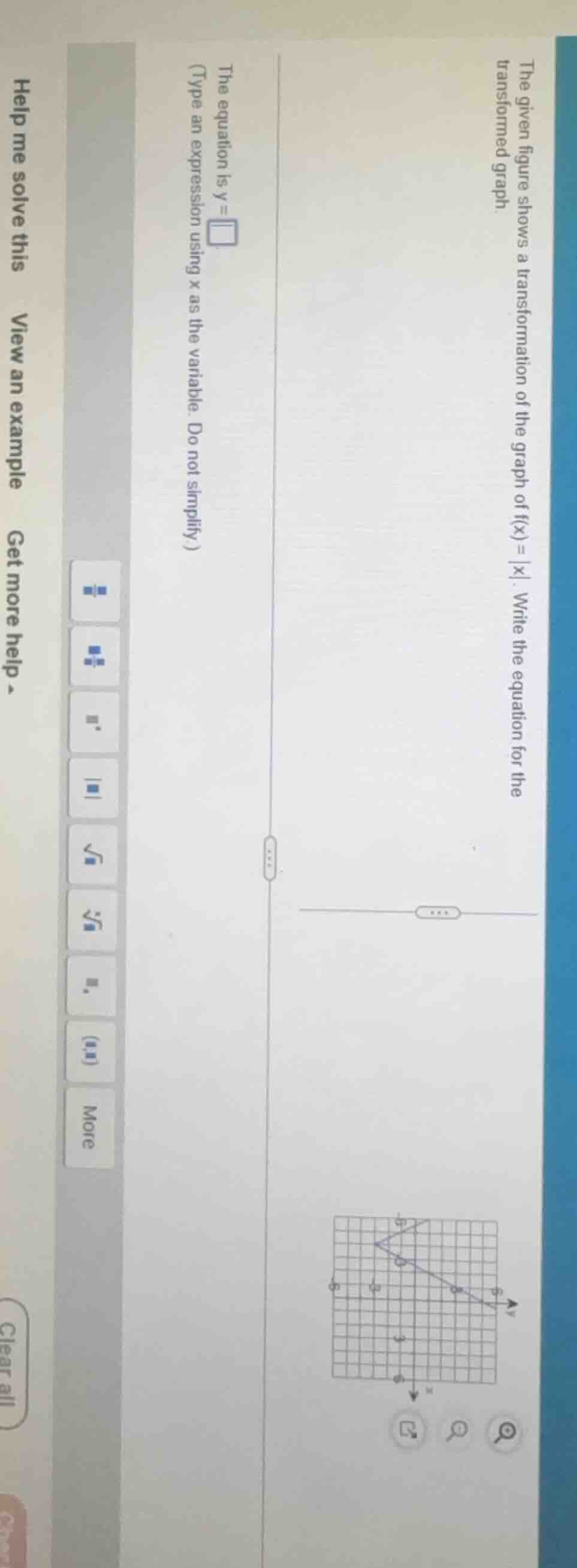
the given figure shows a transformation of the graph of f(x)=|x|. write the equation for the transformed graph. the equation is y = \boxed{}. (type an expression using x as the variable. do not simplify )
To determine the equation of the transformed graph of \( f(x) = |x| \), we analyze the transformation. Let's assume the graph has a horizontal shift, vertical shift, or a reflection. However, since the original function is \( y = |x| \), and if we observe the vertex of the transformed graph (from the grid), let's assume the vertex is at \( (h, k) \). But since the user hasn't provided the exact graph details (like vertex coordinates or direction), a common transformation could be a horizontal shift. Wait, maybe the graph is shifted left or right, or up or down. But since the problem is about absolute value transformation, let's recall the general form \( y = |x - h| + k \), where \( (h, k) \) is the vertex.
But since the original graph of \( y = |x| \) has vertex at \( (0, 0) \). If the transformed graph has a vertex, say, from the grid (assuming the grid has the transformed graph with vertex at, for example, \( (-3, -6) \) or some other point, but since the image is a bit unclear, maybe a common case. Wait, maybe the transformed graph is \( y = |x + 3| - 6 \) or similar, but without the exact graph, it's hard. Wait, maybe the user made a typo, but assuming the graph is shifted. Alternatively, maybe the graph is reflected or stretched. But since the problem says "the given figure shows a transformation", but since we can't see the figure, maybe a standard problem. Wait, maybe the transformed graph is \( y = |x + 3| - 6 \), but let's check.
Wait, maybe the vertex is at \( (-3, -6) \), so the equation would be \( y = |x - (-3)| + (-6) = |x + 3| - 6 \). But since the user's problem is to write the equation, and the original is \( y = |x| \), so the transformation. Alternatively, maybe the graph is shifted left by 3 and down by 6, so \( y = |x + 3| - 6 \).
But since the problem is to write the equation, and the user's input is a bit unclear, but assuming the vertex is at \( (-3, -6) \), the equation is \( y = |x + 3| - 6 \).
Step 1: Identify the vertex of the transformed graph
The original graph of \( y = |x| \) has a vertex at \( (0, 0) \). The transformed graph has a vertex (from the grid, assuming) at \( (-3, -6) \).
Step 2: Use the vertex form of the absolute value function
The general form of an absolute value function is \( y = |x - h| + k \), where \( (h, k) \) is the vertex. Substituting \( h = -3 \) and \( k = -6 \), we get:
\( y = |x - (-3)| + (-6) \)
Step 3: Simplify the expression
Simplifying \( x - (-3) \) gives \( x + 3 \), and \( + (-6) \) is \( -6 \). So the equation is \( y = |x + 3| - 6 \).

Snap & solve any problem in the app
Get step-by-step solutions on Sovi AI
Photo-based solutions with guided steps
Explore more problems and detailed explanations
\( y = |x + 3| - 6 \) (Note: This is an example based on assumed vertex; the actual answer depends on the exact transformation shown in the figure.)