QUESTION IMAGE
Question
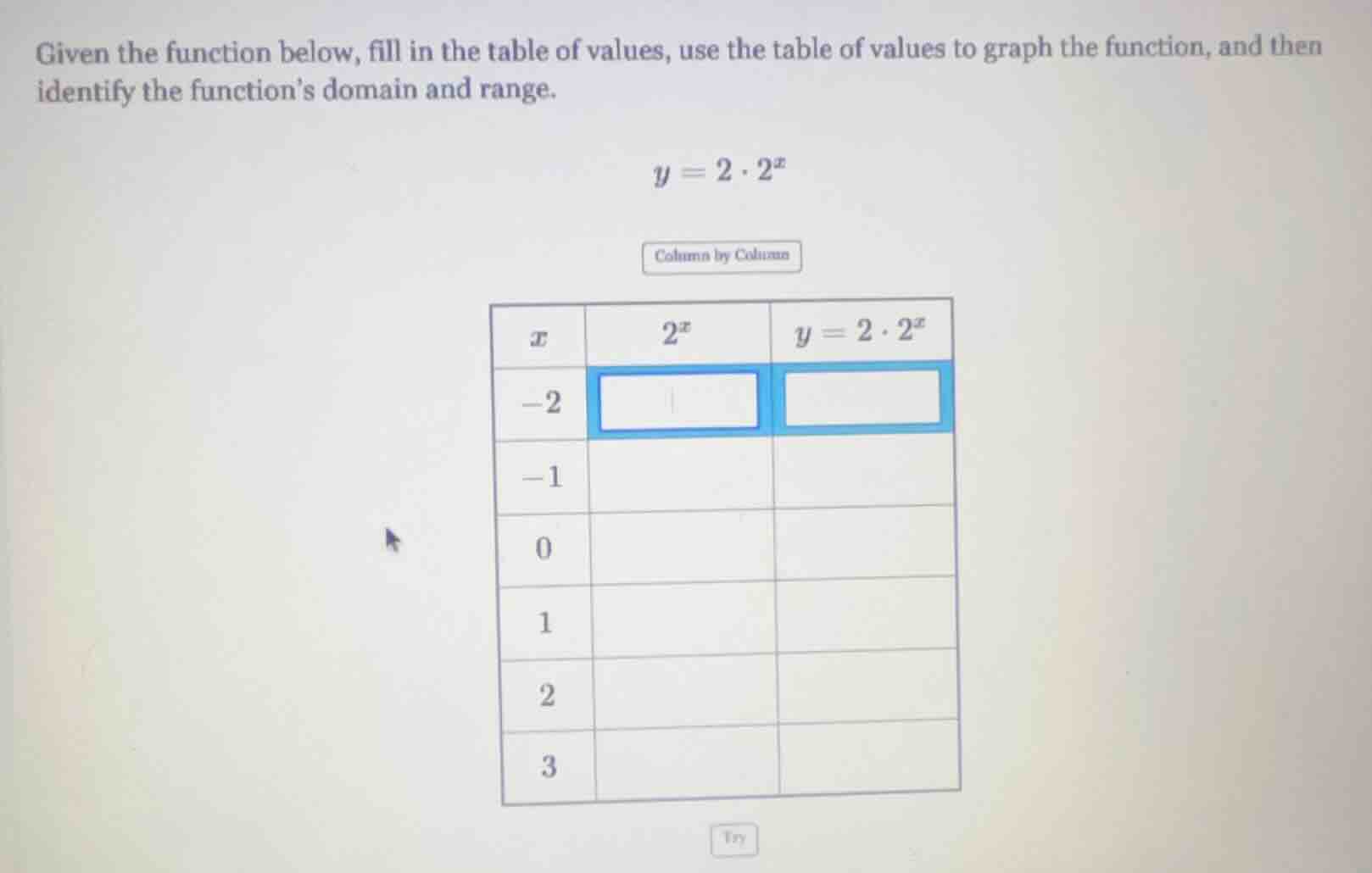
given the function below, fill in the table of values, use the table of values to graph the function, and then identify the function’s domain and range.
$y = 2 \cdot 2^x$
(the table is omitted here as its a chart part, but the relevant x values are -2, -1, 0, 1, 2, 3 with columns for $2^x$ and $y = 2 \cdot 2^x$)
Step1: Calculate \(2^x\) when \(x = -2\)
Recall the rule of negative exponents: \(a^{-n}=\frac{1}{a^n}\). So for \(2^{-2}\), we have \(2^{-2}=\frac{1}{2^2}=\frac{1}{4}\).
Step2: Calculate \(y = 2\cdot2^x\) when \(x = -2\)
Substitute \(2^x=\frac{1}{4}\) into \(y = 2\cdot2^x\). Then \(y = 2\times\frac{1}{4}=\frac{2}{4}=\frac{1}{2}\).
For the other values of \(x\):
- When \(x=-1\):
Step3: Calculate \(2^x\) when \(x = -1\)
Using the negative exponent rule, \(2^{-1}=\frac{1}{2^1}=\frac{1}{2}\).
Step4: Calculate \(y = 2\cdot2^x\) when \(x = -1\)
Substitute \(2^x=\frac{1}{2}\) into \(y = 2\cdot2^x\). Then \(y = 2\times\frac{1}{2}=1\).
- When \(x = 0\):
Step5: Calculate \(2^x\) when \(x = 0\)
Recall that any non - zero number to the power of 0 is 1, so \(2^0 = 1\).
Step6: Calculate \(y = 2\cdot2^x\) when \(x = 0\)
Substitute \(2^x = 1\) into \(y = 2\cdot2^x\). Then \(y=2\times1 = 2\).
- When \(x = 1\):
Step7: Calculate \(2^x\) when \(x = 1\)
\(2^1=2\).
Step8: Calculate \(y = 2\cdot2^x\) when \(x = 1\)
Substitute \(2^x = 2\) into \(y = 2\cdot2^x\). Then \(y = 2\times2=4\).
- When \(x = 2\):
Step9: Calculate \(2^x\) when \(x = 2\)
\(2^2 = 4\).
Step10: Calculate \(y = 2\cdot2^x\) when \(x = 2\)
Substitute \(2^x = 4\) into \(y = 2\cdot2^x\). Then \(y=2\times4 = 8\).
- When \(x = 3\):
Step11: Calculate \(2^x\) when \(x = 3\)
\(2^3=8\).
Step12: Calculate \(y = 2\cdot2^x\) when \(x = 3\)
Substitute \(2^x = 8\) into \(y = 2\cdot2^x\). Then \(y = 2\times8=16\).
Now, for the domain and range:
The function \(y = 2\cdot2^x\) is an exponential function. The domain of an exponential function of the form \(y = a\cdot b^x\) (where \(a>0,b > 0,b
eq1\)) is all real numbers, because we can plug in any real number for \(x\). So the domain is \((-\infty,\infty)\) or \(\{x|x\in\mathbb{R}\}\).
For the range, since \(2^x>0\) for all real \(x\), then multiplying by 2 (a positive number) gives \(2\cdot2^x>0\). So the range is \((0,\infty)\) or \(\{y|y > 0\}\).
Filling the table:
| \(x\) | \(2^x\) | \(y = 2\cdot2^x\) |
|---|---|---|
| \(-1\) | \(\frac{1}{2}\) | \(1\) |
| \(0\) | \(1\) | \(2\) |
| \(1\) | \(2\) | \(4\) |
| \(2\) | \(4\) | \(8\) |
| \(3\) | \(8\) | \(16\) |

Snap & solve any problem in the app
Get step-by-step solutions on Sovi AI
Photo-based solutions with guided steps
Explore more problems and detailed explanations
- Table filled as above.
- Domain: \(\boldsymbol{(-\infty,\infty)}\) (or all real numbers)
- Range: \(\boldsymbol{(0,\infty)}\) (or all positive real numbers)