QUESTION IMAGE
Question
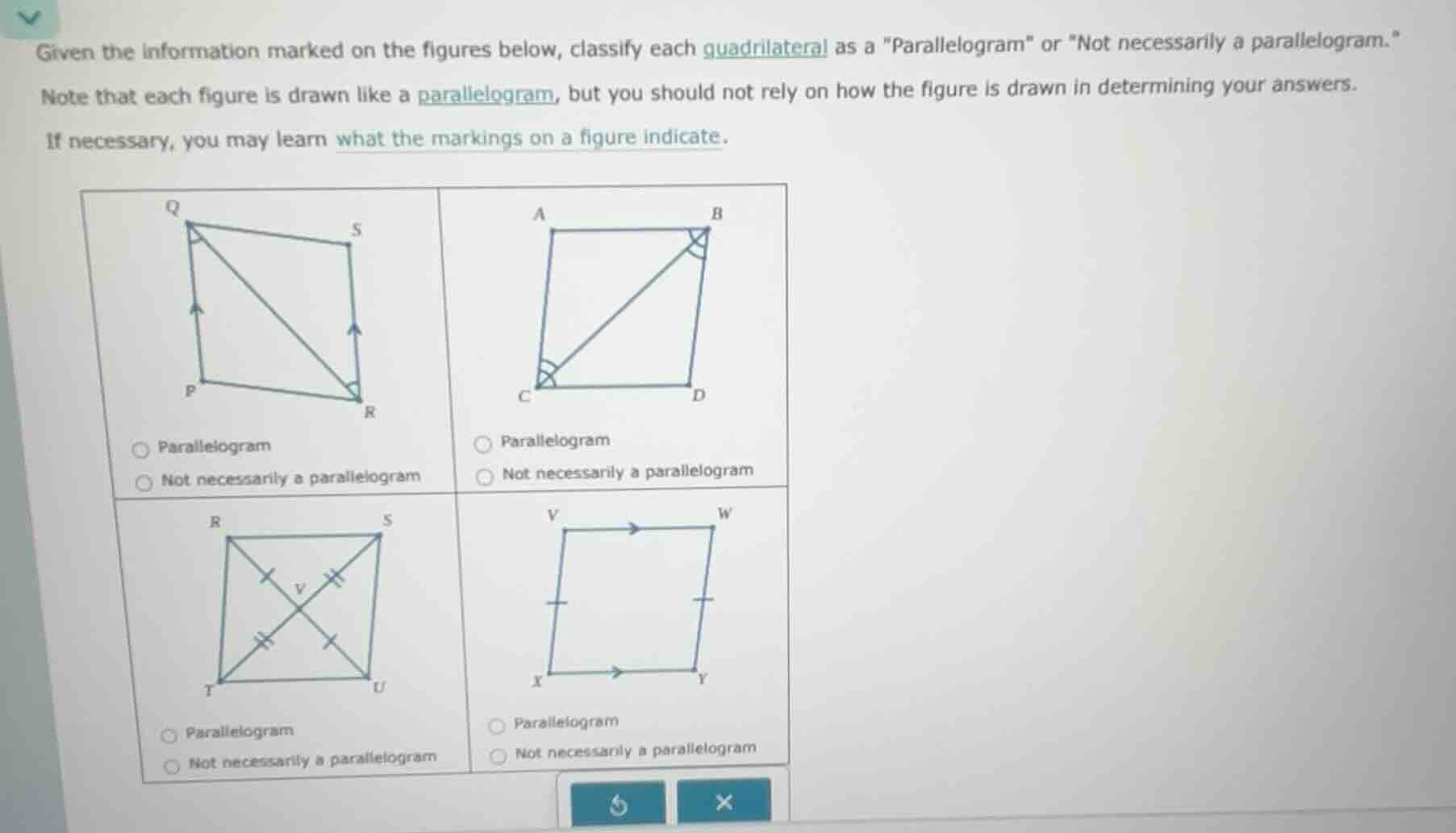
given the information marked on the figures below, classify each quadrilateral as a \parallelogram\ or
ot necessarily a parallelogram.\ note that each figure is drawn like a parallelogram, but you should not rely on how the figure is drawn in determining your answers. if necessary, you may learn what the markings on a figure indicate. (four figures with options to classify as parallelogram or not necessarily a parallelogram)
First Quadrilateral (QPSR):
Step1: Analyze markings (PQ || SR, alternate angles)
We see \( \overrightarrow{PQ} \parallel \overrightarrow{SR} \) (arrow markings) and \( \angle PQR \cong \angle SRQ \) (alternate interior angles for transversal \( QR \)). Also, \( QR \) is common. By AAS (Angle - Angle - Side) congruence, \( \triangle PQR \cong \triangle SRQ \). Thus, \( PQ = SR \) and \( PS = QR \) (corresponding parts of congruent triangles). A quadrilateral with one pair of parallel and equal sides (or both pairs of opposite sides equal) is a parallelogram.
Step2: Conclude it's a parallelogram
Since \( PQ \parallel SR \) and \( PQ = SR \) (from congruence), QPSR is a parallelogram.
Second Quadrilateral (ABCD):
Step1: Analyze angle markings
We have \( \angle ACB \cong \angle DBC \) (markings) and \( \angle BAC \cong \angle CDB \)? No, the markings show \( \angle ACB \) and \( \angle DBC \) are equal, and \( BC \) is common. But this only gives a pair of equal angles and a common side. We can't prove both pairs of opposite sides are parallel or equal. For example, we don't know about \( AB \) and \( CD \), or \( AD \) and \( BC \) (except the angle relation which is for a transversal, but not enough to prove parallelism of both pairs).
Step2: Conclude it's not necessarily a parallelogram
There isn't enough information to confirm both pairs of opposite sides are parallel or equal. So ABCD is not necessarily a parallelogram.
Third Quadrilateral (RSTU, diagonals):
Step1: Analyze diagonal markings
The diagonals bisect each other? Wait, the markings on the diagonals: if the diagonals bisect each other (i.e., \( RV = VU \) and \( SV = VT \) from the tick marks), then by the theorem "If the diagonals of a quadrilateral bisect each other, then it is a parallelogram". The tick marks show that the segments of the diagonals are equal, meaning diagonals bisect each other.
Step2: Conclude it's a parallelogram
Since diagonals bisect each other, RSTU is a parallelogram.
Fourth Quadrilateral (VWXY):

Snap & solve any problem in the app
Get step-by-step solutions on Sovi AI
Photo-based solutions with guided steps
Explore more problems and detailed explanations
s:
- First Quadrilateral (QPSR): Parallelogram
- Second Quadrilateral (ABCD): Not necessarily a parallelogram
- Third Quadrilateral (RSTU): Parallelogram
- Fourth Quadrilateral (VWXY): Parallelogram