QUESTION IMAGE
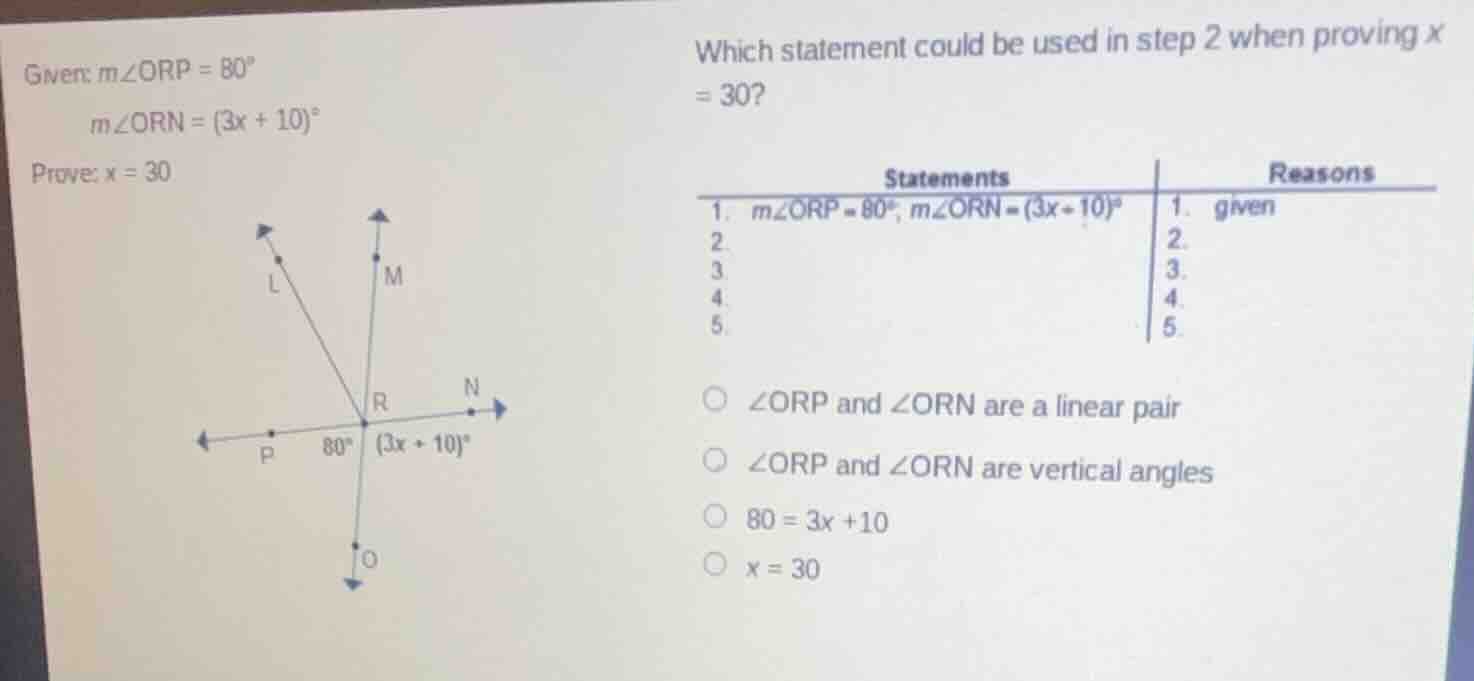
Question
given: ( mangle orp = 80^circ )
( mangle orn = (3x + 10)^circ )
prove: ( x = 30 )
which statement could be used in step 2 when proving ( x = 30 )?
statements | reasons
- ( mangle orp = 80^circ ), ( mangle orn = (3x + 10)^circ ) | 1. given
- | 2.
- | 3.
- | 4.
- | 5.
( angle orp ) and ( angle orn ) are a linear pair
( angle orp ) and ( angle orn ) are vertical angles
( 80 = 3x + 10 )
( x = 30 )
To prove \( x = 30 \), we first analyze the angles. From the diagram, \( \angle ORP \) and \( \angle ORN \) form a linear pair (they are adjacent and form a straight line, so their sum is \( 180^\circ \)). But in step 2, we need to establish the relationship between the angles. Wait, actually, looking at the diagram, \( \angle ORP \) and \( \angle ORN \) are supplementary? No, wait, the diagram shows that \( \angle ORP = 80^\circ \) and \( \angle ORN=(3x + 10)^\circ \), and they are on a straight line (since \( P - R - N \) is a straight line? Wait, no, the diagram has \( P \), \( R \), \( N \) on a horizontal line? Wait, no, the angles at \( R \): \( \angle ORP = 80^\circ \) and \( \angle ORN=(3x + 10)^\circ \), and also there's a vertical line \( O - R - M \). Wait, actually, \( \angle ORP \) and \( \angle ORN \) are supplementary? No, wait, the correct relationship: if \( \angle ORP \) and \( \angle ORN \) are a linear pair, their sum is \( 180^\circ \), but in the answer choices, the first option is " \( \angle ORP \) and \( \angle ORN \) are a linear pair". Wait, but let's check the other options: vertical angles are equal, but these are not vertical angles. The third option is \( 80 = 3x + 10 \), which would be if they are equal, but that's not the case. The fourth option is \( x = 30 \), which is the conclusion, not step 2. Wait, maybe I misread the diagram. Wait, the diagram shows that \( \angle ORP = 80^\circ \) and \( \angle ORN=(3x + 10)^\circ \), and they are adjacent angles forming a linear pair? Wait, no, maybe \( \angle ORP \) and \( \angle ORN \) are supplementary? Wait, no, the correct step 2 should be stating that \( \angle ORP \) and \( \angle ORN \) are a linear pair (so their sum is \( 180^\circ \)), but wait, the answer choices: the first option is " \( \angle ORP \) and \( \angle ORN \) are a linear pair". Wait, but let's check the angles. Wait, maybe the diagram is such that \( \angle ORP \) and \( \angle ORN \) are a linear pair, so their sum is \( 180^\circ \), but in the answer choices, the first option is that. Wait, but let's re - evaluate. The problem is to find which statement is used in step 2. The given is step 1: \( m\angle ORP = 80^\circ \), \( m\angle ORN=(3x + 10)^\circ \). Step 2 should be the relationship between the angles. If \( \angle ORP \) and \( \angle ORN \) are a linear pair, then \( m\angle ORP + m\angle ORN=180^\circ \), which would lead to \( 80+(3x + 10)=180 \), and solving gives \( 3x+90 = 180 \), \( 3x = 90 \), \( x = 30 \). But the answer choices: the first option is " \( \angle ORP \) and \( \angle ORN \) are a linear pair". Wait, but let's check the other options. Vertical angles are equal, but these are not vertical angles. The third option is \( 80 = 3x + 10 \), which would be if they are equal, but that's not the case. The fourth option is the conclusion. So the correct statement for step 2 is that \( \angle ORP \) and \( \angle ORN \) are a linear pair. Wait, but wait, maybe the diagram is different. Wait, looking at the diagram, \( P \), \( R \), \( N \) are on a horizontal line? No, the diagram has \( P \) to the left of \( R \), \( N \) to the right of \( R \), and \( O \) below \( R \), \( M \) above \( R \), and \( L \) at an angle. Wait, maybe \( \angle ORP \) and \( \angle ORN \) are supplementary? No, maybe they are equal? No, that doesn't make sense. Wait, maybe I made a mistake. Wait, the correct answer is the first option: " \( \angle ORP \) and \( \angle ORN \) are a linear pair". Because that establishes the relationship between the two angles, allowing us to se…

Snap & solve any problem in the app
Get step-by-step solutions on Sovi AI
Photo-based solutions with guided steps
Explore more problems and detailed explanations
\(\boldsymbol{\angle ORP}\) and \(\boldsymbol{\angle ORN}\) are a linear pair