QUESTION IMAGE
Question
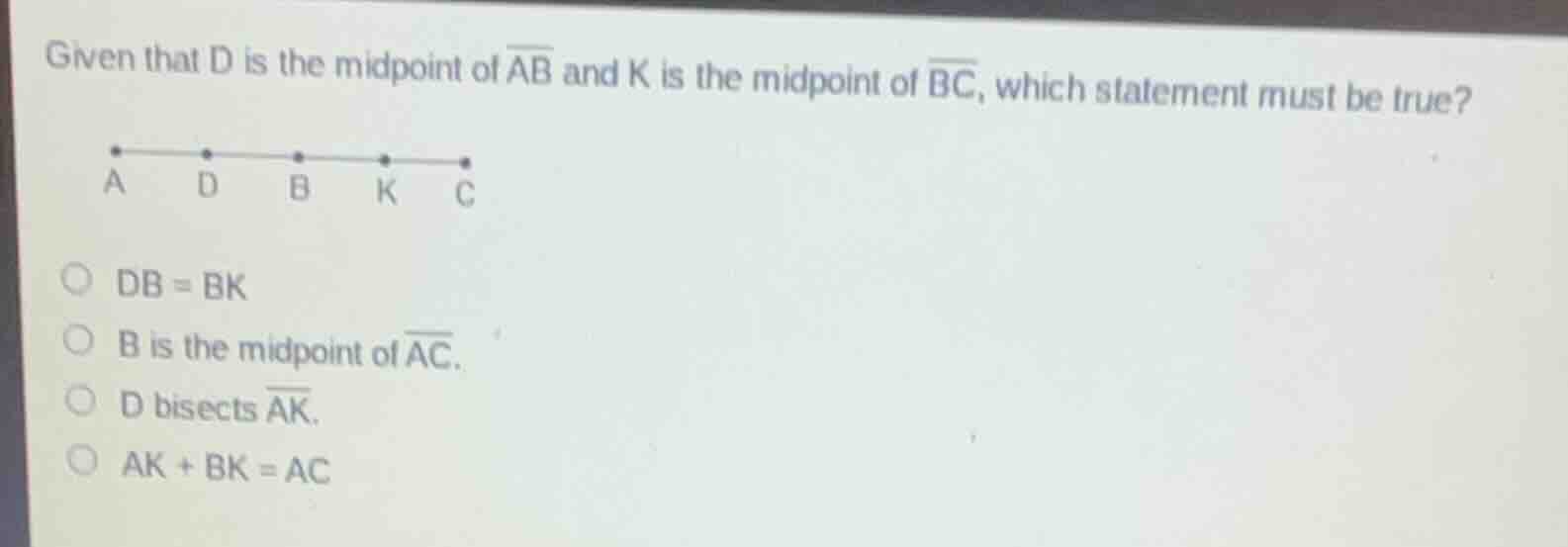
given that d is the midpoint of \\(\overline{ab}\\) and k is the midpoint of \\(\overline{bc}\\), which statement must be true?\
\
a d b k c\
\
\\(\bigcirc\\) \\(db = bk\\)\
\\(\bigcirc\\) b is the midpoint of \\(\overline{ac}\\).\
\\(\bigcirc\\) d bisects \\(\overline{ak}\\).\
\\(\bigcirc\\) \\(ak + bk = ac\\)
Step1: Analyze midpoint definitions
Since D is the midpoint of \( \overline{AB} \), we have \( AD = DB=\frac{1}{2}AB \). Since K is the midpoint of \( \overline{BC} \), we have \( BK = KC=\frac{1}{2}BC \). But we don't know if \( AB = BC \), so \( DB \) and \( BK \) may not be equal.
Step2: Check if B is midpoint of \( \overline{AC} \)
From the diagram, \( AB \) and \( BC \) are segments with B between A and C, but there's no indication \( AB = BC \), so B is not necessarily the midpoint of \( \overline{AC} \).
Step3: Check if D bisects \( \overline{AK} \)
Let's denote \( AD = DB = x \) and \( BK = KC = y \). Then \( AK=AD + DB+BK=x + x + y = 2x + y \), and the midpoint of \( AK \) would be at \( x+\frac{y}{2} \) from A. But \( AD = x \) and \( DB = x \), so D is at \( x \) from A, which is not the midpoint unless \( y = 0 \), which it's not. Wait, maybe I made a mistake. Wait, the points are A---D---B---K---C. So \( AK = AB + BK \), and \( AB = 2DB \), \( BK \) is just \( BK \). Wait, no, let's take lengths. Let \( AD = DB = m \), so \( AB = 2m \). Let \( BK = KC = n \), so \( BC = 2n \). Then \( AK=AB + BK=2m + n \), and \( AD + DK= m + (DB + BK)=m+(m + n)=2m + n \). Wait, no, \( DK = DB + BK=m + n \), so \( AD = m \), \( DK = m + n \), so \( AD
eq DK \) unless \( n = 0 \). Wait, maybe the correct approach is to check the last option.
Step4: Check \( AK + BK = AC \)
We know that \( AC=AB + BC \), and \( AB = AD + DB \), \( BC = BK + KC \). But \( AK=AB + BK \) (since A to K is A to B to K). So \( AK + BK=(AB + BK)+BK=AB + 2BK \), which is not equal to \( AC=AB + BC=AB + 2BK \) (since \( BC = 2BK \) as K is midpoint). Wait, \( AC = AB + BC=AB + 2BK \), and \( AK = AB + BK \), so \( AK + BK=(AB + BK)+BK=AB + 2BK = AC \). Wait, that works. Wait, let's re-express:
\( AC = AB + BC \)
Since K is midpoint of \( BC \), \( BC = 2BK \), so \( AC = AB + 2BK \)
\( AK = AB + BK \) (because A to K is A to B to K)
So \( AK + BK=(AB + BK)+BK=AB + 2BK = AC \)
Now check the third option: D bisects \( \overline{AK} \). \( AK = AD + DB + BK \), and \( AD = DB \) (since D is midpoint of AB), so \( AK = 2DB + BK \). The midpoint of \( AK \) would be at \( \frac{AK}{2}=DB+\frac{BK}{2} \). The length from A to D is \( DB \), and from D to midpoint is \( \frac{BK}{2} \), and from midpoint to K is \( DB+\frac{BK}{2} \)? Wait, no, maybe I messed up the third option. Wait, let's check the first option again. \( DB = BK \): \( DB=\frac{AB}{2} \), \( BK=\frac{BC}{2} \), and we don't know if \( AB = BC \), so \( DB \) and \( BK \) may not be equal. Second option: B is midpoint of AC? \( AC = AB + BC \), B is midpoint only if \( AB = BC \), which we don't know. Third option: D bisects AK? \( AK = AD + DB + BK \), \( AD = DB \), so \( AK = 2DB + BK \). The midpoint of AK would be at \( DB+\frac{BK}{2} \) from A. But \( AD = DB \), so D is at \( DB \) from A, and the midpoint is at \( DB+\frac{BK}{2} \), so D is not the midpoint unless \( BK = 0 \). Fourth option: \( AK + BK = AC \). \( AK = AB + BK \), so \( AK + BK = AB + BK + BK = AB + 2BK \). But \( AC = AB + BC \), and since K is midpoint of BC, \( BC = 2BK \), so \( AC = AB + 2BK \). Therefore, \( AK + BK = AC \) is true. Wait, but let's check with the diagram. A---D---B---K---C. So \( AK \) is from A to K, \( BK \) is from B to K, so \( AK + BK \) would be A to K to B to K? No, wait, \( AK \) is A to K, and \( BK \) is B to K, so \( AK + BK = (A to K)+(B to K)= (A to B to K)+(B to K)=A to B to K to B to K \), which is not correct. Wait, no, length is a scalar. So \( AK \) is the length f…

Snap & solve any problem in the app
Get step-by-step solutions on Sovi AI
Photo-based solutions with guided steps
Explore more problems and detailed explanations
\( AK + BK = AC \) (the last option, but since the options are not labeled with letters here, but in the original problem, the last option is "AK + BK = AC")