QUESTION IMAGE
Question
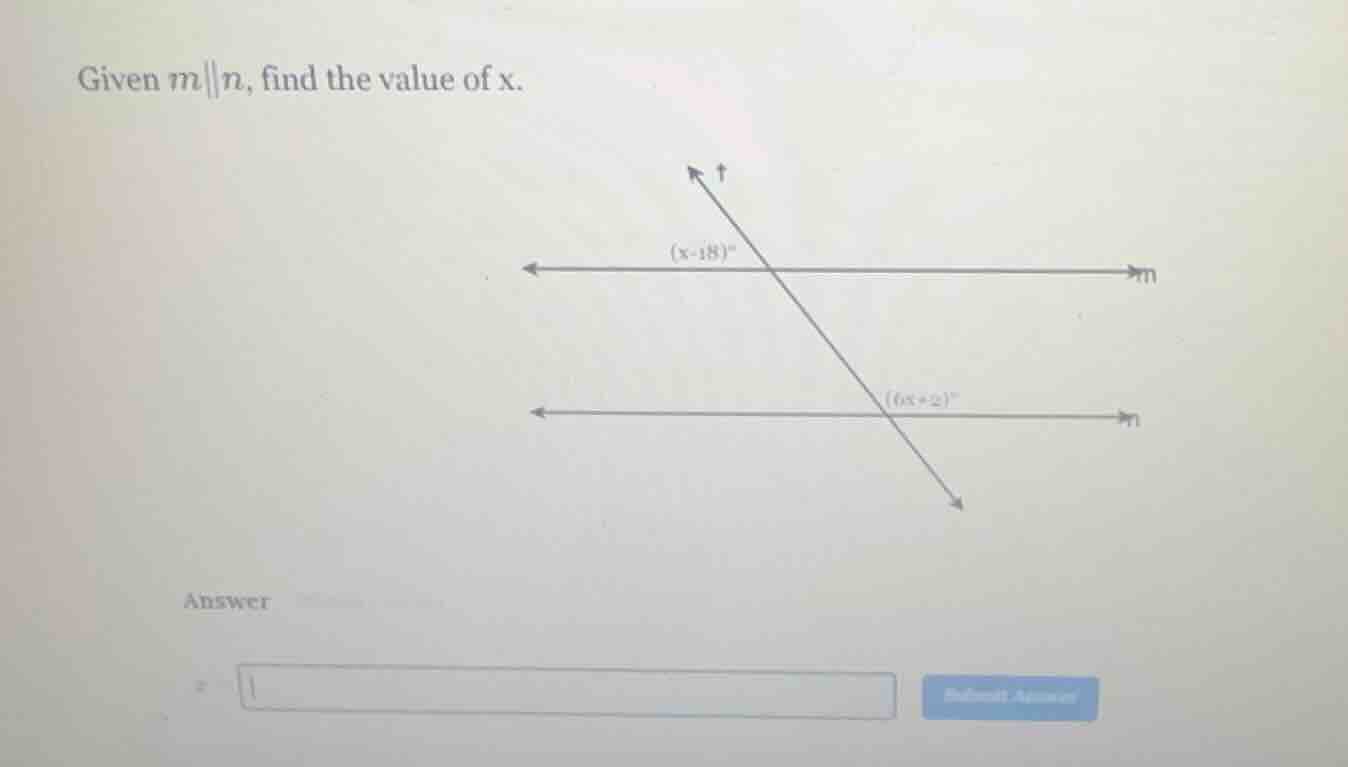
given ( m parallel n ), find the value of ( x ).
answer
Step1: Identify angle relationship
Since \( m \parallel n \), the two angles \((x - 18)^\circ\) and \((6x + 2)^\circ\) are same - side interior angles? Wait, no. Wait, looking at the diagram, actually, when two parallel lines are cut by a transversal, the angles \((x - 18)^\circ\) and \((6x+2)^\circ\) are supplementary? Wait, no, wait. Wait, maybe they are alternate - interior angles? Wait, no, let's re - examine. Wait, if we look at the positions, actually, the angle \((x - 18)^\circ\) and the angle \((6x + 2)^\circ\) are same - side interior angles? No, wait, no. Wait, when two parallel lines are cut by a transversal, same - side interior angles are supplementary. Wait, but maybe they are alternate - exterior or alternate - interior? Wait, no, let's think again. Wait, the angle \((x - 18)^\circ\) and \((6x + 2)^\circ\): if we consider the transversal, and the two parallel lines \( m \) and \( n \), the angle \((x - 18)^\circ\) and \((6x + 2)^\circ\) are same - side interior angles? Wait, no, actually, they should be supplementary? Wait, no, wait, maybe I made a mistake. Wait, no, let's check the sum. Wait, if \( m\parallel n \), then the two angles \((x - 18)^\circ\) and \((6x + 2)^\circ\) are same - side interior angles, so they should add up to \( 180^\circ \)? Wait, no, wait, maybe they are alternate - interior angles? No, alternate - interior angles are equal. Wait, maybe the diagram is such that the angle \((x - 18)^\circ\) and \((6x + 2)^\circ\) are same - side interior angles, so:
\((x - 18)+(6x + 2)=180\)
Step2: Solve the equation
Combine like terms:
\(x+6x-18 + 2=180\)
\(7x-16 = 180\)
Add 16 to both sides:
\(7x=180 + 16\)
\(7x=196\)
Divide both sides by 7:
\(x=\frac{196}{7}=28\)
Wait, that can't be right. Wait, maybe I got the angle relationship wrong. Wait, maybe the angles are supplementary? Wait, no, wait, maybe they are alternate - interior angles. Wait, if they are alternate - interior angles, then \(x - 18=6x + 2\), but that would give \(x-6x=2 + 18\), \(- 5x=20\), \(x=- 4\), which doesn't make sense. Wait, maybe I mixed up the angle types. Wait, let's re - draw the diagram mentally. The line \(m\) and \(n\) are parallel, cut by a transversal. The angle \((x - 18)^\circ\) is above line \(m\), and the angle \((6x + 2)^\circ\) is below line \(n\) on the same side of the transversal. Wait, maybe they are same - side interior angles, so their sum is \(180^\circ\). Wait, but when we solved \((x - 18)+(6x + 2)=180\), we got \(x = 28\), but let's check:
If \(x = 28\), then \((x-18)=28 - 18 = 10\), \((6x + 2)=6\times28+2=168 + 2 = 170\), and \(10+170 = 180\), which works. Wait, so that's correct.
Wait, but maybe I made a mistake in the angle relationship. Wait, another way: the angle \((x - 18)^\circ\) and the angle adjacent to \((6x + 2)^\circ\) (vertical angle) are same - side interior angles. Wait, no, maybe the angle \((x - 18)^\circ\) and \((6x + 2)^\circ\) are supplementary. So:
\((x - 18)+(6x + 2)=180\)
\(7x-16 = 180\)
\(7x=196\)
\(x = 28\)

Snap & solve any problem in the app
Get step-by-step solutions on Sovi AI
Photo-based solutions with guided steps
Explore more problems and detailed explanations
\(x = 28\)