QUESTION IMAGE
Question
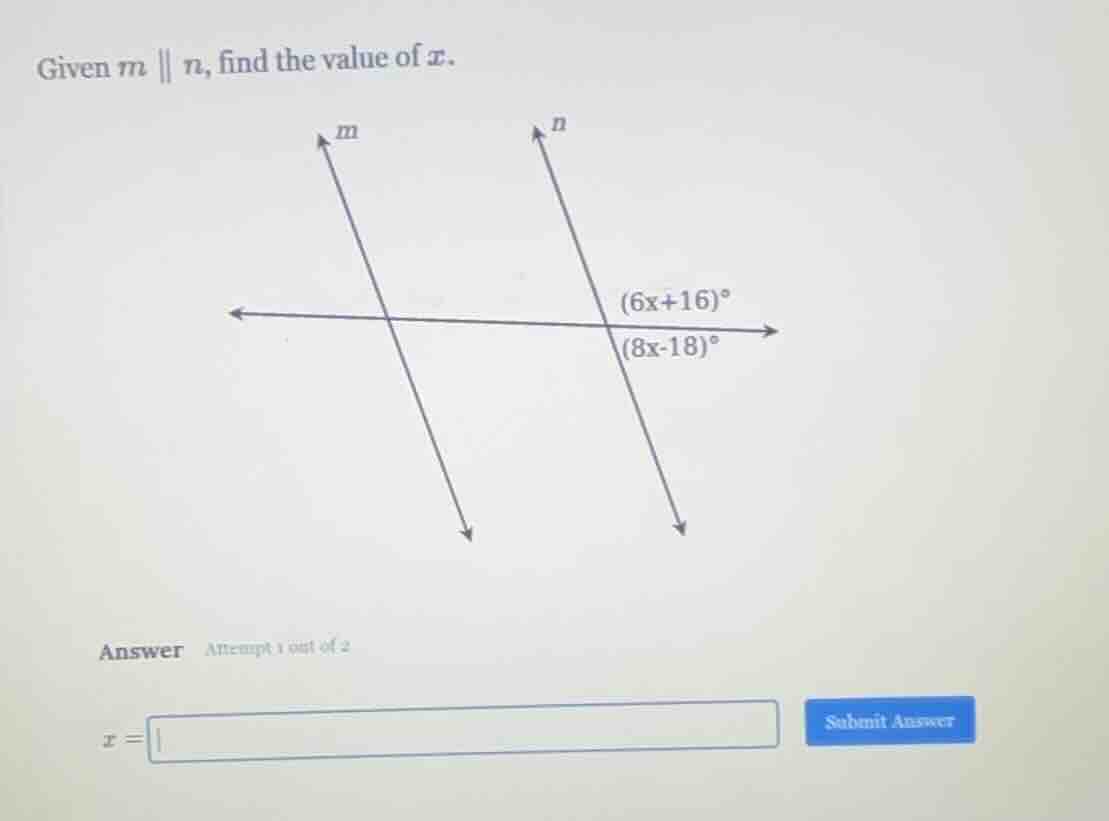
given ( m parallel n ), find the value of ( x ).
answer attempt 1 out of 2
( x = )
submit answer
Step1: Identify the angle relationship
Since \( m \parallel n \), the two angles \( (6x + 16)^\circ \) and \( (8x - 18)^\circ \) are vertical angles? No, wait, actually, since they are adjacent and form a linear pair? Wait, no, looking at the diagram, the two angles \( (6x + 16)^\circ \) and \( (8x - 18)^\circ \) are actually equal because they are alternate interior angles? Wait, no, maybe they are supplementary? Wait, no, let's think again. Wait, when two parallel lines are cut by a transversal, vertical angles are equal, but also, if the angles are adjacent and form a linear pair, they are supplementary. Wait, no, in this case, the two angles \( (6x + 16)^\circ \) and \( (8x - 18)^\circ \) are actually equal because they are vertical angles? Wait, no, maybe they are alternate interior angles? Wait, no, let's check the diagram. The two angles are on a straight line? Wait, no, the transversal cuts the two parallel lines, and the two angles \( (6x + 16)^\circ \) and \( (8x - 18)^\circ \) are actually equal because they are vertical angles? Wait, no, maybe they are supplementary. Wait, no, let's see: if \( m \parallel n \), then the angles \( (6x + 16)^\circ \) and \( (8x - 18)^\circ \) are actually equal because they are alternate interior angles? Wait, no, maybe they are vertical angles. Wait, no, vertical angles are equal, but also, if the angles are adjacent and form a linear pair, they are supplementary. Wait, I think I made a mistake. Wait, the two angles \( (6x + 16)^\circ \) and \( (8x - 18)^\circ \) are actually equal because they are vertical angles? Wait, no, let's re-examine. The diagram shows two parallel lines \( m \) and \( n \), cut by a transversal. The two angles \( (6x + 16)^\circ \) and \( (8x - 18)^\circ \) are adjacent and form a linear pair? No, wait, they are on a straight line, so they should be supplementary? Wait, no, that can't be. Wait, no, actually, the two angles \( (6x + 16)^\circ \) and \( (8x - 18)^\circ \) are equal because they are vertical angles? Wait, no, vertical angles are opposite each other. Wait, maybe the two angles are equal because they are alternate interior angles. Wait, I think I messed up. Wait, let's look at the problem again. The two angles are \( (6x + 16)^\circ \) and \( (8x - 18)^\circ \), and since \( m \parallel n \), these two angles are actually equal because they are vertical angles? Wait, no, vertical angles are equal, but also, if the angles are adjacent and form a linear pair, they are supplementary. Wait, no, let's solve it. Wait, maybe the two angles are equal. So set \( 6x + 16 = 8x - 18 \).
Step2: Solve for \( x \)
\[
\]
Wait, let's check. If \( x = 17 \), then \( 6x + 16 = 6*17 + 16 = 102 + 16 = 118 \), and \( 8x - 18 = 8*17 - 18 = 136 - 18 = 118 \). So they are equal, which makes sense because they are vertical angles (or alternate interior angles, depending on the diagram). So the solution is \( x = 17 \).

Snap & solve any problem in the app
Get step-by-step solutions on Sovi AI
Photo-based solutions with guided steps
Explore more problems and detailed explanations
\( x = 17 \)