QUESTION IMAGE
Question
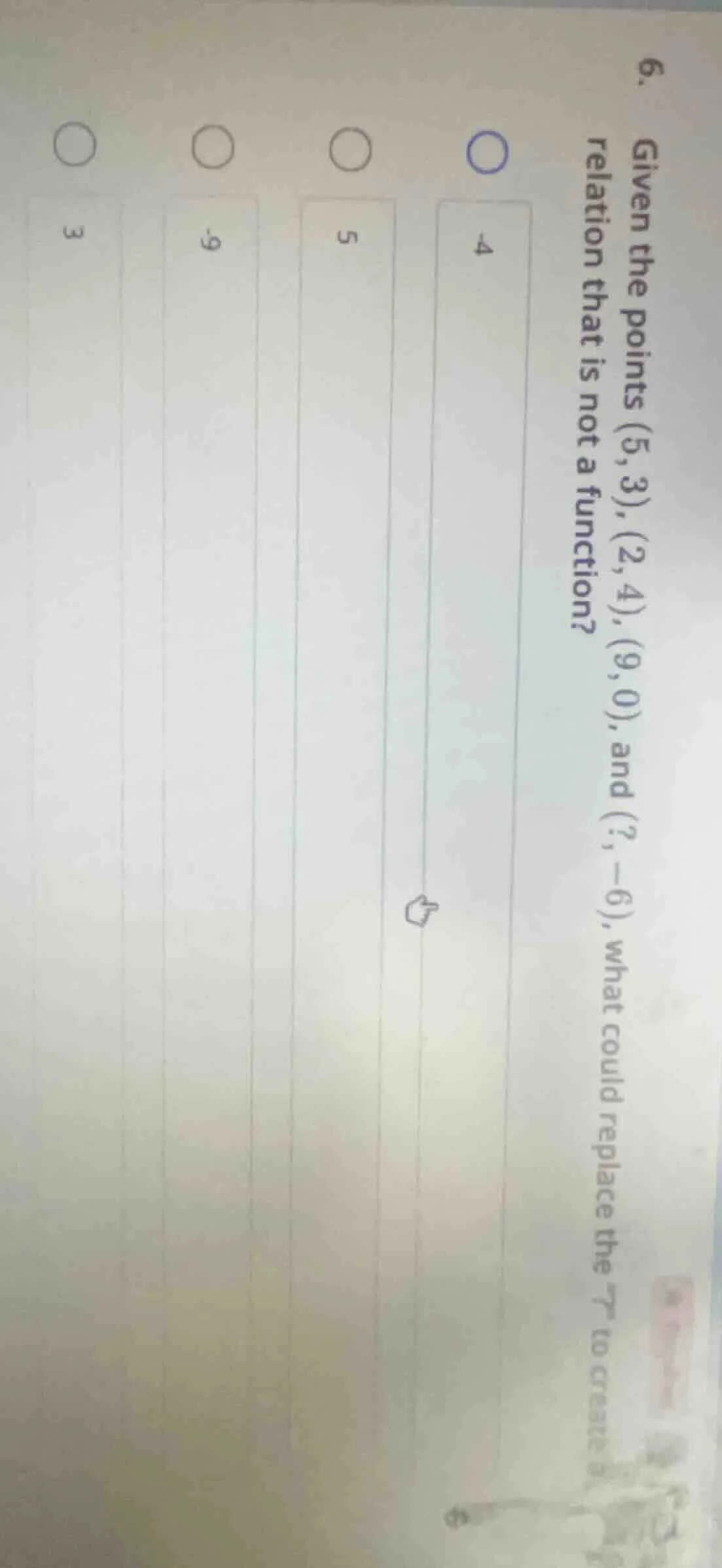
- given the points (5,3), (2,4), (9,0), and (?, -6), what could replace the \?\ to create a relation that is not a function?
options: -4, 5, -9, 3
Step1: Recall the definition of a function
A relation is a function if each input (x - value) has exactly one output (y - value). So, if we have a repeated x - value with a different y - value, the relation is not a function.
Step2: Analyze the given x - values
The given points are \((5,3)\), \((2,4)\), \((9,0)\). The x - values here are \(5\), \(2\), and \(9\). We need to find an x - value that is already present in the set of x - values of the given points.
The x - values of the given points are \(5\), \(2\), \(9\). If we choose \(x = 5\) (since \(5\) is already an x - value with \(y=3\)), and now we have \((5,- 6)\) in addition to \((5,3)\), then for the input \(x = 5\), we have two different outputs \(y = 3\) and \(y=-6\). This violates the definition of a function.
If we choose \(x = 2\), we would have \((2,-6)\) and \((2,4)\) (two outputs for \(x = 2\)), but looking at the options, \(5\) is one of the options. Let's check the options:
- Option with \(x=-4\): The x - value \(-4\) is new, so \((-4,-6)\) would be a valid point for a function (since \(-4\) is not an existing x - value).
- Option with \(x = 5\): The x - value \(5\) already has \(y = 3\), so \((5,-6)\) and \((5,3)\) mean \(x = 5\) has two outputs, so it's not a function.
- Option with \(x=-9\): The x - value \(-9\) is new, so \((-9,-6)\) is valid for a function.
- Option with \(x = 3\): The x - value \(3\) is new, so \((3,-6)\) is valid for a function.

Snap & solve any problem in the app
Get step-by-step solutions on Sovi AI
Photo-based solutions with guided steps
Explore more problems and detailed explanations
The value that replaces "?" to create a non - function is \(5\) (the option with \(x = 5\)). So the answer is the option with \(5\) (assuming the options are labeled with the x - value, so if the option with \(5\) is, say, the third option, we identify it as the one with \(x = 5\)).