QUESTION IMAGE
Question
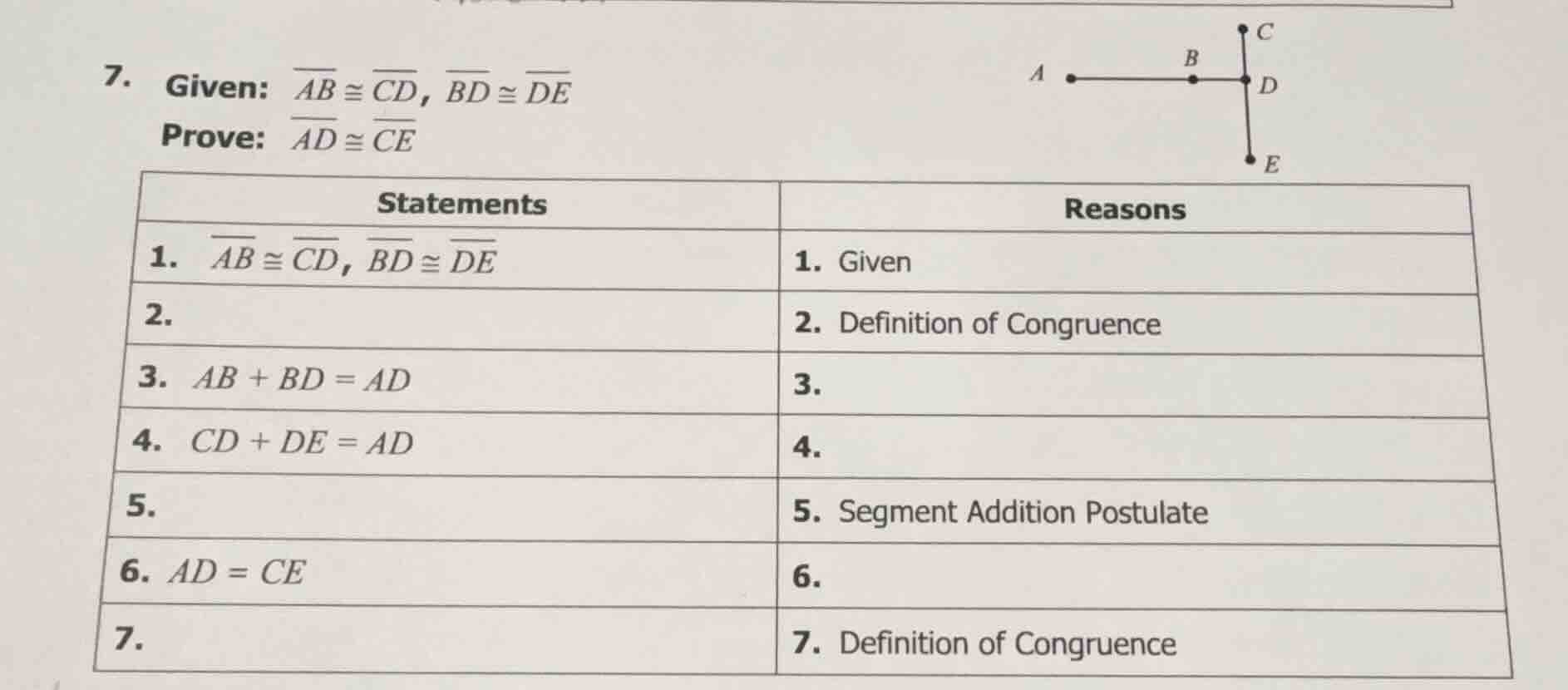
- given: \\(\overline{ab} \cong \overline{cd}\\), \\(\overline{bd} \cong \overline{de}\\)
prove: \\(\overline{ad} \cong \overline{ce}\\)
\
(image: a line segment ad with b between a and d, and a perpendicular segment cde with d between c and e)
Step 1: Analyze Statement 2
The definition of congruence for segments states that if two segments are congruent, their lengths are equal. So from \(\overline{AB} \cong \overline{CD}\) and \(\overline{BD} \cong \overline{DE}\), we get \(AB = CD\) and \(BD=DE\).
Statement 2: \(AB = CD\), \(BD = DE\)
Step 2: Analyze Statement 3's Reason
The reason for \(AB + BD=AD\) is the Segment Addition Postulate, which states that if \(B\) is between \(A\) and \(D\), then \(AB + BD=AD\).
Reason 3: Segment Addition Postulate
Step 3: Analyze Statement 4's Reason
We know \(AB = CD\) (from step 2) and \(BD = DE\) (from step 2). Substitute \(AB\) with \(CD\) and \(BD\) with \(DE\) in \(AB + BD=AD\). So by Substitution Property, \(CD + DE=AD\).
Reason 4: Substitution Property (substituting \(AB = CD\) and \(BD = DE\) into \(AB + BD = AD\))
Step 4: Analyze Statement 5
The Segment Addition Postulate for \(C\), \(D\), \(E\): if \(D\) is between \(C\) and \(E\), then \(CD + DE=CE\).
Statement 5: \(CD + DE=CE\)
Step 5: Analyze Statement 6's Reason
From statement 4 (\(CD + DE = AD\)) and statement 5 (\(CD + DE=CE\)), by Transitive Property of Equality (if \(a = b\) and \(b = c\), then \(a = c\)), we get \(AD=CE\).
Reason 6: Transitive Property of Equality (or Substitution, since \(CD + DE\) is equal to both \(AD\) and \(CE\))
Step 6: Analyze Statement 7
The definition of congruence says that if two segments have equal length, they are congruent. Since \(AD = CE\), then \(\overline{AD} \cong \overline{CE}\).
Statement 7: \(\overline{AD} \cong \overline{CE}\)
Filling the table:
| Statements | Reasons |
|---|---|
| 2. \(AB = CD\), \(BD = DE\) | 2. Definition of Congruence |
| 3. \(AB + BD=AD\) | 3. Segment Addition Postulate |
| 4. \(CD + DE = AD\) | 4. Substitution Property (substituting \(AB = CD\) and \(BD = DE\) into \(AB + BD=AD\)) |
| 5. \(CD + DE=CE\) | 5. Segment Addition Postulate |
| 6. \(AD = CE\) | 6. Transitive Property of Equality (or Substitution) |
| 7. \(\overline{AD} \cong \overline{CE}\) | 7. Definition of Congruence |

Snap & solve any problem in the app
Get step-by-step solutions on Sovi AI
Photo-based solutions with guided steps
Explore more problems and detailed explanations
Filled table as above. The key steps are using the definition of congruence to convert congruent segments to equal lengths, applying the Segment Addition Postulate, substitution, and then converting back to congruent segments. The final answer for the proof is that \(\overline{AD} \cong \overline{CE}\) is proven through the above - mentioned logical steps.