QUESTION IMAGE
Question
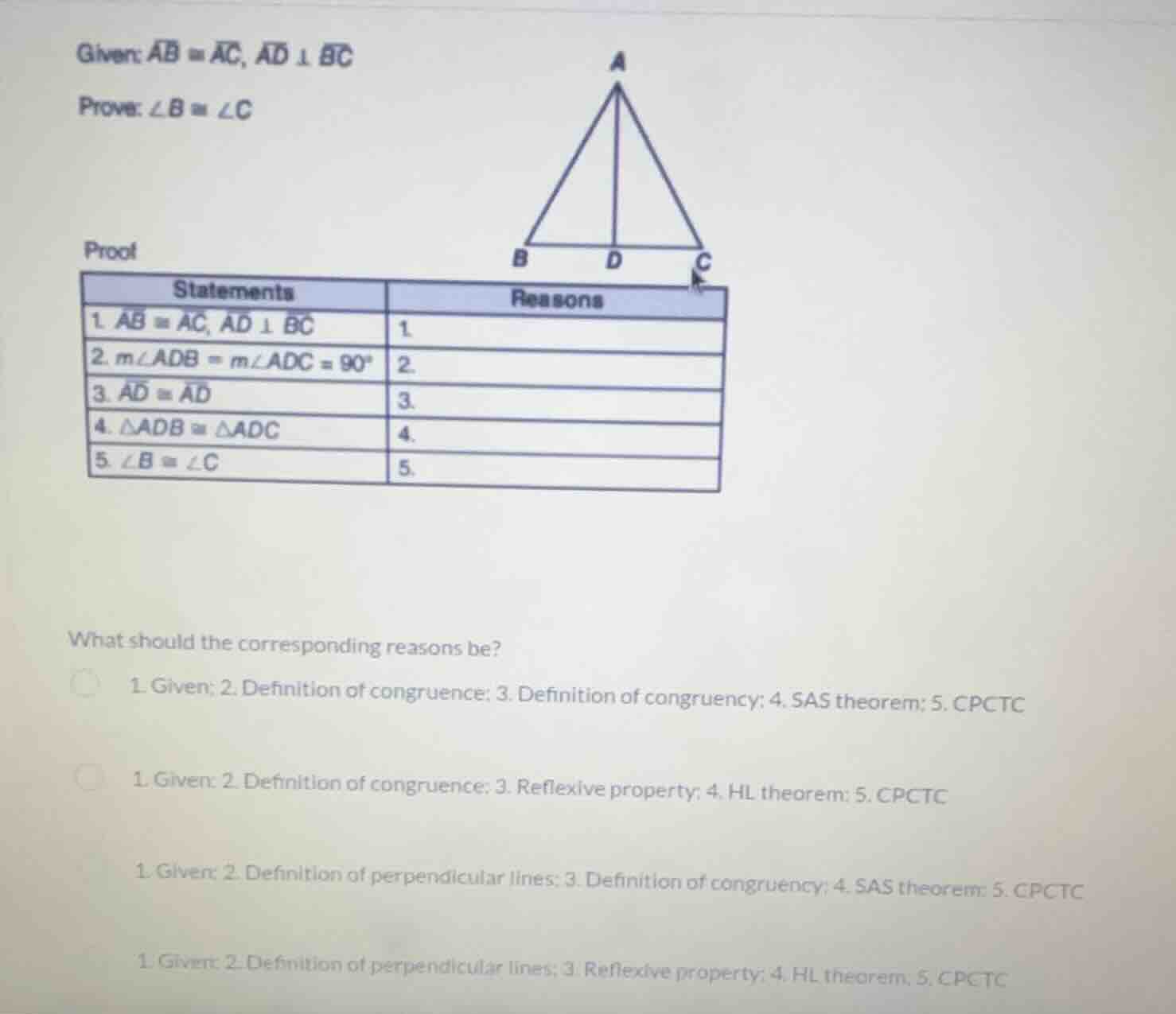
given: $overline{ab} cong overline{ac}$, $overline{ad} perp overline{bc}$
prove: $angle b cong angle c$
proof
| statements | reasons |
|---|---|
| 2. $mangle adb = mangle adc = 90^circ$ | 2. |
| 3. $overline{ad} cong overline{ad}$ | 3. |
| 4. $\triangle adb cong \triangle adc$ | 4. |
| 5. $angle b cong angle c$ | 5. |
what should the corresponding reasons be?
- given; 2. definition of congruence; 3. definition of congruency; 4. sas theorem; 5. cpctc
- given; 2. definition of congruence; 3. reflexive property; 4. hl theorem; 5. cpctc
- given; 2. definition of perpendicular lines; 3. definition of congruency; 4. sas theorem; 5. cpctc
- given; 2. definition of perpendicular lines; 3. reflexive property; 4. hl theorem; 5. cpctc
Brief Explanations
- The first statement is exactly the given information, so the reason is "Given".
- $\overline{AD} \perp \overline{BC}$ means the angles formed are right angles (90°), which is the definition of perpendicular lines.
- A segment is congruent to itself, which is the reflexive property of congruence.
- $\triangle ADB$ and $\triangle ADC$ are right triangles, we have a pair of congruent hypotenuses ($\overline{AB} \cong \overline{AC}$) and a shared congruent leg ($\overline{AD} \cong \overline{AD}$), so we use the HL (Hypotenuse-Leg) theorem for right triangle congruence.
- Once the triangles are proven congruent, corresponding parts are congruent, which is CPCTC (Corresponding Parts of Congruent Triangles are Congruent).

Snap & solve any problem in the app
Get step-by-step solutions on Sovi AI
Photo-based solutions with guided steps
Explore more problems and detailed explanations
- Given; 2. Definition of perpendicular lines; 3. Reflexive property; 4. HL theorem; 5. CPCTC