QUESTION IMAGE
Question
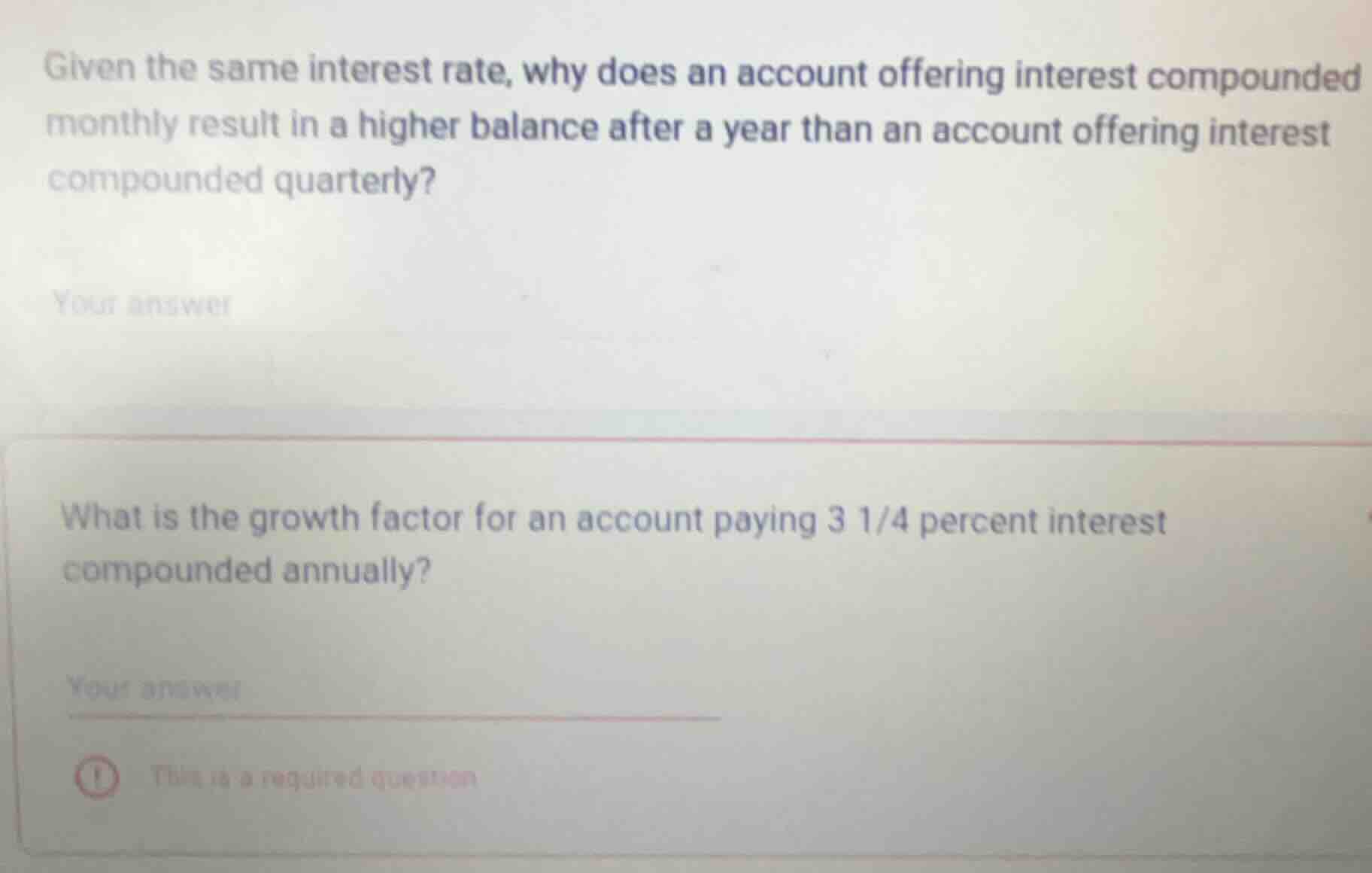
given the same interest rate, why does an account offering interest compounded monthly result in a higher balance after a year than an account offering interest compounded quarterly?
your answer
what is the growth factor for an account paying $3\frac{1}{4}$ percent interest compounded annually?
your answer
this is a required question
Brief Explanations
- For the first question: Monthly compounding means interest is calculated and added to the principal 12 times per year, while quarterly compounding only does this 4 times. More frequent compounding allows interest to earn interest sooner, leading to a higher total balance over the same period, even with the same annual interest rate.
- For the second question: The annual growth factor is calculated by adding 1 to the annual interest rate (converted to a decimal). First, convert $3\frac{1}{4}\%$ to a decimal: $3\frac{1}{4} = 3.25$, so $3.25\% = 0.0325$. Then add 1 to this value to get the growth factor.

Snap & solve any problem in the app
Get step-by-step solutions on Sovi AI
Photo-based solutions with guided steps
Explore more problems and detailed explanations
- Monthly compounding applies interest 12 times yearly (more frequently than quarterly's 4 times), so interest earns interest earlier, leading to a higher year-end balance.
- $1.0325$