QUESTION IMAGE
Question
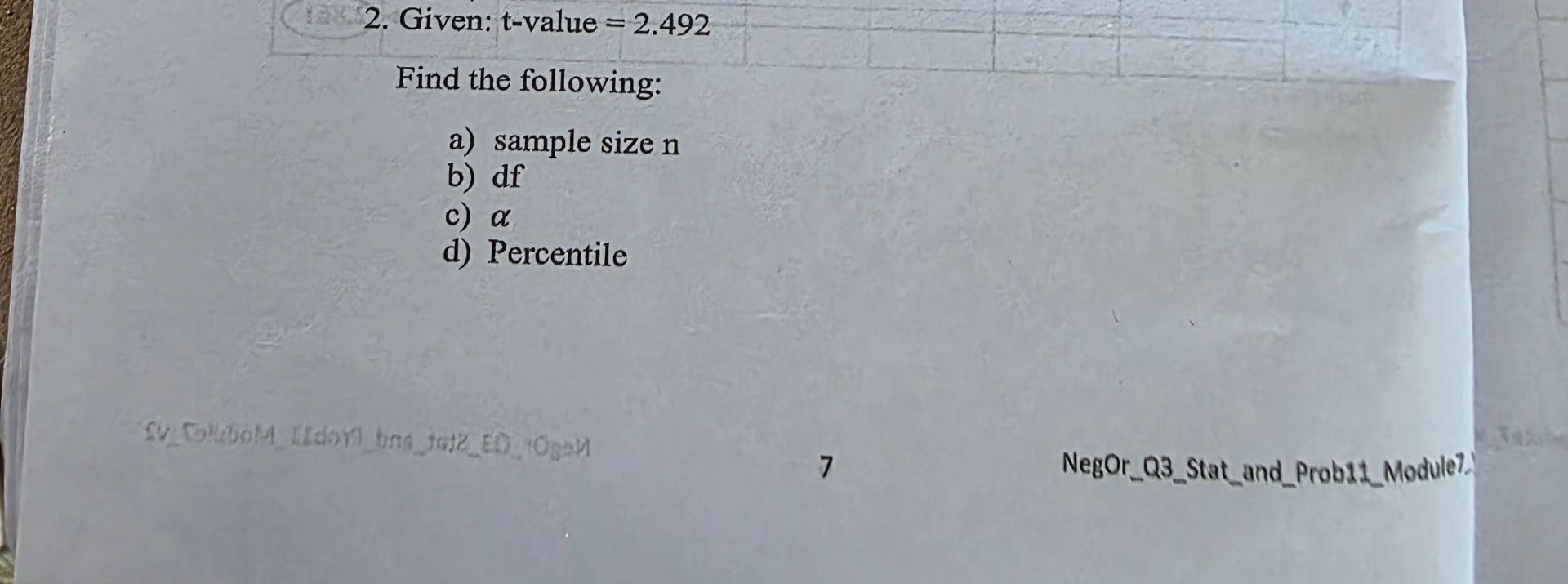
- given: t-value = 2.492
find the following:
a) sample size n
b) df
c) $\alpha$
d) percentile
To solve this, we assume a two - tailed test (common in many cases) and use the t - distribution table. We know that for a t - value of \(t = 2.492\), we will work backwards from the t - table.
Part (a): Sample size \(n\)
Step 1: Recall the formula for degrees of freedom (\(df\))
The formula for the degrees of freedom for a one - sample t - test is \(df=n - 1\), where \(n\) is the sample size.
Step 2: Find the degrees of freedom from the t - table
We look at the t - distribution table. For a two - tailed test, we search for the value \(2.492\) in the body of the table. We find that when \(df = 24\), the two - tailed critical value (for \(\alpha=0.02\) or \(\alpha = 0.01\) and other common significance levels) or the t - value corresponding to a certain percentile. When \(df = 24\), looking at the t - table (for two - tailed), if we consider the 98th percentile (or \(\alpha=0.02\) two - tailed), the t - value is approximately \(2.492\).
Step 3: Calculate the sample size \(n\)
Since \(df=n - 1\) and \(df = 24\), we solve for \(n\) using the formula \(n=df + 1\). Substituting \(df = 24\) into the formula, we get \(n=24 + 1=25\).
Part (b): Degrees of freedom (\(df\))
From the t - table, as we found that the t - value \(t = 2.492\) corresponds to \(df=24\) (by looking at the t - distribution table and matching the t - value with the appropriate row which represents the degrees of freedom).
Part (c): Significance level \(\alpha\)
If we assume a two - tailed test, and we know that for \(df = 24\) and \(t=2.492\), from the t - table, the two - tailed \(\alpha\) value corresponding to \(t = 2.492\) and \(df = 24\) is \(\alpha=0.02\) (because the area in the two tails is \(0.02\), so the area in each tail is \(0.01\)).
Part (d): Percentile
The percentile is related to the cumulative probability. For a two - tailed test with \(t = 2.492\) and \(df = 24\), the percentile is the 98th percentile (because the area to the left of \(t = 2.492\) (for a two - tailed test, we consider the middle area). The total area under the t - distribution curve is 1. For a two - tailed test with \(\alpha = 0.02\), the area between \(-t\) and \(t\) is \(1-\alpha=0.98\), so the percentile is the 98th percentile (or we can also say that the upper tail area is \(0.01\) and the lower tail area is \(0.01\), so the value \(t = 2.492\) is the 99th percentile (if we consider one - tailed) or 98th percentile (if we consider two - tailed). But more accurately, for a two - tailed test, the percentile corresponding to \(t = 2.492\) with \(df = 24\) is the 98th percentile (since the area between \(- 2.492\) and \(2.492\) is \(0.98\)).
Final Answers
a) The sample size \(n=\boldsymbol{25}\)
b) The degrees of freedom \(df=\boldsymbol{24}\)
c) The significance level \(\alpha=\boldsymbol{0.02}\) (for two - tailed test)
d) The percentile is \(\boldsymbol{98}\)th percentile (for two - tailed) or \(\boldsymbol{99}\)th percentile (for one - tailed)

Snap & solve any problem in the app
Get step-by-step solutions on Sovi AI
Photo-based solutions with guided steps
Explore more problems and detailed explanations
To solve this, we assume a two - tailed test (common in many cases) and use the t - distribution table. We know that for a t - value of \(t = 2.492\), we will work backwards from the t - table.
Part (a): Sample size \(n\)
Step 1: Recall the formula for degrees of freedom (\(df\))
The formula for the degrees of freedom for a one - sample t - test is \(df=n - 1\), where \(n\) is the sample size.
Step 2: Find the degrees of freedom from the t - table
We look at the t - distribution table. For a two - tailed test, we search for the value \(2.492\) in the body of the table. We find that when \(df = 24\), the two - tailed critical value (for \(\alpha=0.02\) or \(\alpha = 0.01\) and other common significance levels) or the t - value corresponding to a certain percentile. When \(df = 24\), looking at the t - table (for two - tailed), if we consider the 98th percentile (or \(\alpha=0.02\) two - tailed), the t - value is approximately \(2.492\).
Step 3: Calculate the sample size \(n\)
Since \(df=n - 1\) and \(df = 24\), we solve for \(n\) using the formula \(n=df + 1\). Substituting \(df = 24\) into the formula, we get \(n=24 + 1=25\).
Part (b): Degrees of freedom (\(df\))
From the t - table, as we found that the t - value \(t = 2.492\) corresponds to \(df=24\) (by looking at the t - distribution table and matching the t - value with the appropriate row which represents the degrees of freedom).
Part (c): Significance level \(\alpha\)
If we assume a two - tailed test, and we know that for \(df = 24\) and \(t=2.492\), from the t - table, the two - tailed \(\alpha\) value corresponding to \(t = 2.492\) and \(df = 24\) is \(\alpha=0.02\) (because the area in the two tails is \(0.02\), so the area in each tail is \(0.01\)).
Part (d): Percentile
The percentile is related to the cumulative probability. For a two - tailed test with \(t = 2.492\) and \(df = 24\), the percentile is the 98th percentile (because the area to the left of \(t = 2.492\) (for a two - tailed test, we consider the middle area). The total area under the t - distribution curve is 1. For a two - tailed test with \(\alpha = 0.02\), the area between \(-t\) and \(t\) is \(1-\alpha=0.98\), so the percentile is the 98th percentile (or we can also say that the upper tail area is \(0.01\) and the lower tail area is \(0.01\), so the value \(t = 2.492\) is the 99th percentile (if we consider one - tailed) or 98th percentile (if we consider two - tailed). But more accurately, for a two - tailed test, the percentile corresponding to \(t = 2.492\) with \(df = 24\) is the 98th percentile (since the area between \(- 2.492\) and \(2.492\) is \(0.98\)).
Final Answers
a) The sample size \(n=\boldsymbol{25}\)
b) The degrees of freedom \(df=\boldsymbol{24}\)
c) The significance level \(\alpha=\boldsymbol{0.02}\) (for two - tailed test)
d) The percentile is \(\boldsymbol{98}\)th percentile (for two - tailed) or \(\boldsymbol{99}\)th percentile (for one - tailed)