QUESTION IMAGE
Question
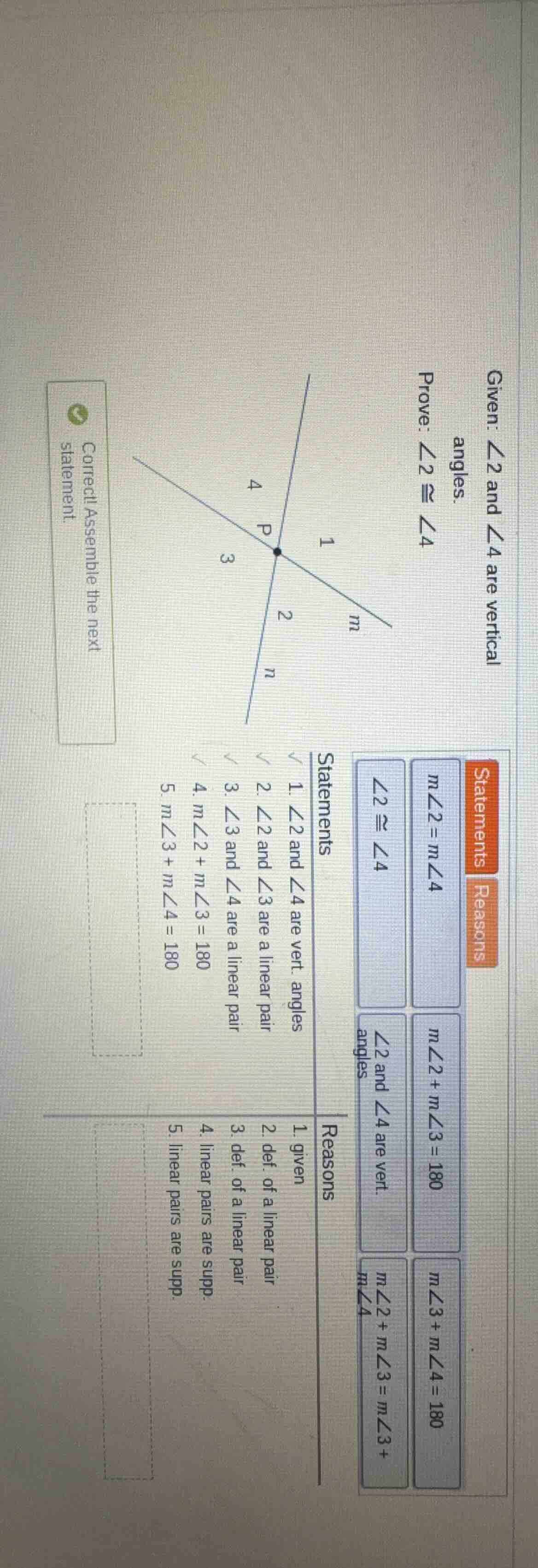
given: ∠2 and ∠4 are vertical angles. prove: ∠2 ≅ ∠4
(there is a diagram with lines m and n intersecting at point p, forming angles 1,2,3,4)
statements reasons
- ∠2 and ∠4 are vert. angles 1. given
- ∠2 and ∠3 are a linear pair 2. def. of a linear pair
- ∠3 and ∠4 are a linear pair 3. def. of a linear pair
- m∠2 + m∠3 = 180 4. linear pairs are supp.
- m∠3 + m∠4 = 180 5. linear pairs are supp.
(then there are some statement and reason boxes to fill, related to m∠2 = m∠4, ∠2 ≅ ∠4, and angle sum equalities)
Step1: Identify Given Information
We know that \( \angle 2 \) and \( \angle 4 \) are vertical angles (given). Also, \( \angle 2 \) and \( \angle 3 \) form a linear pair, and \( \angle 3 \) and \( \angle 4 \) form a linear pair. By the definition of a linear pair, linear pairs are supplementary, so \( m\angle 2 + m\angle 3 = 180^\circ \) and \( m\angle 3 + m\angle 4 = 180^\circ \).
Step2: Set Up Equations
From the linear pair property:
\( m\angle 2 + m\angle 3 = 180^\circ \) (Equation 1)
\( m\angle 3 + m\angle 4 = 180^\circ \) (Equation 2)
Step3: Substitute and Solve for Angles
Since both equations equal \( 180^\circ \), we can set them equal to each other:
\( m\angle 2 + m\angle 3 = m\angle 3 + m\angle 4 \)
Subtract \( m\angle 3 \) from both sides:
\( m\angle 2 = m\angle 4 \)
Step4: Conclude Congruence
If the measures of two angles are equal, then the angles are congruent. So, \( \angle 2 \cong \angle 4 \).

Snap & solve any problem in the app
Get step-by-step solutions on Sovi AI
Photo-based solutions with guided steps
Explore more problems and detailed explanations
To prove \( \angle 2 \cong \angle 4 \) (vertical angles are congruent), we follow these steps:
- Given: \( \angle 2 \) and \( \angle 4 \) are vertical angles.
- Linear Pair Definition: \( \angle 2 \) and \( \angle 3 \) form a linear pair, so \( m\angle 2 + m\angle 3 = 180^\circ \).
\( \angle 3 \) and \( \angle 4 \) form a linear pair, so \( m\angle 3 + m\angle 4 = 180^\circ \).
- Transitive Property of Equality: Since \( m\angle 2 + m\angle 3 = 180^\circ \) and \( m\angle 3 + m\angle 4 = 180^\circ \), we have \( m\angle 2 + m\angle 3 = m\angle 3 + m\angle 4 \).
- Subtract \( m\angle 3 \) from both sides: \( m\angle 2 = m\angle 4 \).
- Definition of Congruent Angles: If \( m\angle 2 = m\angle 4 \), then \( \angle 2 \cong \angle 4 \).
Thus, \( \boldsymbol{\angle 2 \cong \angle 4} \) is proven.