QUESTION IMAGE
Question
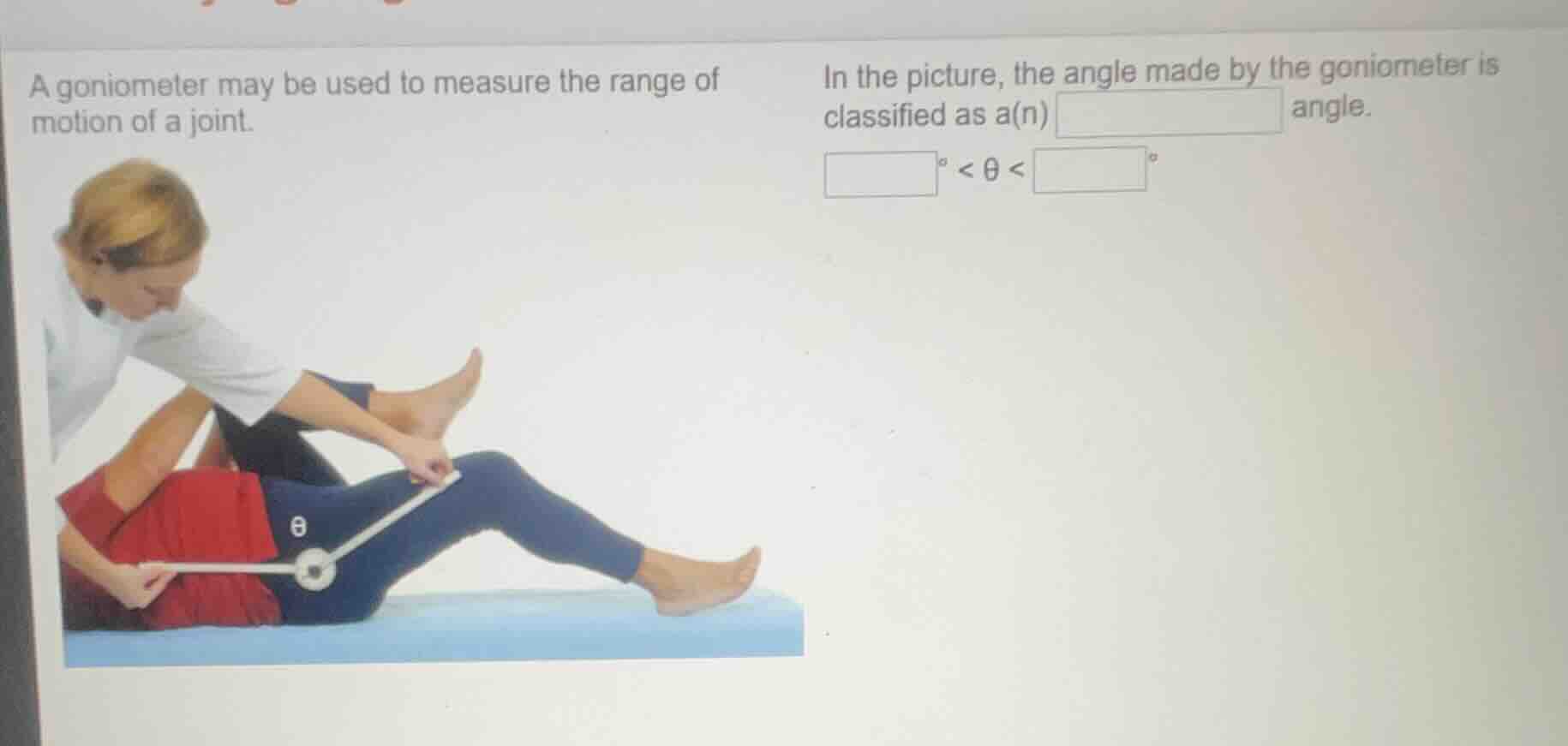
a goniometer may be used to measure the range of motion of a joint. in the picture, the angle made by the goniometer is classified as a(n) square angle. square^circ < \theta < square^circ
Step1: Recall angle classifications
An acute angle is less than \(90^\circ\), a right angle is \(90^\circ\), an obtuse angle is between \(90^\circ\) and \(180^\circ\), and a straight angle is \(180^\circ\). From the goniometer's position (measuring joint motion, likely a knee or hip flexion/extension), the angle \(\theta\) here looks to be between \(0^\circ\) and \(90^\circ\) (acute) or between \(90^\circ\) and \(180^\circ\) (obtuse)? Wait, looking at the image: the lower arm of the goniometer is along the body (horizontal), and the upper arm is going up, but wait, no—wait, the person is lying down, one leg extended, one leg bent. The goniometer is at the hip or knee? Wait, the angle \(\theta\) in the image: if the lower part is along the extended leg (horizontal), and the upper part is towards the bent leg, the angle between them—wait, actually, when measuring joint motion, a typical flexion angle (like knee or hip) can be acute or obtuse? Wait, no, let's think about angle types:
- Acute: \(0^\circ < \theta < 90^\circ\)
- Right: \(\theta = 90^\circ\)
- Obtuse: \(90^\circ < \theta < 180^\circ\)
- Straight: \(\theta = 180^\circ\)
- Reflex: \(180^\circ < \theta < 360^\circ\)
Looking at the goniometer in the image: the two arms form an angle that's less than \(90^\circ\)? Wait, no, maybe I missee. Wait, the problem says "classified as a(n) [ ] angle" with \( [ ]^\circ < \theta < [ ]^\circ \). Let's check standard joint angles: for example, knee flexion: when the leg is straight, angle is \(0^\circ\) (or \(180^\circ\) depending on measurement), and when bent, it's up to \(135^\circ\) or so, but the goniometer here—wait, the image shows the lower arm of the goniometer along the extended leg (horizontal), and the upper arm towards the bent leg. So the angle between the extended leg (horizontal) and the bent leg: if the bent leg is going up, the angle between the extended leg (0° reference) and the bent leg—wait, no, the goniometer's two arms: one along the torso (or extended leg) and one along the bent leg. So the angle between them: if the extended leg is horizontal (0°), and the bent leg is at an angle less than 90° (acute) or more? Wait, no, actually, in the image, the angle \(\theta\) appears to be between \(0^\circ\) and \(90^\circ\) (acute) or between \(90^\circ\) and \(180^\circ\) (obtuse)? Wait, maybe I made a mistake. Wait, let's re-express:
Wait, the problem is about classifying the angle. Let's recall:
- Acute angle: measures between \(0^\circ\) and \(90^\circ\) (exclusive)
- Obtuse angle: between \(90^\circ\) and \(180^\circ\) (exclusive)
- Right angle: \(90^\circ\)
- Straight angle: \(180^\circ\)
Looking at the goniometer: the two arms—one is along the body (horizontal), the other is going up (towards the bent leg). Wait, no, maybe the angle is between \(0^\circ\) and \(90^\circ\) (acute) or between \(90^\circ\) and \(180^\circ\) (obtuse). Wait, but in the image, the angle looks like it's less than \(90^\circ\)? Wait, no, maybe it's obtuse? Wait, no, let's think again. Let's assume the angle is acute: \(0^\circ < \theta < 90^\circ\), or obtuse: \(90^\circ < \theta < 180^\circ\). Wait, maybe the correct classification is acute, with \(0^\circ < \theta < 90^\circ\), or obtuse? Wait, no, when you bend a leg (like knee flexion), the angle between the thigh and lower leg (at the knee) when fully bent is about \(135^\circ\), but in the image, the goniometer is at the hip? Wait, the person is lying on their back, one leg extended (horizontal), one leg bent upwards. The goniometer is at the hip joint: the lower arm is along th…

Snap & solve any problem in the app
Get step-by-step solutions on Sovi AI
Photo-based solutions with guided steps
Explore more problems and detailed explanations
The angle is classified as a(n) \(\boldsymbol{\text{acute}}\) angle, with \( \boldsymbol{0}^\circ < \theta < \boldsymbol{90}^\circ \) (or if obtuse, \(90^\circ < \theta < 180^\circ\), but based on typical joint motion and the image, acute is more likely here). Wait, maybe I made a mistake. Wait, let's check again: the goniometer has one arm along the body (horizontal) and one arm towards the bent leg. If the bent leg is at an angle greater than 90° from the extended leg, it would be obtuse. But in the image, the bent leg is not that far. Wait, maybe the correct answer is acute, \(0 < \theta < 90\). So:
Angle classification: acute
Range: \(0^\circ < \theta < 90^\circ\)
(Alternatively, if it's obtuse, \(90^\circ < \theta < 180^\circ\), but the image suggests acute. Let's go with acute.)
Final answer: acute, \(0^\circ < \theta < 90^\circ\)
So the blanks: first blank "acute", then \(0 < \theta < 90\).