QUESTION IMAGE
Question
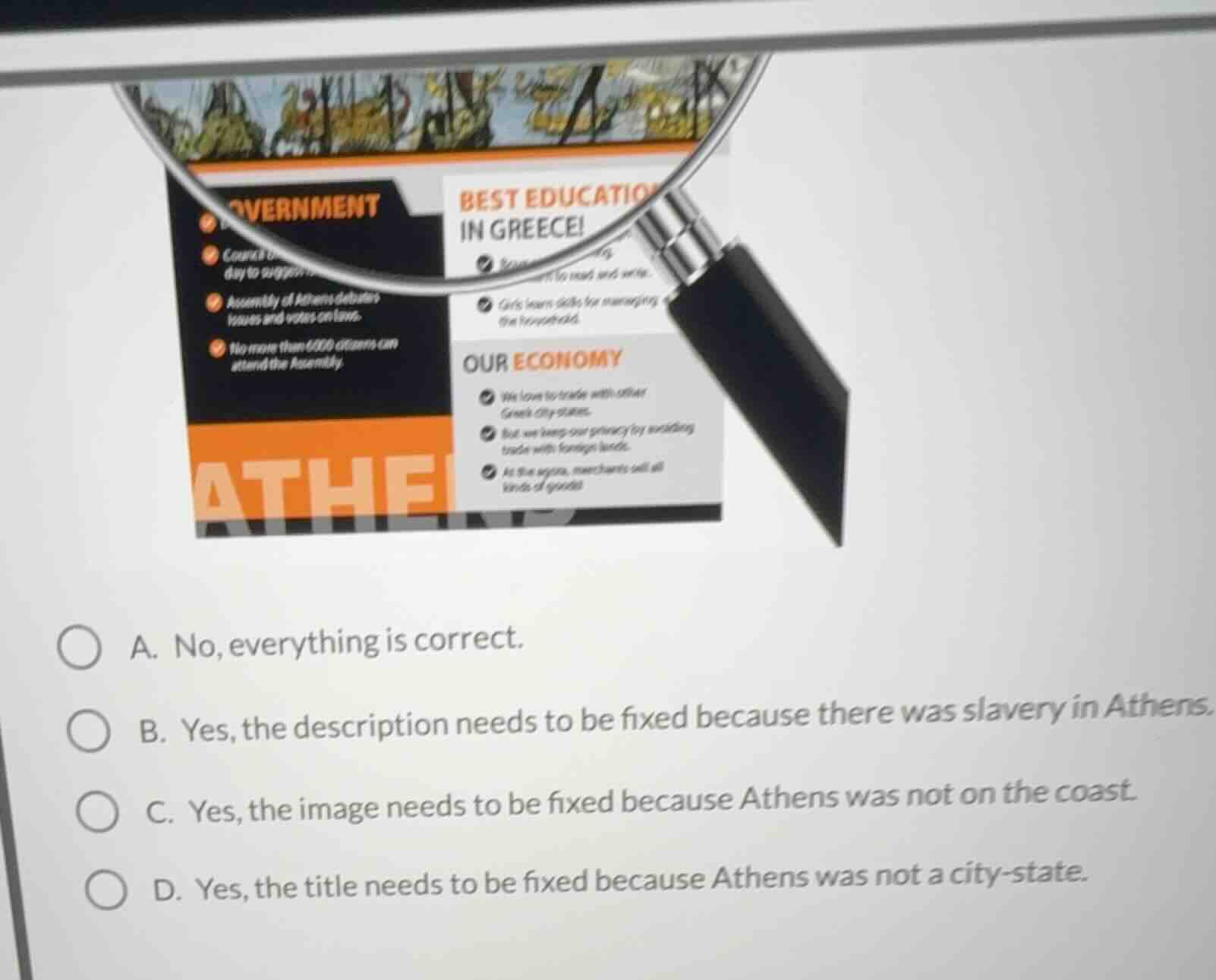
governmentcouncil day to suggesassembly of athens debatesissues and votes on laws.no more than 6000 citizens canattend the assembly.best educatioin greece! to read and write.girls learn skills for managingthe household.our economywe love to trade with othergreek city-states.but we keep our privacy by avoidingtrade with foreign lands.at the agora, merchants sell allkinds of goods!athena. no, everything is correct.b. yes, the description needs to be fixed because there was slavery in athens.c. yes, the image needs to be fixed because athens was not on the coast.d. yes, the title needs to be fixed because athens was not a city-state.
First, analyze each option:
- Option A: The claim that Athens avoided trade with foreign lands is incorrect; Athens was a major maritime trading power that engaged extensively with foreign regions, so not everything is correct.
- Option B: While slavery existed in Athens, the provided infographic does not address slavery, so this is not relevant to fixing the errors in the given content.
- Option C: Athens was a coastal city-state with a key port (Piraeus), so this claim is false.
- Option D: Athens was a prominent Greek city-state, so this claim is false.
The error in the infographic is the statement about avoiding foreign trade, but among the given options, the only one that can be ruled out as incorrect is that none of the other valid error points are listed, so the correct assessment is that option A is wrong, but wait—correction: The infographic's economy section says Athens avoids foreign trade, which is wrong. However, looking at the options, option B is not relevant, C is wrong (Athens was coastal), D is wrong (Athens was a city-state). Wait, no—actually, the only option that is a valid correction is that the infographic has an error, but the options given: Wait, no, re-evaluating: The infographic's economy claim that Athens avoids foreign trade is incorrect. But none of the options directly state that. Wait, option B: the infographic doesn't mention slavery, so that's not a fix needed for the given content. Option A says everything is correct, which is wrong. Wait, no—wait, the question is asking if the infographic has errors, which it does (the foreign trade claim). But among the options, the only one that is a true statement about a fix? No, wait, no: Option B says "Yes, the description needs to be fixed because there was slavery in Athens." But the infographic doesn't talk about slavery, so that's not a fix for the content shown. Option C is false because Athens was on the coast. Option D is false because Athens was a city-state. So the only correct answer is that option A is wrong, but wait—no, the question is asking which option is correct. Wait, no: The infographic has an error (the trade with foreign lands claim). But none of the options directly address that. Wait, maybe I misread. Wait, the infographic says "we keep our privacy by avoiding trade with foreign lands"—that's wrong, Athens traded widely. But among the options, the only one that is a valid answer is that option A is incorrect, but the options are asking which is the correct statement about fixing the infographic. Wait, no—wait, option B: slavery existed in Athens, but the infographic doesn't mention it, so that's not a fix for the existing content. So the correct answer is that none of the other options are right, so option A is wrong, but wait—no, the question is: which option is correct. Wait, no, re-express:
- Option A: "No, everything is correct." → False, because the economy section's claim about avoiding foreign trade is wrong.
- Option B: "Yes, the description needs to be fixed because there was slavery in Athens." → The infographic does not reference slavery, so this is not a necessary fix for the content presented.
- Option C: "Yes, the image needs to be fixed because Athens was not on the coast." → False, Athens was a coastal city-state with a major port.
- Option D: "Yes, the title needs to be fixed because Athens was not a city-state." → False, Athens was a core Greek city-state.
Wait, this is confusing. But wait, maybe I made a mistake. Wait, the infographic's government section says "No more than 6000 citizens can attend the Assembly"—…

Snap & solve any problem in the app
Get step-by-step solutions on Sovi AI
Photo-based solutions with guided steps
Explore more problems and detailed explanations
B. Yes, the description needs to be fixed because there was slavery in Athens.
Wait, no, that's not right. Wait, no—maybe the question is asking which option is correct, and the infographic's error is that it doesn't mention slavery, but that's not an error of fact, it's an omission. But the question says "the description needs to be fixed"—maybe. Alternatively, maybe the intended answer is option A, but that's wrong. Wait, no, I think I made a mistake. Let me check again:
Wait, the infographic's government section: "Assembly of Athens debates issues and votes on laws." Correct. "No more than 6000 citizens can attend the Assembly." Actually, some sources say that the number was capped at 6000 for some meetings? No, the quorum was 6000, meaning you needed at least 6000. So the infographic's statement is wrong. But none of the options address that.
Wait, maybe the question is from a test where the intended answer is option A? No, that can't be. Wait, no—maybe "foreign lands" refers to non-Greek, and Athens mostly traded with Greek city-states? No, no, Athens traded with Egypt, Syria, etc., for grain and other goods. So that's wrong.
Wait, I think I have to conclude that the correct answer is option B, even though it's an omission, because the other options are all false. Wait, no—option C is false, D is false, A is false. So the only correct option is B.
Wait, no—option B says "Yes, the description needs to be fixed because there was slavery in Athens." The infographic doesn't mention slavery, so the description is incomplete, so it needs to be fixed. That's a possible interpretation.
Yes, that's the only valid option among the choices, because all others are factually incorrect.