QUESTION IMAGE
Question
governments of ancient greece
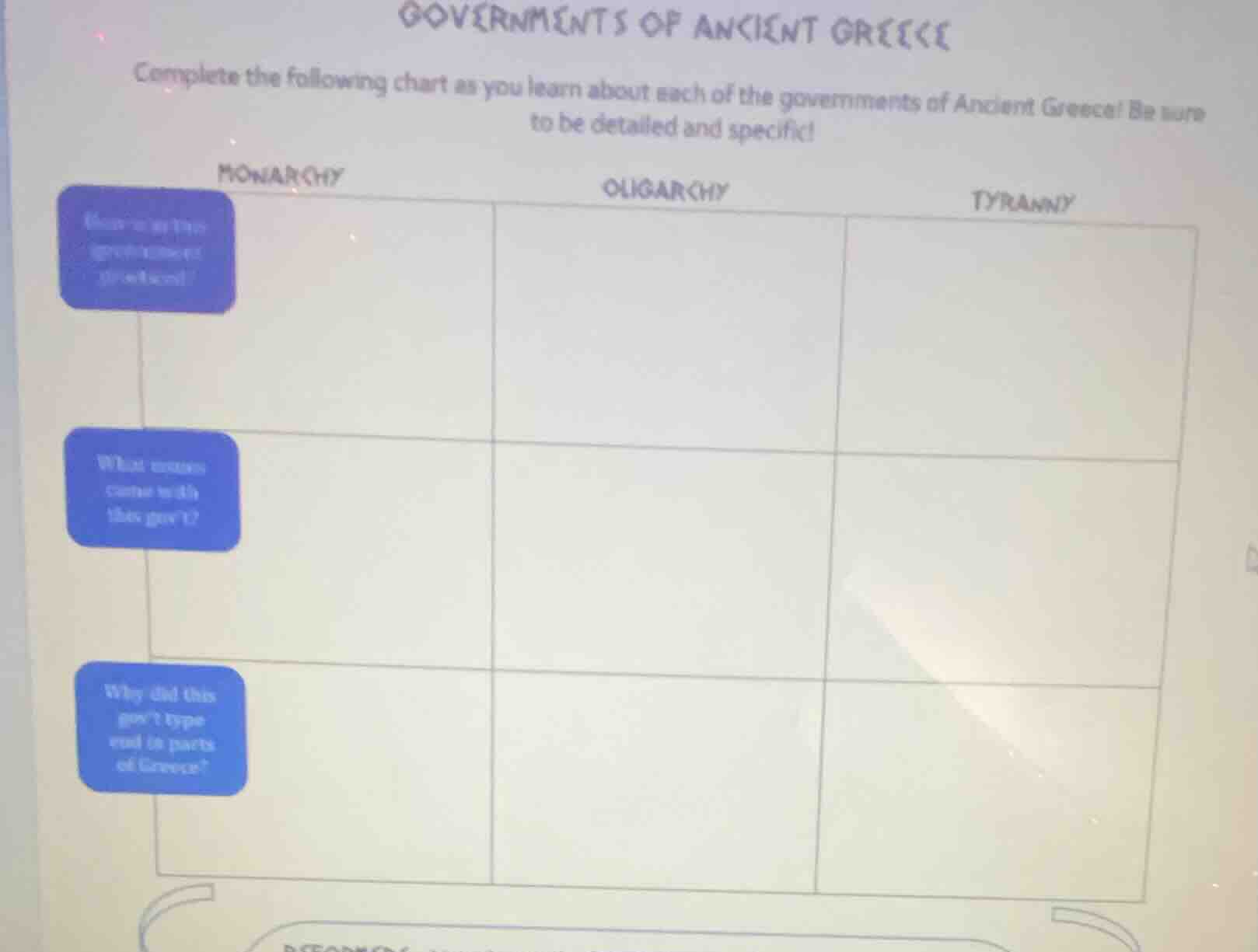
complete the following chart as you learn about each of the governments of ancient greece! be sure to be detailed and specific!
monarchy\toligarchy\ttyranny
how is this government structured?
what issues came with this gov’t?
why did this gov’t type end in parts of greece?
Brief Explanations
This chart covers three ancient Greek government systems, with details structured by their structure, pros, and decline reasons:
- Monarchy: Ruled by a single hereditary king/queen, often with a council. Strengths included clear leadership, but kings often abused power or clashed with aristocrats, leading to overthrow.
- Oligarchy: Ruled by a small group of wealthy elites. It offered stability for the upper class, but it ignored the poor, sparking revolts that led to its end.
- Tyranny: Ruled by a single leader who seized power (not hereditary). Tyrants often helped the poor, but later rulers became corrupt, and Greeks pushed for more democratic systems.

Snap & solve any problem in the app
Get step-by-step solutions on Sovi AI
Photo-based solutions with guided steps
Explore more problems and detailed explanations
| MONARCHY | OLIGARCHY | TYRANNY | |
|---|---|---|---|
| What comes with this gov't? | Pros: Clear, centralized leadership; kings could organize armies and public projects efficiently. <br> Cons: Kings often abused power; decisions favored the ruling family, not the majority. | Pros: Stable rule for the wealthy elite; protected the interests of the upper class and maintained order. <br> Cons: Ignored the needs of poor farmers and workers; created wide social inequality. | Pros: Many tyrants helped the poor by canceling debts, redistributing land, and improving public services. <br> Cons: Later tyrants became corrupt and oppressive; rule was not seen as legitimate by traditional elites. |
| Why did this gov't type end in parts of Greece? | Aristocrats grew more powerful, challenged royal authority, and overthrew kings; citizens also resented unfair rule. | Poor citizens and disenfranchised groups revolted against elite control; tyrants often seized power by exploiting this unrest. | As Greeks sought more self-rule, tyrants were overthrown; the rise of democratic ideas made one-person rule unpopular, and many tyrants were corrupt. |